Near Field Communication (NFC) has become one of the world’s most widely adopted contactless technologies. From mobile payments and access control to product authentication and smart packaging, billions of NFC interactions occur every year.
For nearly two decades, users have accepted one common limitation: NFC devices needed to be positioned extremely close together to establish a reliable connection. In many cases, users had to carefully align their phone with an NFC sticker or card before communication would begin.
That experience is beginning to change.
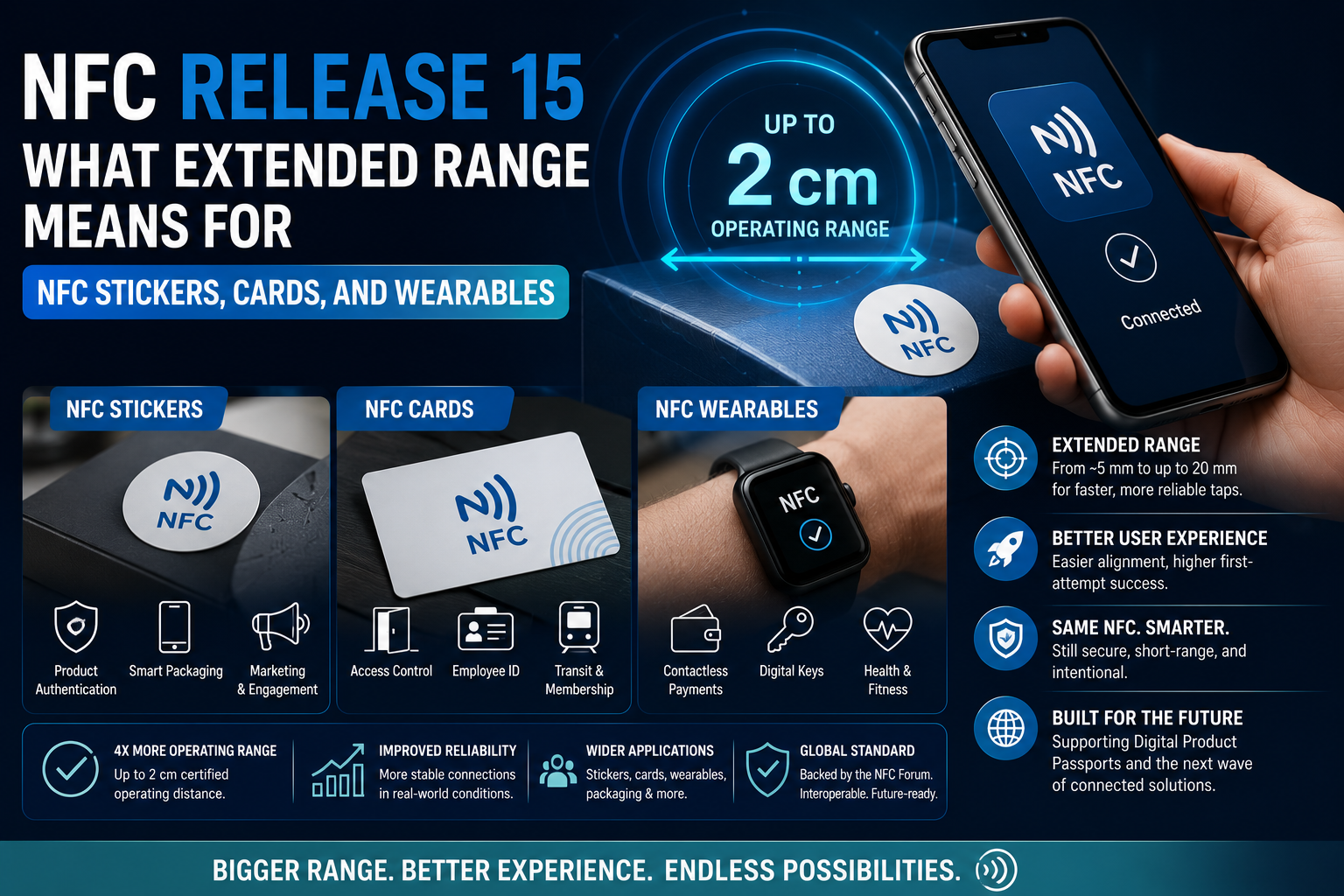
In 2025, the NFC Forum announced NFC Release 15, introducing one of the most significant updates to the NFC standard in recent years. The new specification increases the certified operating range from approximately 5 mm to 20 mm (2 cm)—a fourfold increase—making NFC interactions faster, more reliable, and less dependent on precise alignment.
Although the increase may appear modest, it has meaningful implications for product designers, RFID manufacturers, packaging companies, wearable device developers, and brands adopting connected products.
This guide explains what NFC Release 15 is, how extended range works, and what it means for NFC stickers, cards, wearables, and future smart packaging applications.
What Is NFC Release 15?
NFC Release 15 is the latest specification released by the NFC Forum, the organization responsible for developing global NFC interoperability standards.
Rather than introducing a completely new communication technology, Release 15 improves the certified operating volume for NFC Forum-compliant devices.
The most notable enhancement is the increase in certified contactless operating distance from roughly:
- Previous baseline: 5 mm
- Release 15 baseline: up to 20 mm
This extended operating volume allows NFC connections to begin sooner while requiring less precise alignment between the reader and the tag or device.
Why Does an Extra 15 mm Matter?
At first glance, increasing the operating distance by only 15 millimeters may seem insignificant.
In practice, it greatly improves user experience.
Traditional NFC interactions often require users to:
- Search for the phone’s NFC antenna location.
- Align the phone carefully with the tag.
- Retry if the first attempt fails.
- Hold the device perfectly still.
These issues become more noticeable when using:
- Smartwatches
- Smart rings
- Small NFC stickers
- Embedded NFC labels
- Automotive digital keys
With Release 15, devices can establish communication earlier, reducing failed reads and making interactions feel more natural. The NFC Forum emphasizes that this improves speed and reliability while preserving the deliberate “tap” user experience rather than turning NFC into a long-range technology.
Does NFC Release 15 Turn NFC Into Long-Range RFID?
Nein.
One common misconception is that Release 15 makes NFC comparable to UHF RFID.
It does not.
NFC remains a short-range communication technology based on magnetic induction at 13,56 MHz.
Even after Release 15:
- Users still intentionally tap or bring devices close together.
- Communication remains secure and proximity-based.
- It is not intended for multi-meter reading or bulk identification.
The goal is to make NFC easier to use—not to change its fundamental operating principle.
How NFC Stickers Benefit
NFC stickers are widely used in:
- Intelligente Verpackung
- Produkt-Authentifizierung
- Digitale Visitenkarten
- Marketing-Kampagnen
- Identifizierung von Vermögenswerten
- Industrial labeling
Many users have experienced inconsistent reads because phone antenna positions differ between manufacturers.
Extended operating range helps reduce these issues.
Mögliche Vorteile sind:
- Faster smartphone detection
- Improved first-attempt success rates
- Easier interaction through packaging materials
- Bessere Kundenerfahrung
- Fewer support requests related to failed scans
Brands deploying thousands of NFC-enabled products may see improved user engagement as interactions become more intuitive.
What It Means for NFC Smart Cards
Smart cards are already one of the largest NFC application categories.
Beispiele hierfür sind:
- Mitarbeiterausweise
- Hotel-Schlüsselkarten
- Transit cards
- Student identification
- Mitgliedskarten
- Healthcare cards
Release 15 makes card presentation more forgiving.
Users no longer need to align the card as precisely with compatible readers, reducing transaction friction in high-volume environments such as offices, public transportation, and access control systems.
Better Performance for Wearables
Wearables are expected to benefit significantly from the new operating range.
Unlike smartphones, devices such as:
- Smartwatches
- Smart rings
- Fitness bands
- Medical wearables
have much smaller antennas.
This makes alignment more challenging.
Release 15 improves usability by allowing certified devices to establish communication with less precise positioning, supporting applications such as:
- Contactless payments
- Digital keys
- Building access
- Öffentliche Verkehrsmittel
- Device pairing
The update is particularly valuable because wearable devices often have physical design constraints that limit antenna size.
Implications for Connected Packaging
Connected packaging continues to expand across industries including:
- Kosmetika
- Wine and spirits
- Luxusgüter
- Unterhaltungselektronik
- Pharmazeutika
Brands increasingly embed NFC tags beneath labels or inside product packaging.
The extended certified operating volume can improve interaction even when the tag is located beneath thicker packaging materials or decorative layers.
For consumers, this means fewer failed taps and a smoother product experience.
Supporting Digital Product Passport Initiatives
Another important aspect of Release 15 is its support for future Digital Product Passport (DPP) implementations.
Many DPP initiatives aim to provide product information throughout the entire lifecycle, including:
- Daten zur Herstellung
- Materialzusammensetzung
- Reparaturanleitung
- Recycling guidance
- Authentifizierung
- Sustainability information
NFC offers an intuitive way to access this information with a simple tap.
The improved operating range helps make these interactions more reliable, especially for consumer products. The NFC Forum has highlighted DPP support as a strategic focus alongside Release 15.
Will Existing NFC Tags Still Work?
In many cases, existing NFC tags will continue to function with compatible readers.
However, Release 15 defines a new certification baseline rather than automatically upgrading every device already in the market.
To achieve the full certified extended operating range, both hardware design and certification play important roles.
As new smartphones, readers, wearables, and tags are introduced, support for Release 15 is expected to increase progressively.
Does This Affect Popular NFC Chips?
Release 15 is a specification update rather than a new chip family.
Common NFC integrated circuits—including NTAG, MIFARE, ICODE, and similar products—remain widely used.
Future products designed and certified under the new specification may deliver improved operating performance depending on the complete system design, including:
- Reader hardware
- Entwurf einer Antenne
- Device firmware
- NFC tag construction
- Certification compliance
Performance depends on the entire NFC ecosystem rather than the chip alone.
Design Considerations for NFC Product Manufacturers
Manufacturers developing NFC-enabled products should review several design considerations.
Antenna Optimization
Improved operating range does not eliminate the need for proper antenna design.
Coil geometry, tuning, and matching remain critical.
Product Materials
Metal, carbon fiber, and some composite materials continue to affect NFC performance.
Anti-metal NFC constructions may still be required in challenging environments.
Tag Placement
Even with improved operating range, placing tags where users naturally tap remains important.
Benutzererfahrung
Clear tap indicators and intuitive interaction design remain valuable even as NFC becomes more forgiving.
Industries That Will Benefit
The advantages of Release 15 extend across many industries.
Einzelhandel
Better customer interaction with smart packaging and loyalty experiences.
Gesundheitswesen
More reliable patient identification and medical device interactions.
Automobilindustrie
Improved digital key usability and access control.
Unterhaltungselektronik
Simpler Bluetooth pairing and device configuration.
Industrielle Fertigung
Easier commissioning of equipment using NFC-enabled service labels.
Gastfreundschaft
More reliable guest access with NFC-enabled room credentials.
Häufig gestellte Fragen
Does NFC Release 15 increase read distance to several meters?
No. NFC remains a short-range technology designed for intentional close-proximity interactions.
Is Release 15 compatible with smartphones?
Support depends on future hardware and certification. As compatible devices enter the market, users will benefit from the improved operating range.
Does Release 15 replace NFC stickers already in use?
No. Existing NFC tags remain usable, although achieving the certified extended range requires compatible hardware and certification.
Is Release 15 only useful for payments?
No. Benefits extend to access control, wearables, connected packaging, digital keys, healthcare, smart appliances, product authentication, and Digital Product Passport applications.
Should manufacturers redesign NFC products immediately?
Manufacturers developing new products should evaluate Release 15 during future product planning. Existing solutions remain suitable for many applications, while new designs can take advantage of improved usability as the ecosystem adopts the updated specification.
Abschluss
NFC Release 15 represents an important evolution in contactless technology. By extending the certified operating range from approximately 5 mm to 20 mm, it makes NFC interactions faster, more reliable, and less dependent on perfect alignment while preserving the security and intentional nature of close-proximity communication.
For manufacturers of NFC stickers, smart cards, wearable devices, and connected packaging, the update creates new opportunities to improve user experience without changing the familiar tap-based interaction that has made NFC successful worldwide.
As more certified devices become available, Release 15 is expected to support the next generation of digital product experiences, including smart packaging, Digital Product Passports, digital keys, healthcare applications, and wearable technology.