As RFID access control systems evolve, security is no longer optional—it is the foundation of system design.
Traditional RFID cards based on weak or proprietary encryption (such as Crypto1 in MIFARE Classic) are increasingly vulnerable to cloning and relay attacks. This has forced global markets—including Canada—to adopt AES-based secure RFID chips.
Today, three chip families dominate secure RFID access control deployments:
- Ultralight AES (entry-level secure RFID)
- MIFARE Plus (migration-grade secure RFID)
- MIFARE DESFire EV3 (high-security enterprise RFID)
For hotel access systems, especially in regulated markets like Canada, AES encryption is becoming a minimum compliance requirement rather than an upgrade feature.
1. Understanding AES Security in RFID Systems
What is AES in RFID?
AES (Advanced Encryption Standard) is a symmetric cryptographic algorithm widely used in:
- Government identity systems
- Banking security
- Secure IoT devices
- Modern RFID access cards
In RFID systems, AES provides:
- 🔐 Mutual authentication (card ↔ reader verification)
- 🔐 Encrypted communication channels
- 🔐 Protection against cloning and replay attacks
- 🔐 Secure key diversification per card
Unlike older RFID systems, AES ensures that even if communication is intercepted, data cannot be reused or decrypted easily.
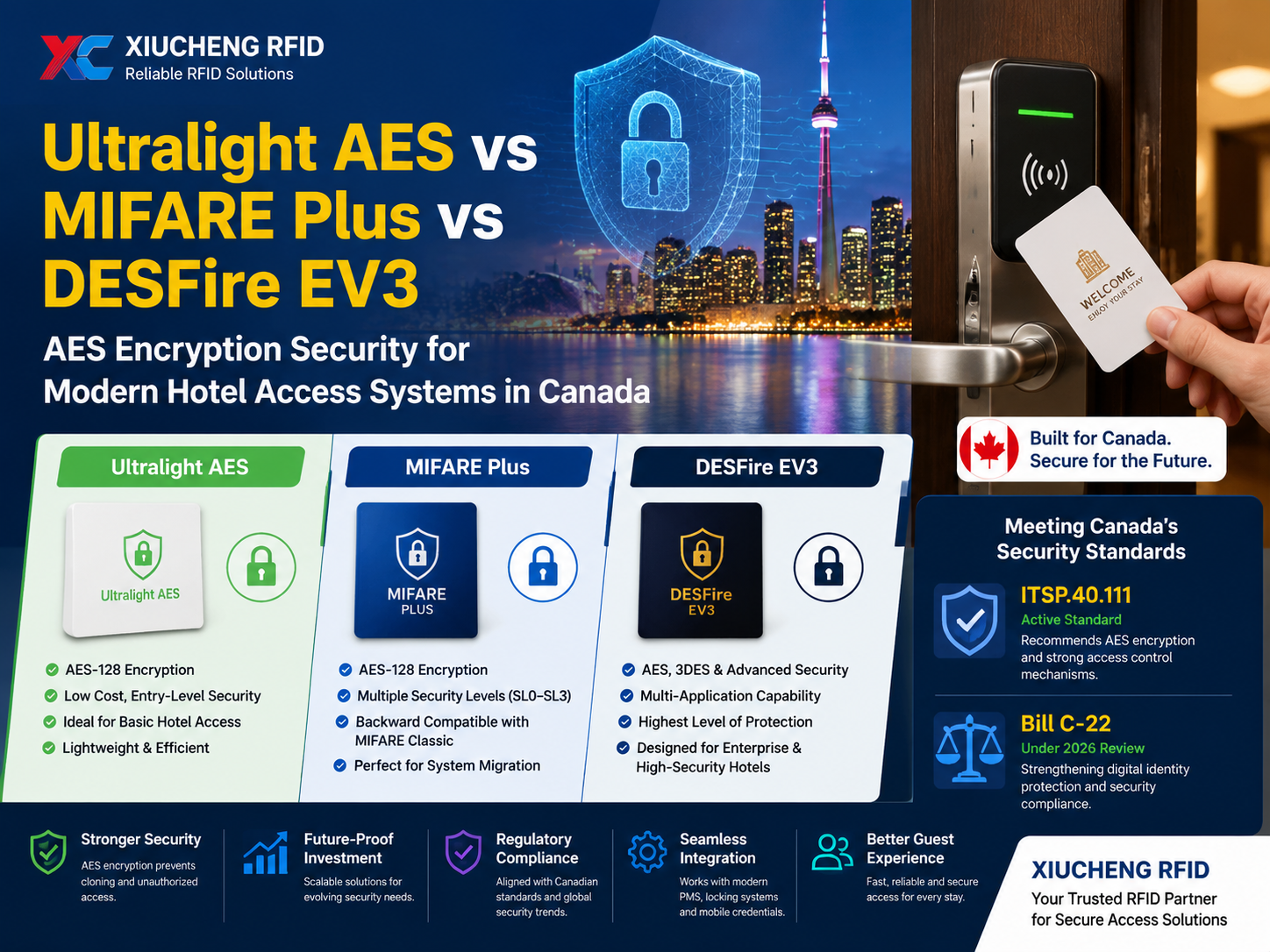
2. Chip Overview: Ultralight AES vs MIFARE Plus vs DESFire EV3
🔹 Ultralight AES (Entry-Level Secure RFID)
Ultralight AES is designed as a low-cost upgrade from basic Ultralight RFID tags.
Características principales:
- AES-128 encryption added
- Lightweight memory structure
- Limited application capability
- Low-cost deployment
Lo mejor para:
- Basic hotel room cards (budget hotels)
- Temporary access passes
- Event ticketing systems
👉 Limitation:
Not suitable for multi-application or high-security systems.
🔹 MIFARE Plus (Migration Security Platform)
MIFARE Plus is designed as a bridge technology between legacy MIFARE Classic systems and modern secure infrastructure.
Key features:
- AES-128 encryption
- Multiple security levels (SL0 to SL3)
- Compatibility with MIFARE Classic infrastructure
- Flexible migration path
Lo mejor para:
- Mid-range hotels
- University campuses
- Corporate access systems
👉 Advantage:
Allows gradual system upgrade without replacing all infrastructure.
🔹 MIFARE DESFire EV3 (High-Security Enterprise Chip)
DESFire EV3 is the most advanced secure RFID chip in the MIFARE family.
Key features:
- AES, 3DES, and diversified encryption support
- Multi-application architecture
- Advanced anti-tamper security
- High-speed transaction capability
Lo mejor para:
- Luxury hotels
- Government buildings
- High-security enterprise campuses
- Transport ticketing systems
👉 Key strength:
Designed for financial-grade security environments.
3. Technical Comparison Table (SEO Core Section)
| Característica | Ultraligero AES | MIFARE Plus | DESFire EV3 |
|---|---|---|---|
| Cifrado | AES-128 | AES-128 | AES + Multi-algorithm |
| Nivel de seguridad | Básico | Medio-Alto | Muy alta |
| Compatibilidad del sistema | Bajo | High (Legacy support) | Medio |
| Multi-application | No | Limitado | Sí |
| Coste | Bajo | Medio | Alto |
| Recommended Use | Entry hotel access | Migration systems | High-security hotels |
4. AES Security vs Legacy RFID Systems
Older RFID systems (such as MIFARE Classic using Crypto1) are now considered cryptographically outdated.
Main vulnerabilities of legacy RFID:
- Card cloning using cheap tools
- Replay attacks
- Static UID duplication
- Weak authentication logic
AES-based systems solve:
- Dynamic key authentication
- Encrypted challenge-response protocol
- Per-card unique keys
- Strong resistance to reverse engineering
👉 Conclusion: AES is no longer “advanced”—it is baseline security.
5. Canada Hotel Access Systems: Real-World Application Case
🇨🇦 Scenario: Mid-to-large hotel chain upgrade in Toronto & Vancouver
A typical Canadian hotel chain managing 300–800 rooms faces the following challenges:
- Frequent key card cloning incidents
- Guest complaints about room access failures
- Outdated MIFARE Classic infrastructure
- Compliance pressure from government security frameworks
Solution Architecture
The hotel implements a three-tier RFID upgrade strategy:
Phase 1: Migration Layer (MIFARE Plus)
- Replaces legacy Classic cards gradually
- Maintains existing door lock infrastructure
- Enables AES authentication without full system replacement
Phase 2: Premium Rooms (DESFire EV3)
- Used for VIP suites and executive floors
- Provides multi-application functionality:
- Room access
- Elevator control
- Parking access
- Spa & gym access
Phase 3: Budget Rooms (Ultralight AES)
- Low-cost deployment for high turnover rooms
- Used in seasonal or short-stay hotel segments
Resultado:
- 85% reduction in card cloning incidents
- 30% faster check-in process
- Unified secure access architecture
6. Regulatory Drivers in Canada: ITSP.40.111 & Bill C-22
🇨🇦 ITSP.40.111 (Active Security Standard)
Issued by the Canadian Centre for Cyber Security, ITSP.40.111 emphasizes:
- Mandatory use of strong encryption (AES-level or higher)
- Elimination of weak cryptographic systems
- Secure identity and access management
- Zero-trust security architecture alignment
👉 Impact on RFID:
Hotels and institutions must upgrade to AES-based RFID systems.
🇨🇦 Bill C-22 (Under 2026 Review)
Bill C-22 focuses on:
- Digital identity protection
- AI-driven security governance
- Data privacy compliance
- Secure access auditing
👉 RFID implications:
- Access systems must be traceable and encrypted
- Weak RFID systems may be considered non-compliant in future audits
- Encourages adoption of DESFire EV3-level security
7. Industry Trend: RFID Security is Becoming Mandatory
The global RFID access control market is shifting toward:
1. AES as baseline requirement
No AES = non-compliant in regulated environments
2. Migration architecture adoption
Most organizations do not replace systems fully—they upgrade gradually:
- Ultralight AES → Entry level
- MIFARE Plus → Migration layer
- DESFire EV3 → High-security layer
3. Hotel industry transformation
Hotels are becoming the largest adopters of AES-based RFID cards debido a:
- High guest turnover
- Security liability risks
- Integration with mobile + NFC systems
Conclusion: Which RFID Chip Should You Choose?
The right RFID chip depends on your security requirement:
- 🔹 Ultralight AES → Budget hotel & temporary access
- 🔹 MIFARE Plus → System migration & mid-security environments
- 🔹 DESFire EV3 → High-security enterprise & premium hotels
For Canada’s evolving regulatory landscape, AES encryption is no longer optional—it is a compliance requirement driven by ITSP.40.111 and emerging Bill C-22 frameworks.

Acerca de XIUCHENG RFID
XIUCHENG RFID se especializa en la fabricación de una amplia gama de productos RFID, incluyendo pulseras de silicona RFID, pulseras Tyvek, pulseras de tela, pulseras elásticas, pulseras de vinilo, etiquetas RFID para lavandería, etiquetas para animales y tarjetas RFID. Todos los productos se fabrican bajo un estricto control de calidad y con tecnología de producción avanzada.
Con 12 años de experiencia en el diseño de pulseras, etiquetas, gestión de calidad y gestión de relaciones con los clientes, hemos construido una base sólida para ofrecer soluciones RFID fiables y de alto rendimiento.
Visión final
Hotels and access control systems that fail to upgrade to AES-based RFID architecture risk:
- Security breaches
- Regulatory non-compliance
- Loss of operational trust
Meanwhile, companies adopting DESFire EV3 and MIFARE Plus architectures are building future-proof secure identity systems aligned with global digital security standards.