What Are Nanochips?
Nanochips are ultra-miniaturized integrated circuits engineered at the micro- and nanometer scale to perform identification, sensing, data storage, or processing functions within extremely constrained physical dimensions. In RFID and identification systems, nanochips are typically passive semiconductor devices designed to operate without an internal power source.
Because of their small size, durability, and long operational lifespan, nanochips are widely used in RFID identification, biomedical applications, industrial traceability, y security systems where conventional chips or tags are impractical.
How Nanochips Are Manufactured
The manufacturing of nanochips is a highly controlled, multi-stage semiconductor process combining microelectronics fabrication, precision packaging, y application-specific encapsulation.
1. Semiconductor Wafer Fabrication
Nanochip production begins at the wafer level inside semiconductor fabrication facilities:
- High-purity silicon wafers are prepared and polished
- Photolithography is used to pattern nano-scale circuit designs
- Etching and ion implantation create transistors, memory cells, and logic circuits
- Metal layers are deposited to form interconnections
Modern nanochips may contain millions of transistors within an area smaller than a grain of rice, depending on function.
2. Circuit Miniaturization and Low-Power Design
Unlike general-purpose processors, nanochips are optimized for:
- Ultra-low power consumption
- Minimal logic complexity
- Long-term data retention
In RFID nanochips, engineers focus on:
- Efficient rectifier circuits to harvest energy from RF fields
- Stable EEPROM or ROM memory structures
- Noise-resistant signal modulation
This design philosophy enables nanochips to operate passively for 10–20 years or more.
3. Antenna Integration
For wireless nanochips (such as RFID nanochips), the chip must be paired with a micro-antenna:
- Copper or aluminum coils are micro-wound or etched
- Antenna geometry is tuned to specific frequencies (LF, HF, or UHF)
- Chip and antenna are bonded using conductive adhesives or ultrasonic welding
The antenna design directly affects read range, reliability, and resistance to interference.
4. Encapsulation and Packaging
Packaging is critical to nanochip performance and longevity.
Depending on the application, nanochips may be encapsulated in:
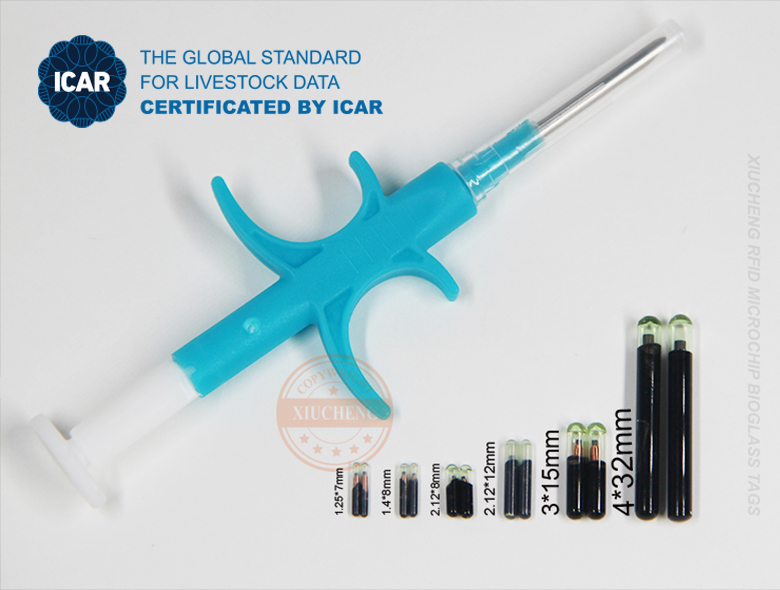
- Biocompatible glass (bioglass) for implantable use
- Polymer or epoxy coatings for industrial environments
- Ceramic housings for high-temperature or high-stress conditions
For implantable RFID nanochips, medical-grade bioglass provides:
- Chemical and moisture resistance
- Mechanical strength
- Long-term biocompatibility
5. Testing, Programming, and Quality Control
Before deployment, nanochips undergo rigorous testing:
- Electrical performance verification
- Frequency response validation
- Memory integrity checks
- Environmental stress testing
In regulated industries, additional compliance testing is required, such as ISO or ICAR certification.
Key Types of Nanochips
Different nanochip designs serve different purposes:
- Identification nanochips (RFID UID storage)
- Read/write nanochips (data update capability)
- Sensor nanochips (temperature or motion detection)
- Secure nanochips (encryption and authentication)
Each type is optimized for a specific balance of size, functionality, and durability.
Applications of Nanochips
1. RFID Identification Systems
The most established use of nanochips is in RFID identification, particularly where permanent or hidden identification is required.
Common applications include:
- Animal identification (pets, livestock, wildlife)
- Autenticación de productos
- Anti-counterfeiting systems
- Secure asset tracking
Nanochips enable reliable identification without visible labels or batteries.
2. Veterinary and Biomedical Applications
In veterinary and biomedical fields, nanochips are used for:
- Permanent animal identification
- Medical research tracking
- Health data association
- Long-term study management
Implantable nanochips provide stable identification throughout the lifetime of an animal or specimen.
3. Industrial Traceability and Manufacturing
Nanochips support advanced traceability in:
- Automotive component tracking
- Tool and equipment identification
- Harsh industrial environments
Their resistance to heat, vibration, and chemicals makes nanochips suitable for demanding production conditions.
4. Security and Access Control
In high-security environments, nanochips are embedded into:
- Secure credentials
- Authentication devices
- Anti-tamper systems
Because nanochips can be hidden and cloned-resistant, they are effective for sensitive authentication use cases.
5. Research and Emerging Technologies
Ongoing research is expanding nanochip applications into:
- Smart materials
- Embedded sensor networks
- Advanced medical diagnostics
- Internet of Things (IoT) micro-devices
As semiconductor processes continue to advance, nanochips are expected to gain increased functionality without increasing size.
Advantages of Nanochips
Nanochips offer several technical and commercial advantages:
- Extremely small physical size
- Long operational lifespan
- Passive operation (no battery)
- High durability and environmental resistance
- Global compatibility with standardized readers
These advantages make nanochips ideal for applications requiring permanence, reliability, and minimal maintenance.
Challenges and Limitations
Despite their strengths, nanochips have constraints:
- Limited data storage capacity
- Shorter read range compared to larger Etiquetas RFID
- Higher manufacturing precision requirements
- Strict regulatory compliance in certain markets
Understanding these limitations is essential for proper system design.
Future Outlook for Nanochips
The future of nanochips is driven by:
- Continued semiconductor miniaturization
- Improved energy-harvesting efficiency
- Integration with sensors and encryption
- Growing regulatory demand for traceability
As identification and security requirements increase globally, nanochips will play an increasingly important role across multiple industries.
Conclusión
Nanochips are foundational components in modern identification, traceability, and security systems. Their sophisticated manufacturing process enables reliable operation at an extremely small scale, while their diverse applications continue to expand across veterinary, industrial, biomedical, and research fields.
For organizations seeking permanent, maintenance-free identification solutions, nanochips represent a mature and strategically important technology.