RFID labels are widely used in logistics, retail, manufacturing, healthcare, inventory management, and asset tracking systems.
While RFID chips and antennas determine identification performance, the label material determines how well the RFID label performs in real-world environments.
Different applications require different RFID label materials. A warehouse shipping label may only need to remain readable for several days, while an industrial asset label may need to withstand moisture, chemicals, abrasion, and years of outdoor exposure.
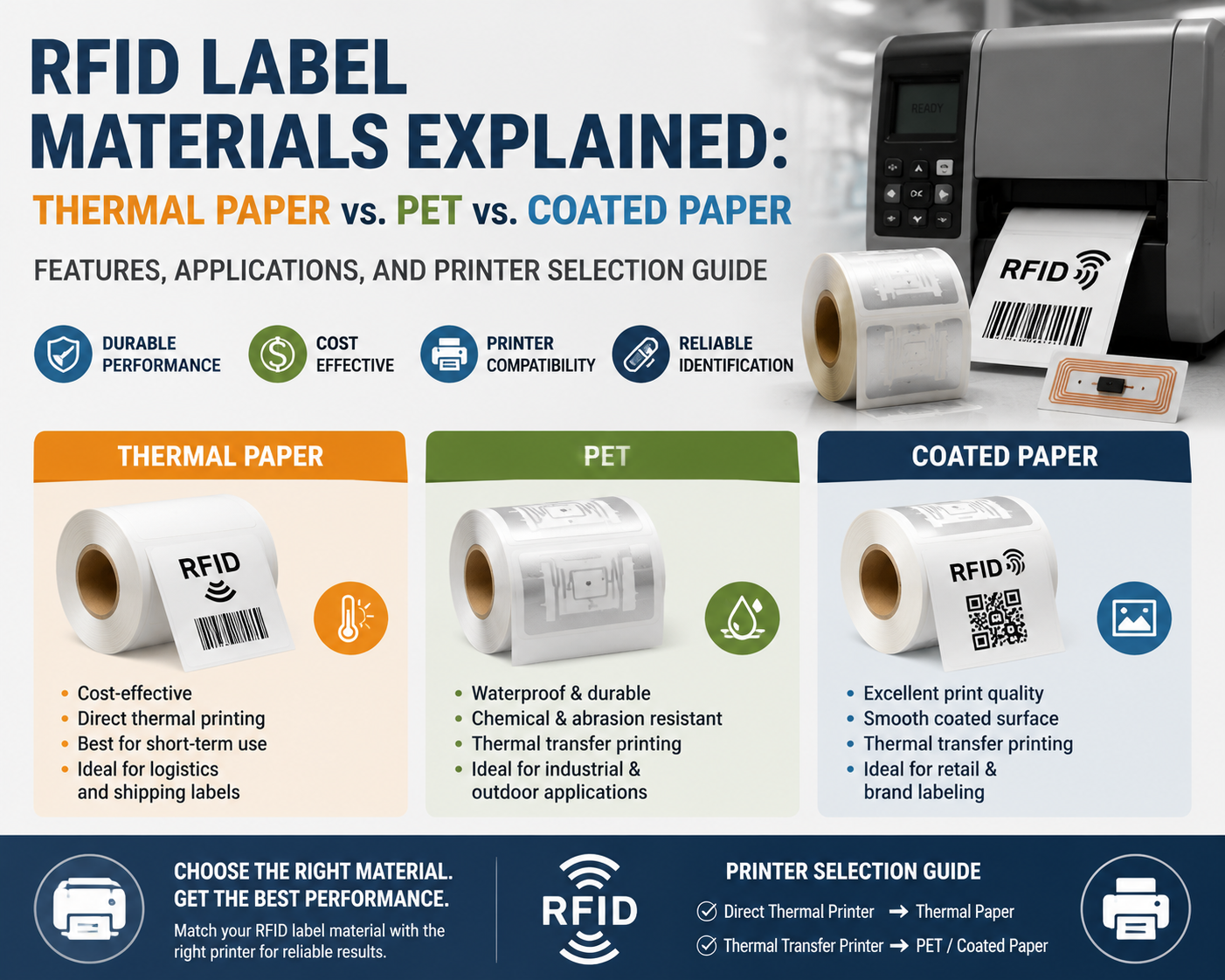
The three most common RFID label materials include:
- Thermal paper RFID labels
- PET RFID labels
- Coated paper RFID labels
Each material has different characteristics in terms of durability, printing method, cost, and application environment.
This guide explains the differences between thermal paper, PET, and coated paper RFID labels, and helps you choose the right material and RFID printer for your project.
What Is an RFID Label Material?
An RFID label is a smart label that combines an RFID inlay with a printable surface material.
A typical RFID label consists of four layers:
Face Material
The face material is the printable surface of the RFID label.
К распространенным материалам относятся:
- Термобумага
- Coated paper
- PET film
The face material determines:
- Качество печати
- Долговечность
- Устойчивость к воздействию окружающей среды
- Service life
Вкладыш RFID
The RFID inlay contains:
- RFID-чип
- Антенна
- Субстрат
The RFID inlay is responsible for:
- Хранение данных
- Wireless communication
- Reading performance
Adhesive Layer
The adhesive allows the RFID label to attach to different surfaces, such as:
- Cardboard boxes
- Plastic containers
- Metal assets
- Glass products
Release Liner
The release liner protects the adhesive before application.
Thermal Paper RFID Labels
Thermal paper RFID labels are one of the most commonly used RFID label types for short-term applications.
Thermal paper is coated with a heat-sensitive layer that changes color when heated by a thermal print head.
Unlike thermal transfer printing, direct thermal printing does not require ink ribbons.
Features of Thermal Paper RFID Labels
Low Cost and Easy Printing
Thermal paper RFID labels have the lowest material cost among the three options.
Because direct thermal printers do not require ribbons or ink cartridges, they provide:
- Lower operating cost
- Simple maintenance
- Faster printing workflow
High Printing Efficiency
Thermal paper labels are suitable for high-volume printing environments.
К числу распространенных областей применения относятся:
- Shipping labels
- Warehouse labels
- Courier tracking labels
- Retail price labels
Limited Environmental Resistance
The biggest limitation of thermal paper is durability.
Thermal paper is sensitive to:
- Тепло
- Sunlight
- Влажность
- Химикаты
- Friction
Over time, printed information may fade.
Applications of Thermal Paper RFID Labels
Logistics and Transportation
Примеры:
- Отслеживание посылок
- Shipping identification
- Distribution center management
Retail Inventory Management
Примеры:
- Price tags
- Product inventory labels
- Short-term stock tracking
Temporary Identification
Suitable for products that require identification for:
- Days
- Weeks
- Several months
Advantages of Thermal Paper RFID Labels
| Характеристика | Выгода |
|---|---|
| Low material cost | Suitable for large-volume applications |
| No ribbon required | Reduces printing cost |
| Fast printing | Improves operational efficiency |
| Lightweight | Easy to handle |
Limitations of Thermal Paper RFID Labels
Thermal paper labels are not recommended for:
- Outdoor applications
- Long-term asset tracking
- Industrial environments
- Chemical exposure environments
For these applications, PET RFID labels are usually a better choice.
PET RFID Labels
PET RFID labels use polyethylene terephthalate film as the printable surface material.
Compared with paper-based RFID labels, PET provides significantly better durability and environmental resistance.
Features of PET RFID Labels
Excellent Durability
PET RFID labels can withstand:
- Вода
- Oil
- Химикаты
- Scratching
- Изменения температуры
This makes PET RFID labels suitable for demanding industrial applications.
Long Service Life
PET labels are designed for applications requiring permanent identification.
Typical applications include asset tracking systems where labels need to remain readable for several years.
High-Quality Printing
PET surfaces provide excellent printing performance with:
- Термотрансферная печать
- Печать штрих-кодов
- Печать QR-кодов
- High-resolution graphics
Applications of PET RFID Labels
Industrial Asset Tracking
Примеры:
- Equipment identification
- Machine tracking
- Управление инструментами
- Factory automation
Healthcare and Laboratory Management
Примеры:
- Medical equipment tracking
- Laboratory asset identification
- Pharmaceutical management
Outdoor Identification
Примеры:
- Контейнеры
- Поддоны
- Vehicles
- Outdoor equipment
Advantages of PET RFID Labels
| Характеристика | Выгода |
|---|---|
| Водонепроницаемый | Works in humid environments |
| Химическая стойкость | Suitable for industrial applications |
| Scratch resistant | Maintains readability |
| Длительный срок службы | Suitable for permanent tracking |
Limitations of PET RFID Labels
- Higher cost than paper materials
- Requires thermal transfer printing
- Less suitable for disposable applications
Coated Paper RFID Labels
Coated paper RFID labels provide a balance between printing quality, appearance, and cost.
Coated paper has a smooth surface layer that improves printing performance compared with standard paper.
Features of Coated Paper RFID Labels
Excellent Appearance
Coated paper supports:
- Sharp text printing
- Clear barcodes
- Brand graphics
- Color printing
This makes coated paper RFID labels popular for consumer products and retail applications.
Balanced Cost Performance
Compared with PET:
- Lower cost
- Easier processing
Compared with thermal paper:
- Better appearance
- Better printing quality
Applications of Coated Paper RFID Labels
Retail Products
Примеры:
- Clothing labels
- Cosmetic products
- Consumer goods
Brand Identification
Примеры:
- Premium packaging
- Product authentication labels
- Marketing labels
Inventory Management
Примеры:
- Warehouse products
- Internal product tracking
Advantages of Coated Paper RFID Labels
| Характеристика | Выгода |
|---|---|
| High print quality | Suitable for branding |
| Moderate cost | Good price-performance ratio |
| Professional appearance | Improves product presentation |
Limitations of Coated Paper RFID Labels
Coated paper is less durable than PET.
It is not recommended for:
- Outdoor exposure
- Heavy industrial use
- Long-term equipment tracking
Thermal Paper vs PET vs Coated Paper RFID Labels Comparison
| Характеристика | Thermal Paper RFID Label | PET RFID Label | Coated Paper RFID Label |
|---|---|---|---|
| Материал | Бумага | Plastic film | Coated paper |
| Долговечность | Низкий | Превосходно | Средний |
| Водонепроницаемость | Бедный | Превосходно | Умеренный |
| Метод печати | Direct thermal | Thermal transfer | Thermal transfer |
| Стоимость | Lowest | Highest | Средний |
| Внешний вид | Основные | Профессия | High quality |
| Продолжительность жизни | Короткие | Длинный | Средний |
| Outdoor use | Нет | Да | Ограниченный |
How to Choose the Right RFID Label Material?
Selecting the correct RFID label material depends on the application environment, required lifespan, printing method, and budget.
Different industries have different requirements for RFID labels. Choosing the wrong material may result in poor printing quality, label failure, or unnecessary replacement costs.
Choose Thermal Paper RFID Labels When
Thermal paper RFID labels are suitable when you need:
- Low-cost identification
- High-volume label printing
- Short-term tracking
- Fast warehouse operations
Typical industries include:
- Logistics and transportation
- E-commerce fulfillment
- Управление запасами в розничной торговле
- Распределительные центры
The main priority for thermal paper RFID labels is:
Low cost + fast printing efficiency
Choose PET RFID Labels When
PET RFID labels are recommended when applications require:
- Длительный срок службы
- High durability
- Водонепроницаемость
- Химическая стойкость
- Outdoor reliability
Typical industries include:
- Производство
- Здравоохранение
- Industrial asset management
- Отслеживание оборудования
The main priority for PET RFID labels is:
Durability + long-term identification reliability
Choose Coated Paper RFID Labels When
Coated paper RFID labels are suitable when you need:
- Better appearance
- High-quality printing
- Moderate durability
- Balanced cost performance
Typical industries include:
- Retail products
- Consumer goods
- Brand packaging
- Проверка подлинности продукта
The main priority for coated paper RFID labels is:
Appearance + printing quality + reasonable cost
RFID Label Printer Selection Guide
Choosing the correct RFID label printer is essential for achieving reliable printing and RFID encoding performance.
Different RFID label materials require different printing technologies.
Direct Thermal RFID Printers
Direct thermal RFID printers use heat-sensitive thermal paper labels.
The printer head directly heats the label surface to create images and text.
Suitable Materials
- Thermal paper RFID labels
Advantages of Direct Thermal Printing
- No ink ribbon required
- Lower operating cost
- Simple maintenance
- Fast printing speed
Общие приложения
- Shipping labels
- Warehouse labels
- Courier tracking labels
- Retail price labels
Thermal Transfer RFID Printers
Thermal transfer RFID printers use a ribbon to transfer ink onto the label surface.
This printing method provides better durability and is recommended for long-term identification applications.
Suitable Materials
- PET RFID labels
- Coated paper RFID labels
Advantages of Thermal Transfer Printing
- Long-lasting printed information
- Excellent print quality
- Better resistance against environmental factors
- Suitable for industrial applications
Общие приложения
- Отслеживание промышленных активов
- Medical equipment identification
- Управление складом
- Permanent product identification
Direct Thermal vs Thermal Transfer RFID Printer Comparison
| Характеристика | Direct Thermal Printer | Thermal Transfer Printer |
|---|---|---|
| Метод печати | Heat-sensitive coating | Ribbon transfer printing |
| Suitable label material | Термобумага | PET and coated paper |
| Ribbon required | Нет | Да |
| Стойкость печати | Низкий | Высокий |
| Стоимость | Нижний | Выше |
| Main applications | Short-term labels | Long-term identification |
Popular RFID Label Printer Brands
Common industrial RFID printer brands used in global RFID applications include:
- Zebra RFID printers
- SATO RFID printers
- Honeywell RFID printers
- TSC RFID printers
When selecting an RFID printer, consider the following factors:
- RFID frequency compatibility
- UHF or HF RFID requirements
- Label size
- Printing volume
- Требования к кодированию
- Connection interface
Does RFID Label Material Affect Reading Distance?
The label material itself does not directly determine RFID reading distance.
RFID reading performance mainly depends on:
- RFID chip model
- Конструкция антенны
- Рабочая частота
- RFID reader power
- Условия установки
However, the label material affects the protection and stability of the RFID inlay.
For example, PET RFID labels provide better protection for RFID components in harsh environments, helping maintain stable performance over a longer service period.
Frequently Asked Questions About RFID Label Materials
Which RFID label material is the most durable?
PET RFID labels provide the highest durability among common RFID label materials.
They are suitable for industrial equipment tracking, outdoor applications, and long-term asset identification.
Are thermal RFID labels waterproof?
No. Thermal paper RFID labels have limited resistance to water, heat, and sunlight.
They are mainly designed for short-term indoor applications.
Can PET RFID labels be printed with a normal printer?
Most PET RFID labels require thermal transfer RFID printers because thermal transfer printing provides better adhesion and long-lasting results on plastic surfaces.
Which RFID label material is the cheapest?
Thermal paper RFID labels are usually the most economical option and are widely used in logistics and retail applications.
What printer should be used for PET RFID labels?
A thermal transfer RFID printer with a suitable ribbon is recommended for PET RFID labels to achieve durable printing performance.
Заключение
RFID label material selection directly affects label durability, printing quality, cost, and application performance.
Thermal paper RFID labels are ideal for low-cost and short-term identification applications such as logistics, warehouse operations, and retail inventory management.
PET RFID labels provide excellent durability and environmental resistance, making them suitable for industrial tracking, healthcare equipment management, and outdoor applications.
Coated paper RFID labels offer a balance between appearance, printing quality, and cost, making them suitable for retail products, consumer goods, and branded packaging.
By selecting the right RFID label material and matching it with the correct RFID printer technology, businesses can build more reliable and efficient RFID identification systems.