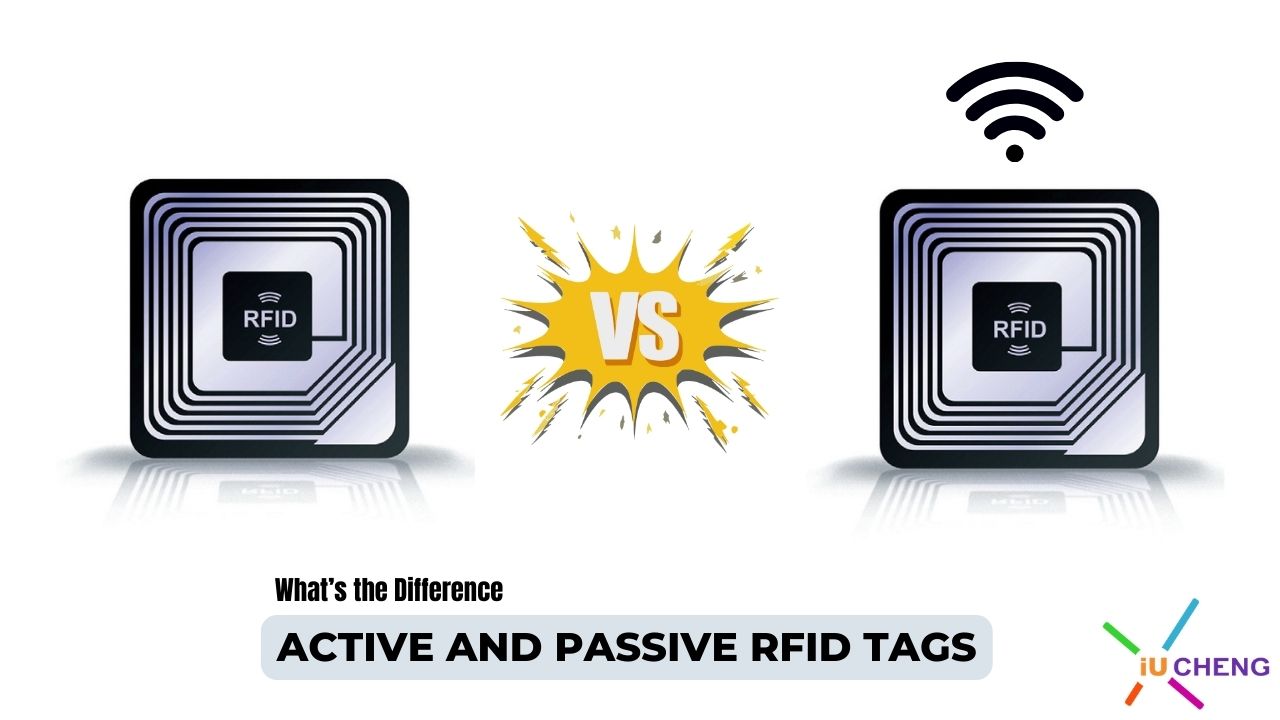
When designing an RFID system, one of the most important decisions is choosing between active RFID tags and passive RFID tags. Although both technologies use radio frequency communication for identification and tracking, their capabilities, cost structures, and use cases differ significantly.
Understanding these differences helps businesses select the most suitable RFID solution for logistics, asset tracking, inventory management, and industrial applications.
What Are Active RFID Tags
Active RFID tags contain an internal battery that powers the tag’s circuitry and radio transmission. Because the tag actively broadcasts a signal, it can be detected over much longer distances compared to passive tags.
Key characteristics of active RFID tags include:
- Built-in battery power source
- Long read range, often up to hundreds of meters
- Larger physical size
- Higher unit cost
- Ability to support sensors (temperature, motion, etc.)
Active RFID tags are commonly used in real-time location systems (RTLS), vehicle tracking, and large-area asset monitoring.
What Are Passive RFID Tags
Passive RFID tags do not contain a battery. Instead, they rely on energy transmitted by the RFID reader to power the chip and reflect a signal back to the reader.
Typical features of passive RFID tags include:
- No internal power source
- Shorter read range compared to active tags
- Small size and flexible formats (labels, cards, inlays)
- Lower cost per unit
- Long operational lifespan with minimal maintenance
Passive RFID tags are widely used in inventory management, logistics tracking, retail labeling, access control, and asset identification.
Product: UHF RFID labels for logistics and inventory
Key Differences Between Active and Passive RFID Tags
| Feature | Active RFID Tags | Passive RFID Tags |
|---|---|---|
| Power Source | Internal battery | Powered by reader |
| Read Range | Long (tens to hundreds of meters) | Short to medium |
| Tag Size | Larger | Small and flexible |
| Cost | Higher | Lower |
| Maintenance | Battery replacement required | Maintenance-free |
| Typical Use | RTLS, vehicle tracking | Inventory, logistics, retail |
Learn more: How UHF RFID Tags Work
Read Range and Performance Considerations
Active RFID tags excel in environments where long-distance tracking and continuous signal transmission are required. Passive RFID tags, especially UHF RFID labels, offer sufficient read range for most supply chain and warehouse applications while maintaining low deployment costs.
Environmental factors such as metal, liquids, and tag orientation also influence performance, particularly for passive RFID systems.
Cost and Scalability
From a scalability perspective, passive RFID tags are more suitable for high-volume deployments due to their low cost and minimal maintenance requirements. Active RFID tags are typically reserved for tracking high-value assets where the additional cost is justified by extended functionality.
Choosing the Right RFID Tag Type
Selecting between active and passive RFID tags depends on several factors:
- Required read range
- Deployment scale
- Budget constraints
- Data and sensor requirements
- Maintenance capabilities
In many enterprise systems, a combination of both technologies is used to balance coverage, cost, and performance.
Conclusion
Both active and passive RFID tags play important roles in modern identification and tracking systems. Active RFID tags provide long-range, real-time tracking, while passive RFID tags offer cost-effective and scalable solutions for identification and inventory management.
Understanding their differences allows organizations to design RFID systems that align with operational goals and technical requirements.