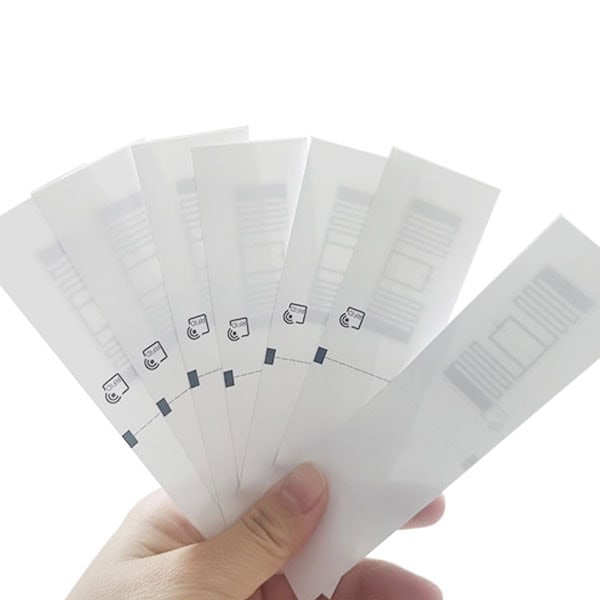
RFID technology is widely used for asset tracking, inventory management, logistics, manufacturing, and warehouse automation. In many RFID projects, users expect tags to perform consistently regardless of where they are attached.
However, one of the most common issues encountered during RFID deployment is that standard RFID tags often stop working or experience dramatically reduced read ranges when mounted on metal surfaces.
Many businesses discover this problem only after purchasing large quantities of RFID tags and finding that read performance drops from several meters to just a few centimeters—or disappears entirely.
So why does this happen?
The Relationship Between RFID and Radio Waves
RFID systems communicate through radio frequency signals.
A typical RFID system consists of:
- قارئ الترددات اللاسلكية
- هوائي RFID
- بطاقة تعريف بالترددات اللاسلكية
- Software platform
The reader sends electromagnetic energy through its antenna. The RFID tag receives this energy and responds by transmitting its stored data.
For RFID communication to work properly:
- The tag antenna must resonate at its designed frequency.
- The electromagnetic field must remain stable.
- Signal reflection and absorption must be minimized.
Metal surfaces disrupt all three conditions.
Why Metal Causes RFID Problems
Metal is an excellent conductor of electricity.
When an RFID tag is placed directly on a metal surface, the metal interacts with the tag’s antenna and changes its electrical characteristics.
This leads to several problems:
Signal Reflection
Metal reflects radio waves rather than allowing them to pass through.
When RFID signals hit a metal surface:
- Part of the signal is reflected.
- Signal patterns become distorted.
- Reader-to-tag communication becomes unstable.
The result is shorter read distances and inconsistent performance.
Antenna Detuning
Detuning is the primary reason normal RFID tags fail on metal.
RFID antennas are carefully designed to operate at specific frequencies.
على سبيل المثال:
- UHF RFID: 860–960 MHz
- HF RFID: 13.56 MHz
- LF RFID: 125 KHz or 134.2 KHz
When a standard RFID tag is attached directly to metal:
- The antenna’s impedance changes.
- Resonance frequency shifts.
- Energy transfer efficiency drops.
The tag may still work, but read distance can decrease by 80–95%.
In many cases, the tag becomes completely unreadable.
Signal Absorption
Metal can absorb and redirect electromagnetic energy.
Instead of transferring energy efficiently into the RFID chip, much of the signal is lost.
هذا يقلل:
- Tag sensitivity
- Reader performance
- قراءة الموثوقية
The effect becomes more severe as the operating frequency increases.

Why UHF RFID Is Most Affected
Among all RFID frequencies, UHF RFID is generally the most sensitive to metal interference.
UHF RFID systems are popular because they offer:
- مسافة قراءة طويلة
- قراءة مجمعة سريعة
- High inventory efficiency
However, UHF signals have shorter wavelengths and are highly influenced by nearby conductive materials.
A standard UHF label that reads 8–10 meters in open air may only read:
- 10–30 cm on metal
- Or not read at all
This is why standard paper RFID labels often fail in industrial environments.
Real-World Examples of RFID Failure on Metal
Warehouse Shelving
Many warehouses use metal racks.
If standard RFID labels are attached directly to steel shelves:
- Read range drops dramatically
- Inventory accuracy decreases
- Missed reads become common
IT Asset Tracking
Servers, laptops, routers, and switches all contain large metal components.
Normal RFID labels often become unreadable when applied directly to:
- Server chassis
- Network equipment
- Data center assets
Tool Tracking
Manufacturing facilities frequently track:
- Wrenches
- Drills
- Cutting tools
- Mold components
Most tools are entirely metal, making standard RFID labels ineffective.
Industrial Containers
Metal containers, cylinders, and returnable transport items present similar challenges.
Without anti-metal RFID technology, tag performance becomes unreliable.
How Anti-Metal RFID Tags Solve the Problem
To overcome metal interference, manufacturers developed specialized anti-metal RFID tags.
These tags include a separation layer between the antenna and the metal surface.
This layer is often called:
- Isolation layer
- Spacer layer
- Foam backing
- Ferrite layer
Its purpose is to prevent the metal from detuning the antenna.
Ferrite Technology
Many high-performance anti-metal RFID tags use ferrite materials.
Ferrite provides magnetic isolation between:
- هوائي RFID
- Metal object
تشمل المزايا ما يلي:
- Improved signal stability
- Longer read distance
- Higher read accuracy
- Better performance near conductive surfaces
Ferrite-based tags are widely used in:
- التصنيع
- الفضاء الجوي
- Data centers
- الأتمتة الصناعية
Types of RFID Tags Designed for Metal
Printable Anti-Metal Labels
مناسب لـ
- إدارة الأصول
- Warehouse tracking
- IT equipment
المزايا:
- Lightweight
- فعالة من حيث التكلفة
- Printable surface
Hard Anti-Metal RFID Tags
Designed for harsh industrial environments.
المزايا:
- مبيت متين
- Waterproof design
- مقاومة الصدمات
- عمر خدمة طويل
تشمل التطبيقات الشائعة ما يلي:
- تتبع الأدوات
- معدات ثقيلة
- Outdoor assets
PCB RFID Tags
PCB anti-metal tags use circuit board technology.
الفوائد:
- Compact size
- أداء مستقر
- High durability
Frequently used in electronics manufacturing.
Magnetic RFID Tags
Some anti-metal RFID tags include magnetic mounting options.
مثالية لـ
- Temporary asset tracking
- إدارة المستودعات
- Reusable industrial applications
How Much Better Are Anti-Metal RFID Tags?
The difference can be dramatic.
| نوع العلامة | Read Range on Metal |
|---|---|
| Standard UHF RFID Label | 0–30 cm |
| Anti-Metal RFID Label | 1–5 meters |
| Hard Anti-Metal RFID Tag | 3–12 meters |
| Industrial Long-Range Anti-Metal Tag | Up to 15+ meters |
Actual performance depends on:
- قوة القارئ
- تصميم الهوائي
- Mounting method
- Metal surface size
- الظروف البيئية

نبذة عن XIUCHENG RFID
تتخصص شركة XIUCHENG RFID في تصنيع مجموعة واسعة من منتجات RFID، بما في ذلك أساور المعصم المصنوعة من السيليكون RFID، وأساور المعصم المصنوعة من تايفك، وأساور المعصم المصنوعة من القماش، وأساور المعصم المرنة، وأساور المعصم المصنوعة من الفينيل، وعلامات الغسيل RFID، وعلامات الحيوانات RFID، وبطاقات RFID. يتم إنتاج جميع المنتجات تحت رقابة صارمة على الجودة وتكنولوجيا الإنتاج المتقدمة.
مع 12 عامًا من الخبرة في تصميم الأساور وتصميم العلامات وإدارة الجودة وإدارة علاقات العملاء، قمنا ببناء أساس متين لتقديم حلول موثوقة وعالية الأداء في مجال تحديد الهوية بموجات الراديو اللاسلكية.
Common Industries Using Anti-Metal RFID Tags
التصنيع
Track:
- Production tools
- Equipment
- Fixtures
- Work-in-progress assets
Oil and Gas
Monitor:
- Pipes
- Cylinders
- Valves
- Drilling equipment
Data Centers
Manage:
- Servers
- Network switches
- Storage systems
السيارات
Track:
- Vehicle components
- Production assets
- الحاويات القابلة للإرجاع
Construction
Monitor:
- Heavy machinery
- Metal equipment
- Rental assets
How to Choose the Right RFID Tag for Metal
Before selecting a tag, consider:
Metal Surface Size
Large steel objects affect RFID performance differently than small metal tools.
قراءة متطلبات المسافة المقروءة
Determine whether you need:
- Close-range identification
- Mid-range tracking
- Long-range asset visibility
Indoor or Outdoor Use
Outdoor environments may require:
- Waterproof ratings
- مقاومة الأشعة فوق البنفسجية
- Impact resistance
Mounting Method
تشمل الخيارات ما يلي:
- Adhesive backing
- Rivets
- Screws
- Welding brackets
- Magnetic attachment
Operating Environment
Consider exposure to:
- الحرارة
- المواد الكيميائية
- الرطوبة
- الاهتزاز
Why Testing Matters Before Deployment
One mistake many businesses make is assuming all RFID tags perform the same.
في الواقع
- Metal type matters
- Surface shape matters
- Reader configuration matters
- Installation method matters
A tag that performs perfectly in a laboratory may behave differently in the field.
Professional RFID manufacturers typically provide:
- Sample testing
- Read-range verification
- Application-specific recommendations
XIUCHENG RFID recommends testing tags on actual assets before large-scale deployment.
الخاتمة
Normal RFID tags fail on metal surfaces because metal reflects radio waves, absorbs electromagnetic energy, and detunes the RFID antenna. These effects drastically reduce read range and can make tags completely unreadable.
The solution is to use specially designed anti-metal RFID tags that incorporate ferrite or isolation layers to maintain antenna performance near conductive materials.
For industries such as manufacturing, warehousing, IT asset management, oil and gas, and construction, selecting the correct anti-metal RFID tag is essential for achieving reliable tracking performance and maximizing RFID system ROI.
As an experienced RFID manufacturer, XIUCHENG RFID provides a wide range of anti-metal RFID labels, PCB tags, and industrial hard tags designed for reliable operation on metal assets in demanding environments.
الأسئلة الشائعة
Can standard RFID tags work on metal?
In most cases, standard RFID tags experience severe performance degradation when mounted directly on metal surfaces.
Why does metal reduce RFID read range?
Metal reflects and absorbs radio waves while also detuning the RFID antenna, reducing communication efficiency.
What is an anti-metal RFID tag?
An anti-metal RFID tag is specially designed with an isolation layer or ferrite material that allows reliable operation on metal surfaces.
Do NFC tags also have problems with metal?
Yes. NFC tags operating at 13.56 MHz can also experience reduced performance when attached directly to metal without proper shielding.
Which industries need anti-metal RFID tags?
Manufacturing, logistics, data centers, automotive production, construction, oil and gas, and industrial asset tracking commonly require anti-metal RFID solutions.