Measuring the temperature of every cow with a handheld thermometer is impractical on a commercial farm. The process requires labor, restraining animals and direct contact, while isolated measurements may miss changes that occur between inspections.
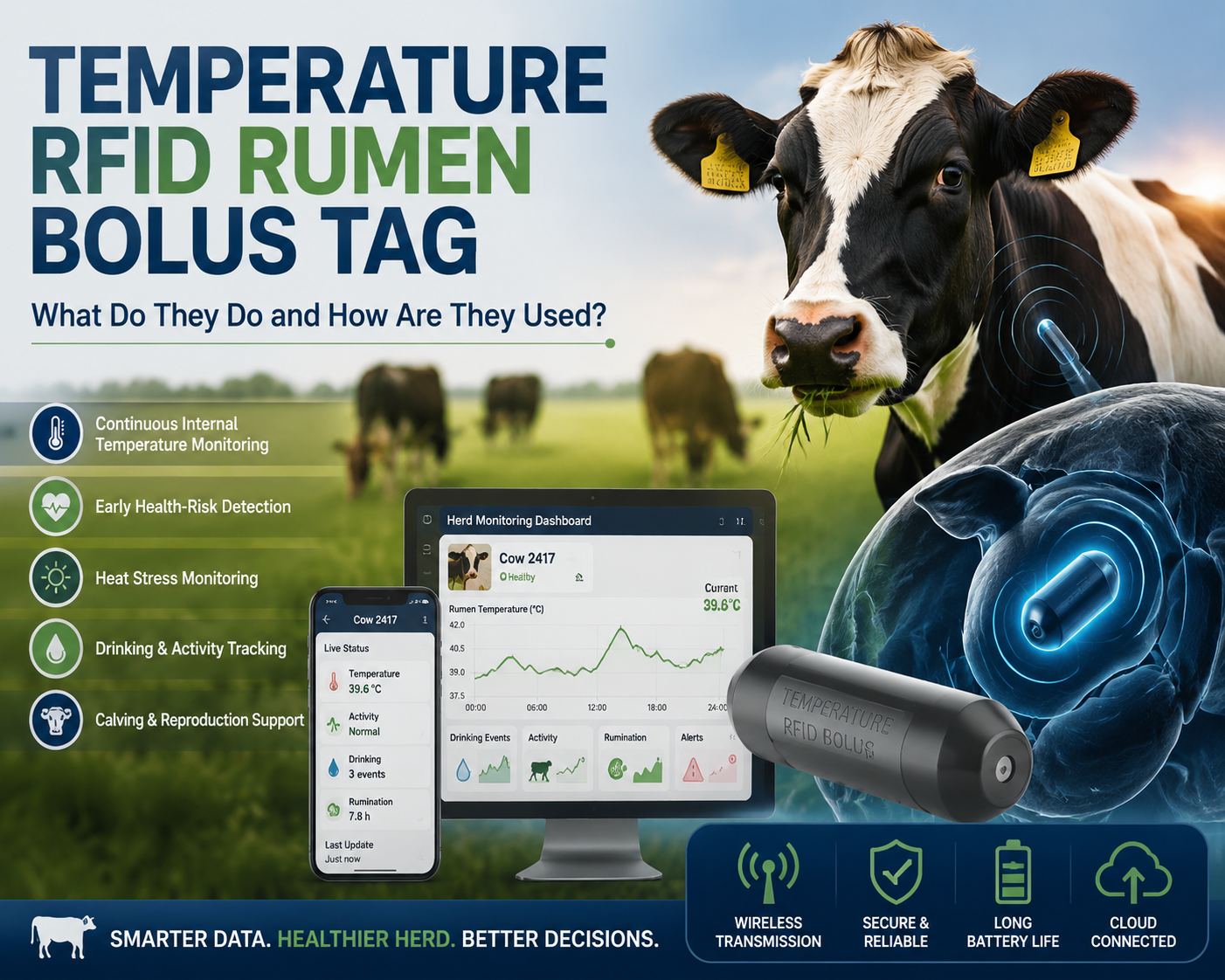
A temperature RFID rumen bolus tag provides a different approach. It is orally administered to a cow and remains inside the reticulorumen, where it can measure internal temperature repeatedly over an extended period.
Depending on the model, the bolus may also monitor activity, rumination, drinking events, movement or rumen pH. Measurements are transmitted to a nearby gateway and then sent to livestock management software, where algorithms compare the animal’s current readings with its normal pattern.
The result is not a replacement for a veterinarian. It is a continuous monitoring tool that can help farm staff identify animals that require closer inspection.
What Is a Temperature RFID Rumen Bolus Tag?
A temperature RFID rumen bolus tag is an ingestible electronic device designed for cattle or other specified ruminants.
It normally consists of:
- A temperature sensor
- A microcontroller
- A unique electronic identification number
- A radio communication module
- An internal battery
- A weighted, acid-resistant housing
- Optional activity, pH or motion sensors
After oral administration, the bolus travels through the esophagus and settles in the reticulum or lower reticulorumen.
Its weight and density help prevent it from moving farther through the digestive system. A properly selected bolus is designed to remain inside the animal for several years or, in some systems, for the productive lifetime of the animal.
Although the product is frequently called a rumen bolus, many sensor boluses actually settle in the reticulum. For practical farm use, the terms “rumen bolus” and “reticulorumen bolus” are often used interchangeably.
Not Every RFID Rumen Bolus Measures Temperature
The term “RFID rumen bolus” can describe two different product categories.
Passive RFID Identification Bolus
A passive identification bolus contains an RFID transponder but no battery-powered temperature sensor.
Its main purpose is permanent animal identification.
Typische Merkmale sind:
- Low-frequency operation, commonly around 134.2 kHz
- ISO 11784 and ISO 11785 compatibility
- FDX-B or HDX communication
- Keine interne Batterie
- Readable only when an RFID reader is nearby
- A unique identification number
- No continuous temperature transmission
This type of bolus works as an internal alternative to an RFID ear tag. It does not continuously measure animal health parameters.
Active Temperature-Sensing Rumen Bolus
A temperature-monitoring bolus contains a sensor, battery and active wireless communication system.
It may transmit data at scheduled intervals to a proprietary gateway installed in a barn, milking area, feedlot or other location.
Typische Merkmale sind:
- Continuous or periodic temperature measurement
- Battery-powered electronics
- Longer communication range than a passive LF tag
- Connection to a farm gateway
- Cloud or local livestock software
- Automated alerts
- Optional activity, pH or rumination monitoring
Some active boluses also include an RFID identity function. However, this does not automatically mean that they can be read by every standard ISO livestock reader.
Buyers should therefore confirm whether “RFID” refers to:
- A standard ISO animal identification transponder
- A proprietary wireless sensor identity
- An active telemetry system
- A combination of identification and sensor technologies
What Does a Temperature Rumen Bolus Measure?
The core measurement is internal reticulorumen temperature.
Because the bolus remains inside the animal, it can collect readings without requiring employees to restrain the cow repeatedly.
A typical system records:
- The animal’s unique bolus ID
- The measured temperature
- The date and time
- Optional activity or motion data
- The gateway receiving the transmission
- The status of the bolus battery
- Any calculated health or management alerts
The software does not normally make decisions from one isolated temperature value. More useful systems build an individual baseline for each animal and monitor changes from that baseline.
This is important because normal temperature patterns differ according to:
- Individual animal
- Time of day
- Feeding schedule
- Drinking behavior
- Lactation stage
- Umweltbedingungen
- Reproductive status
- Recent handling
- Health condition
Main Functions of a Temperature RFID Rumen Bolus
1. Continuous Internal Temperature Monitoring
The primary function is to measure internal temperature repeatedly throughout the day and night.
This produces a temperature curve rather than a single reading.
A continuous record can reveal:
- A gradual increase
- A sudden temperature rise
- An abnormal temperature decrease
- A persistent deviation from the animal’s baseline
- Repeated fluctuations
- Recovery after treatment
An isolated manual measurement may appear normal even when the animal experienced an abnormal change several hours earlier. Continuous monitoring provides more context.
2. Early Health-Risk Detection
Changes in internal temperature may occur before obvious clinical signs become visible.
Depending on the animal and condition, temperature changes may be associated with:
- Infection
- Inflammation
- Respiratory disease
- Mastitis
- Metritis
- Post-calving complications
- Digestive disturbances
- General physiological stress
A temperature alert does not identify a specific disease. It tells the farmer that the animal’s temperature pattern differs from its normal range and that further examination may be justified.
The correct response may include:
- Visual inspection
- Checking feed intake
- Checking milk production
- Taking a rectal temperature
- Reviewing rumination or activity data
- Examining the udder
- Reviewing recent calving records
- Contacting a veterinarian
The value of the bolus is earlier attention, not automatic diagnosis.
3. Heat-Stress Monitoring
High environmental temperature and humidity can place cattle under heat stress.
A smart rumen bolus may help evaluate how individual animals are responding to hot weather.
The system can combine internal temperature data with:
- Ambient temperature
- Relative humidity
- Temperature-Humidity Index
- Drinking behavior
- Activity
- Rumination
- Feeding time
This can help farm managers evaluate whether cooling measures are working.
Beispiele hierfür sind:
- Fans
- Sprinklers
- Shade
- Ventilation
- Changed feeding times
- Increased water access
- Reduced animal density
Not every cow responds to heat in the same way. Individual internal-temperature records can identify animals that are struggling even when the herd average appears acceptable.
4. Monitoring Drinking Events
Cold or cool drinking water causes a temporary decrease in reticulorumen temperature.
Software can use the shape and duration of these temperature drops to estimate drinking events.
Depending on the system, it may identify:
- Drinking frequency
- Time of drinking
- Changes in normal water-consumption behavior
- Possible failure to visit a water source
- Response to hot weather
- Changes following illness
Temperature boluses generally do not measure the exact volume of water directly. Some systems estimate water intake or drinking behavior using algorithms based on temperature changes and other sensor data.
These estimates should be interpreted according to the manufacturer’s validation method.
5. Calving Support
Changes in temperature, activity and behavior can occur around calving.
A multi-sensor bolus system may use these patterns to generate a calving-related alert.
The system may help farm staff:
- Prioritize cows for observation
- Identify animals approaching calving
- Reduce unnecessary nighttime checks
- Review temperature changes after calving
- Monitor transition-cow recovery
Accuracy depends on the sensor package, algorithm, animal history and farm conditions. Bolus alerts should support, rather than replace, standard calving-management procedures.
6. Estrus and Reproduction Monitoring
Temperature alone is not normally the strongest indicator of estrus.
However, a bolus that also contains an accelerometer may monitor:
- Increased movement
- Activity peaks
- Changes in rumination
- Changes in resting behavior
- Temperature patterns
The software may combine these signals to identify animals that are likely to be in heat.
This can support:
- Insemination timing
- Reproductive monitoring
- Identification of silent heat
- Review of animals that have not returned to estrus
- Herd fertility management
Not every temperature bolus offers reproduction monitoring. Buyers should check whether the product includes motion sensing and validated heat-detection software.
7. Rumination and Activity Monitoring
Some smart boluses use internal movement sensors to estimate activity or digestive behavior.
Depending on the product, the system may monitor:
- General activity
- Resting time
- Movement changes
- Rumination
- Digestive contractions
- Reduced activity associated with illness
- Increased activity associated with estrus
The exact measurement method varies considerably between manufacturers.
One supplier may calculate rumination from motion patterns, while another may use a different combination of sensor signals. Product claims should be evaluated using field-validation data rather than assuming all boluses perform the same functions.
8. Rumen pH Monitoring
Some advanced boluses contain both temperature and pH sensors.
These systems are generally more expensive and may be used for:
- Research
- Feed trials
- Nutrition management
- Monitoring ruminal acidosis risk
- Evaluating ration changes
- Studying rumen fermentation
Long-term pH measurement is technically more difficult than temperature measurement because pH sensors can drift and may require calibration or have a shorter useful monitoring period.
A temperature-only bolus should not be advertised as a pH-monitoring product unless it contains a dedicated pH sensor.
How Does the System Work?
A complete temperature rumen bolus system normally contains four parts.
1. The Bolus
The bolus measures temperature and other available parameters.
Each bolus has a unique ID and is assigned to one specific animal in the software.
2. The Wireless Gateway
The gateway receives data transmitted by boluses within its coverage area.
It may be installed near:
- Milking parlors
- Barns
- Feed areas
- Watering points
- Handling facilities
- Feedlot pens
Coverage depends on:
- Radio technology
- Building construction
- Farm layout
- Antenna position
- Terrain
- Distance
- Interference
- Animal location
Large or dispersed farms may require more than one gateway.
3. Data Connection
The gateway transfers information to a server through a connection such as:
- Ethernet
- Wi-Fi
- Cellular network
- Another supported internet connection
Temporary internet loss does not necessarily mean that all data is lost. Some systems store readings and upload them later, but this should be confirmed with the supplier.
4. Management Software
The software displays individual and herd-level information.
It may provide:
- Temperature graphs
- Animal alerts
- Drinking-event records
- Activity trends
- Health lists
- Reproduction alerts
- Calving alerts
- Battery status
- Group comparisons
- Reports
- Mobile notifications
The quality of the software and alert algorithms is as important as the physical bolus.
A highly accurate temperature sensor provides limited value if the software generates excessive false alerts or does not fit the farm’s workflow.
How Is a Temperature Rumen Bolus Used?
The exact administration procedure depends on the product. The following workflow describes the general process for cattle.
Manufacturer instructions must take priority.
Step 1: Confirm Animal Eligibility
Before administration, confirm:
- Species
- Minimum animal weight
- Minimum age, if specified
- Bolus size
- Bolus weight
- Animal health status
- Applicator compatibility
- Whether trained or veterinary administration is required
Commercial products may have different minimum weight limits. Some full-size cattle boluses are intended only for animals weighing approximately 300 to 350 kilograms or more.
A bolus designed for an adult dairy cow should not be administered to a calf, sheep or goat.
Step 2: Inspect the Bolus and Applicator
Before each administration:
- Check the bolus for damage
- Check the applicator for cracks
- Look for sharp or pointed edges
- Confirm that the release mechanism works
- Clean and disinfect the applicator as instructed
- Do not use damaged equipment
Damage to the applicator or bolus can injure the mouth, throat or esophagus.
Step 3: Activate the Bolus
Active sensor boluses may require activation before administration.
Depending on the product, activation may involve:
- Removing a magnetic switch
- Scanning the bolus
- Connecting it to an activation device
- Registering it through an app
- Placing it near a reader
- Following a specific startup procedure
Verify that the bolus is transmitting before it is given to the animal. Once swallowed, retrieving it is generally not practical.
Step 4: Assign the Bolus to the Correct Animal
The unique bolus ID must be linked to the correct animal record.
The record may include:
- Official animal ID
- RFID ear tag number
- Visual ear tag number
- Animal name
- Group
- Lactation number
- Date of birth
- Reproductive status
Incorrect assignment can cause health data from one cow to appear under another cow’s profile.
A good deployment process includes a second check before administration.
Step 5: Restrain the Animal Safely
The animal should be restrained in an appropriate cattle-handling system.
The setup should:
- Limit forward and backward movement
- Allow safe access to the head
- Avoid unnecessary stress
- Allow the head and neck to be positioned correctly
- Protect the animal and operator
Bolus administration should be performed by a veterinarian or properly trained person.
Step 6: Load the Bolus into the Applicator
Place the bolus into the approved bolus gun or applicator in the orientation specified by the manufacturer.
Different boluses may require different applicators.
Do not assume that a mineral-bolus gun or another manufacturer’s applicator is suitable. Incorrect fit can damage the device, release it too early or cause injury.
Step 7: Insert the Applicator
The applicator is generally introduced through the side of the mouth and guided carefully toward the back of the tongue.
The operator should:
- Keep the applicator and animal’s head properly aligned
- Move slowly
- Allow the animal time to swallow
- Avoid the teeth
- Never use excessive force
- Stop if strong resistance is felt
Patience is safer and more effective than forcing the applicator.
Step 8: Release the Bolus and Encourage Swallowing
Once the applicator is correctly positioned, release the bolus according to the manufacturer’s procedure.
The operator may raise the animal’s head slightly and rub the throat to encourage swallowing.
The applicator should then be withdrawn carefully.
Step 9: Prevent Immediate Regurgitation
Keep the animal restrained briefly and confirm that it has swallowed normally.
Signs of successful administration may include:
- Normal swallowing
- Normal breathing
- No bolus visible in the mouth
- No immediate regurgitation
- Normal behavior after release
Step 10: Observe the Animal
The animal should be monitored after administration.
Warning signs may include:
- Heavy breathing
- Repeated coughing
- Rattling sounds
- Excessive salivation
- Difficulty swallowing
- Signs of choking
- Abdominal distension
- Suspected bolus retention in the esophagus
Seek veterinary assistance immediately when abnormal signs are observed.
Step 11: Confirm Data Reception
After administration, confirm that:
- The gateway receives the bolus signal
- The correct animal appears in the software
- Temperature readings are plausible
- The bolus ID matches the animal
- Battery information is available
- Alerts are configured correctly
Initial readings may require a stabilization period before the system establishes a reliable individual baseline.
Why Does the Bolus Stay Inside the Animal?
A rumen bolus is manufactured with sufficient mass and density to remain in the reticulorumen.
ICAR describes an identification ruminal bolus as a transponder placed in a high-specific-gravity container. The device is orally administered and retained because its density prevents it from passing through the digestive tract.
Sensor boluses use the same general retention principle, although their dimensions, housing materials and internal electronics differ from passive identification boluses.
The exterior material must be selected to resist:
- Rumen fluid
- Acidity changes
- Luftfeuchtigkeit
- Continuous body temperature
- Mechanical movement
- Long-term chemical exposure
Commercial housings may be manufactured from acid-resistant resin, engineering polymers or other biocompatible materials.
How Long Does a Temperature Rumen Bolus Last?
Battery life varies by model.
Factors affecting service life include:
- Transmission frequency
- Sensor sampling interval
- Radio power
- Number of sensors
- Gateway availability
- Battery capacity
- Operating conditions
- Firmware
- Data-processing method
Some commercial systems advertise battery life of six years or more, while other boluses may have a shorter operating life.
A longer battery-life claim should be evaluated together with the measurement interval.
A bolus that transmits infrequently may last longer but provide less detailed data than one that samples and transmits frequently.
Before purchasing, ask the supplier to define:
- Expected battery life
- Sampling frequency
- Transmission interval
- Data-storage capacity
- Low-battery warning
- Warranty
- Expected data availability near the end of battery life
The Effect of Drinking Water on Temperature Readings
One of the most important limitations of a rumen temperature sensor is the effect of drinking.
When a cow drinks cool water, the reticulorumen temperature can fall rapidly. The decrease may last long enough to look abnormal if the software does not recognize it as a drinking event.
The size and duration of the drop depend on:
- Wassertemperatur
- Volume consumed
- Speed of drinking
- Ambient conditions
- Previous water restriction
- Bolus position
- Individual animal
For this reason, a single low rumen-temperature reading should not automatically be interpreted as reduced body temperature.
Well-designed software attempts to distinguish drinking-related drops from physiological changes by analyzing the shape, timing and recovery of the temperature curve.
Other Factors That Affect Rumen Temperature
Reticulorumen temperature is useful but not perfectly identical to rectal or core body temperature.
Readings can be influenced by:
- Water intake
- Feed intake
- Rumen fermentation
- Time of day
- Activity
- Environmental heat
- Lactation
- Pregnancy
- Calving
- Bolus position
- Measurement interval
The best systems analyze trends against each animal’s own historical baseline rather than applying one fixed threshold to the entire herd.
Can a Temperature Bolus Diagnose Disease?
Nein.
A temperature rumen bolus is a monitoring and decision-support device.
It may detect a pattern associated with a developing health issue, but it cannot independently confirm:
- Mastitis
- Pneumonia
- Metritis
- Acidosis
- Bovine viral diarrhea
- Ketosis
- Specific infections
Diagnosis requires clinical examination and, where appropriate, veterinary testing.
Marketing claims should use terms such as:
- Early warning
- Health-risk alert
- Abnormal pattern detection
- Decision support
- Animal requiring inspection
Claims that a bolus directly diagnoses a disease should only be made when supported by the relevant regulatory clearance and validated clinical evidence.
Advantages of Temperature RFID Rumen Boluses
Continuous Measurement
The system can collect data throughout the day without repeated manual handling.
Internal Sensor Location
The device is protected from mud, impact, weather and external damage.
Low Loss Risk
Unlike an ear-mounted sensor or collar, a retained bolus cannot normally fall off in a field or become caught on a fence.
Individual Animal Baselines
Software can learn the normal temperature pattern of each cow.
Earlier Intervention
Abnormal trends may be detected before a problem becomes clearly visible.
Reduced Routine Checking
Farm staff can prioritize animals with alerts instead of checking every animal with the same intensity.
Combined Monitoring
Multi-sensor boluses may combine temperature with activity, rumination, drinking behavior or pH.
Long-Term Data
Historical records can support comparisons across lactation, seasons, treatments and environmental conditions.
Limitations and Risks
Higher Initial Cost
An active sensor bolus costs substantially more than a passive identification tag.
The system also requires gateways, software and network infrastructure.
Product-Specific Ecosystem
Many temperature boluses communicate through proprietary gateways and software.
A bolus from one manufacturer may not work with another manufacturer’s gateway.
Battery Is Not Replaceable
Once the internal battery reaches the end of its life, replacement inside a live animal is generally not practical.
Difficult to Retrieve
The bolus is designed to remain inside the animal. It should be treated as a long-term or permanent device.
Drinking-Related Temperature Drops
Water intake can temporarily distort the temperature curve.
False Alerts
Poorly configured thresholds or algorithms may create unnecessary alerts.
Not Suitable for Every Animal
Minimum animal weight and bolus dimensions must be respected.
Administration Risk
Incorrect administration can cause choking or esophageal injury.
Coverage Limitations
Animals outside gateway range may not transmit data in real time.
Regulatory Requirements
Electronic devices used in food-producing animals may be subject to national identification, material-safety, radio-frequency and food-chain requirements.
Temperature Bolus vs Ear Sensor vs Collar
| Funktion | Temperature rumen bolus | Smart ear sensor | Smart collar |
|---|---|---|---|
| Sensor location | Inside reticulorumen | On or inside ear | Around neck |
| Direct internal temperature | Ja | Usually measures ear temperature | Normalerweise nein |
| Risk of falling off | Niedrig | Mäßig | Mäßig |
| Easy to remove | Nein | Ja | Ja |
| Reusable between animals | Normalerweise nein | Often possible | Often possible |
| Drinking-event detection | Often possible | Usually limited | Usually limited |
| Rumination monitoring | Product-dependent | Product-dependent | Gemeinsame |
| Administration required | Oral bolus applicator | Ear attachment | Collar fitting |
| Battery replacement | Usually unavailable | Product-dependent | Product-dependent |
| Effect of cold drinking water | Significant | Minimal | Not applicable |
The most suitable system depends on what the farm needs to measure.
A collar may be effective for activity and rumination. An ear sensor may offer removable temperature and behavior monitoring. A rumen bolus provides protected, long-term internal temperature data.
What Should Buyers Ask a Supplier?
Before purchasing temperature RFID rumen bolus tags, request clear answers to the following questions.
Animal Suitability
- Which species can use the bolus?
- What is the minimum animal weight?
- Is it suitable for dairy cattle, beef cattle or both?
- Is a smaller version available for heifers or small ruminants?
Measurements
- Does it measure temperature only?
- Does it measure activity?
- Can it estimate drinking events?
- Does it monitor rumination?
- Does it contain a pH sensor?
- What is the measurement accuracy?
- What is the sampling interval?
Kommunikation
- What radio technology is used?
- What is the expected communication range?
- How many gateways are required?
- Does the system store data during a network outage?
- Can it integrate with herd-management software?
- Is an API available?
RFID Identification
- Does it contain a standard LF animal RFID transponder?
- Is it compliant with ISO 11784 and ISO 11785?
- Is it HDX or FDX-B?
- Can standard livestock readers read the ID?
- Is the sensor ID proprietary?
Battery and Service Life
- What is the expected battery life?
- How often does it transmit?
- Is there a low-battery alert?
- What warranty applies?
- What happens when the battery expires?
Software
- Is the software subscription-based?
- Which alerts are included?
- Can thresholds be customized?
- Can employees access the system from a phone?
- Can data be exported?
- Can the software connect with existing farm systems?
Safety and Certification
- What housing material is used?
- Is the material biocompatible?
- Has the housing been tested in rumen fluid?
- What veterinary approvals are available?
- Does the radio comply with local regulations?
- What administration training is provided?
How to Run a Farm Pilot
A pilot should evaluate the complete system, not only whether the bolus transmits.
Select a representative group of animals and measure:
- Successful administration rate
- Data reception rate
- Gateway coverage
- Temperature stability
- Drinking-event detection
- Number of health alerts
- False-alert rate
- Time from alert to inspection
- Health outcomes
- Labor saved
- Software usability
- Battery reporting
- Integration with existing records
During the pilot, compare bolus alerts with:
- Rectal temperature
- Veterinary findings
- Milk yield
- Feed intake
- Rumination
- Activity
- Treatment records
- Environmental temperature
The objective is to determine whether the system produces actionable information under the farm’s actual conditions.
Is a Temperature RFID Rumen Bolus Worth the Investment?
The investment is more likely to be justified when a farm has:
- A large dairy or beef herd
- Limited labor for individual observation
- High costs associated with late disease detection
- Transition cows requiring close monitoring
- Frequent heat-stress conditions
- A need for continuous water-intake information
- Existing digital herd-management systems
- Reliable gateway and internet coverage
- Staff prepared to act on alerts
The technology may provide less value when:
- The herd is small and closely observed
- Alerts are not reviewed consistently
- Animals remain outside communication coverage
- The farm has no defined response procedure
- Software cannot integrate with existing records
- The product is selected only because it offers more sensor data
The financial return comes from decisions made after an alert, not from collecting data alone.
Final Answer: What Does a Temperature Rumen Bolus Do?
A temperature RFID rumen bolus continuously or periodically measures internal reticulorumen temperature and links the data to an individual animal.
Depending on the product, it may help monitor:
- Abnormal health patterns
- Heat stress
- Drinking events
- Calving
- Estrus
- Activity
- Rumination
- Rumen pH
It acts as an early-warning and herd-management tool rather than a diagnostic device.
Final Answer: How Is It Used?
The bolus is activated, assigned to the correct animal and orally administered using an approved bolus applicator.
After swallowing, its weight keeps it inside the reticulum or reticulorumen. The bolus measures temperature and transmits data to a gateway. The gateway sends the information to herd-management software, which analyzes trends and issues alerts.
Administration should be performed by a veterinarian or trained operator following the product manufacturer’s instructions. The animal should be observed afterward for signs of choking, coughing, breathing difficulty or regurgitation.
Häufig gestellte Fragen
Is a temperature rumen bolus the same as an RFID ear tag?
No. An RFID ear tag is attached externally to the ear and is mainly used for identification. A temperature rumen bolus is swallowed and remains inside the animal, where it can monitor internal temperature.
Does every RFID rumen bolus measure temperature?
No. Passive LF RFID boluses provide identification only. Temperature-monitoring boluses require a temperature sensor, battery and communication system.
Where does the bolus stay?
Most cattle sensor boluses settle in the reticulum or reticulorumen because of their weight and density.
Can the bolus be removed?
It is generally not designed for routine removal from a live animal. Buyers should treat it as a long-term internal device.
Can the battery be replaced?
Usually not. Battery life and measurement frequency should be confirmed before purchase.
Can it detect fever?
It can identify an abnormal increase in internal temperature and generate an alert. The alert does not independently confirm fever or diagnose the cause.
Why does the temperature drop after the cow drinks?
Cool water temporarily reduces the temperature around the bolus. Software may use this pattern to identify drinking events.
Does the bolus need internet access?
The bolus communicates with a nearby gateway. The gateway normally requires an internet or network connection to send data to cloud software.
Can it be used in calves?
Only when the product is specifically approved for the animal’s weight and size. Full-size cattle boluses may require a minimum weight of approximately 300 to 350 kilograms.
Can one gateway cover the entire farm?
Coverage depends on radio technology, building structure, terrain and animal movement. Large farms may require several gateways.
Is it compatible with any livestock software?
Not necessarily. Many temperature bolus systems use proprietary software. API or third-party integration support must be confirmed with the supplier.
Can a temperature bolus replace veterinary examinations?
No. It helps identify animals that may need attention. Diagnosis and treatment decisions should be based on proper examination and veterinary guidance.