


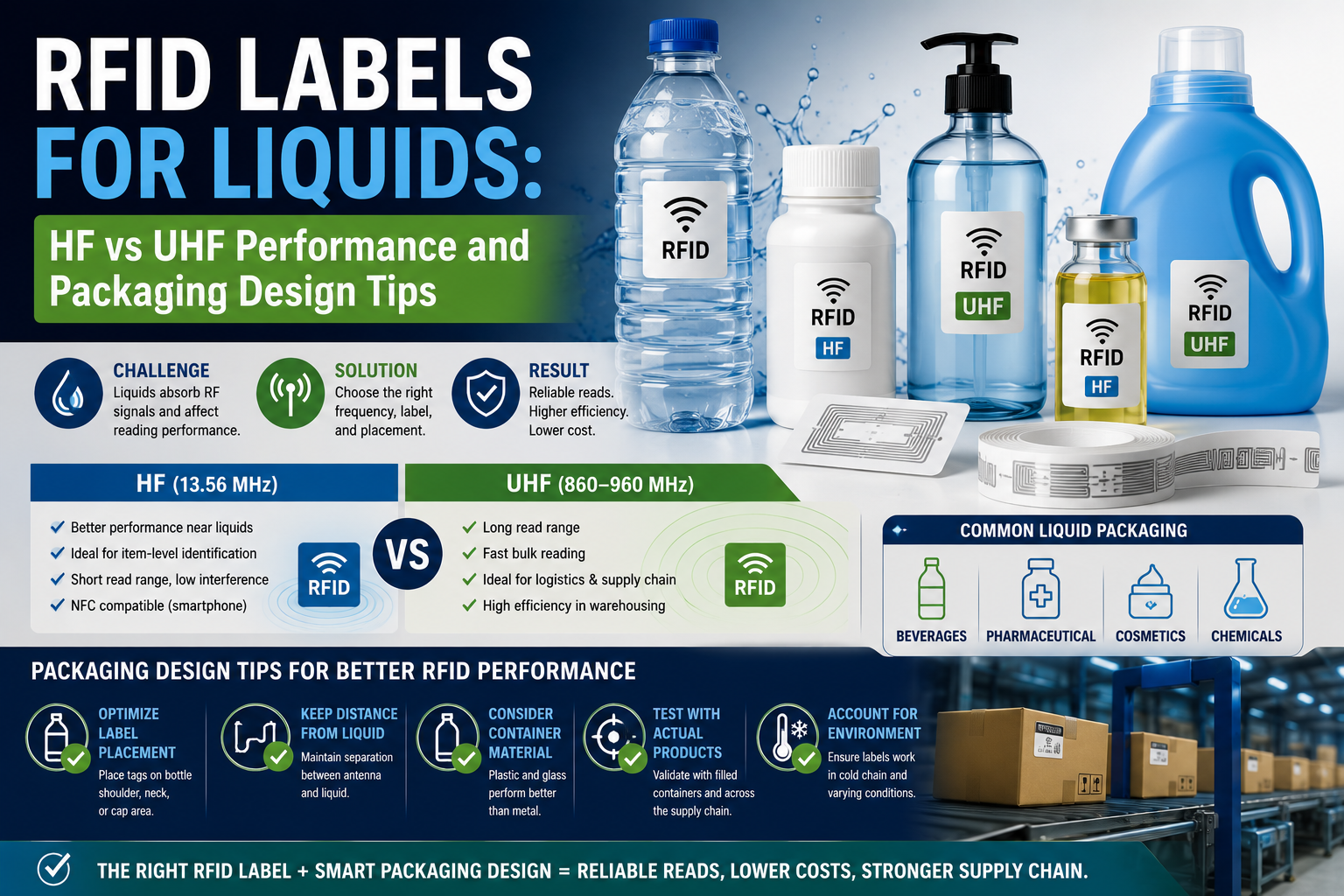
RFID has become an essential technology for inventory management, product authentication, and supply chain visibility. However, when products contain liquids, designing a reliable RFID solution becomes significantly more challenging.
Water-based liquids absorb radio frequency energy, while metal containers reflect it. Together, these characteristics can reduce reading distance, create inconsistent performance, and increase deployment costs if the wrong RFID technology is selected.
Fortunately, these challenges can be addressed through proper frequency selection, label placement, antenna design, and packaging optimization.
This guide explains how liquids affect RFID performance, compares HF and UHF RFID labels, and shares practical packaging design tips for manufacturers, packaging engineers, and RFID system integrators.
Why Liquids Affect RFID Performance
Unlike paper or plastic packaging, liquids interact directly with radio waves.
Most water-based products—including beverages, milk, pharmaceuticals, cosmetics, detergents, and chemicals—absorb RF energy to varying degrees.
This absorption can:
- Reduce reading distance
- Decrease read reliability
- Create blind spots
- Increase orientation sensitivity
- Cause inconsistent portal reading
The amount of interference depends on several factors:
- Liquid composition
- Water content
- Container material
- Container size
- Platzierung von Tags
- RFID-Frequenz
- Konfiguration des Lesers
For example, purified water generally creates stronger RF absorption than oils or alcohol-based liquids.
Understanding HF and UHF RFID
The two most common RFID technologies used in packaging are HF (High Frequency) and UHF (Ultra High Frequency).
Each has advantages depending on the application.
HF-RFID
HF RFID operates at 13,56 MHz.
Its shorter reading distance makes it less sensitive to water absorption than UHF.
Typical advantages include:
- Better performance near liquids
- More stable close-range reading
- NFC smartphone compatibility (for NFC-enabled tags)
- Reduced interference in densely packed products
Zu den üblichen Anwendungen gehören:
- Pharmazeutische Verpackungen
- Cosmetic products
- Medizinische Geräte
- Laboratory samples
- Echtheitsprüfung von Luxusgütern
HF systems are particularly suitable when products are scanned individually.
UHF-RFID
UHF RFID typically operates between 860 und 960 MHz, depending on regional regulations.
It offers:
- Größere Lesereichweite
- Schnelleres Auslesen von Bulkware
- High-speed warehouse automation
- Conveyor applications
- Distribution center operations
Typische Anwendungsbereiche sind:
- Palettenverfolgung
- Case-level logistics
- Einzelhandelsbestand
- Automatisierung des Lagers
- Transparenz in der Lieferkette
Although liquids present challenges for UHF, proper label design often allows excellent performance.
HF vs UHF for Liquid Packaging
| Faktor | HF-RFID | UHF-RFID |
|---|---|---|
| Betriebsfrequenz | 13,56 MHz | 860–960 MHz |
| Typical read distance | Kurz | Medium to long |
| Performance near liquids | Im Allgemeinen besser | More sensitive to liquid interference |
| Bulk Reading | Begrenzt | Ausgezeichnet |
| Smartphone-Kompatibilität | NFC-enabled versions | Nein |
| Automatisierung des Lagers | Begrenzt | Ausgezeichnet |
| Individual product authentication | Ausgezeichnet | Gut |
| Supply chain logistics | Gut | Ausgezeichnet |
Rather than asking which technology is better, manufacturers should ask which technology best matches the business process.
Liquid Type Matters
Not all liquids behave the same.
Wasser
Pure water absorbs UHF signals strongly and often requires careful tag placement.
Alcohol
Alcohol generally creates less RF absorption than water but still affects antenna performance.
Oils
Vegetable oils and petroleum-based liquids typically interfere less with RFID signals than water.
Milk
Milk contains significant water content and generally behaves similarly to water-based products.
Chemikalien
Chemical composition varies widely.
Some solvents have minimal RF impact, while others behave similarly to water.
Testing with actual products is always recommended.
Container Material Influences Performance
The packaging itself plays an equally important role.
Plastic Bottles
Plastic allows RF signals to pass relatively easily.
Most RFID liquid applications use plastic packaging.
Glass Bottles
Glass has minimal impact on RF transmission, making it suitable for RFID labels.
However, the liquid inside still affects performance.
Metal Containers
Metal creates the greatest challenge.
It reflects radio waves and can prevent standard RFID labels from functioning correctly.
Specialized on-metal or engineered label designs are often required.
Flexible Pouches
Liquid pouches continuously change shape as contents move.
This changing geometry can alter antenna performance during handling and transportation.
RFID Label Placement Best Practices
Label position often has a greater impact than tag selection.
Place Labels Away from the Liquid Center
Whenever possible, position labels where there is greater separation between the antenna and the liquid.
Beispiele hierfür sind:
- Bottle necks
- Caps
- Upper shoulder areas
Avoid Full Contact with Liquid
Some packaging designs intentionally create a small air gap between the RFID antenna and the liquid.
This can improve read consistency.
Maintain Consistent Orientation
Consistent label placement improves automated reading at warehouse portals.
Inconsistent orientation often reduces read rates.
Test Actual Packaging
Laboratory testing on empty containers rarely predicts real-world performance.
Always test:
- Filled products
- Production packaging
- Versandkartons
- Palletized loads
Antenna Design for Liquid Applications
RFID antenna design is often customized for liquid packaging.
Engineers may optimize:
- Antenna shape
- Antenna length
- Feed point
- Ground isolation
- Impedance matching
Purpose-built “liquid-friendly” RFID labels generally outperform standard labels applied to liquid containers.
Pharmaceutical Packaging Considerations
Pharmaceutical companies frequently use RFID for:
- Serialisierung von Produkten
- Fälschungsschutz
- Cold chain monitoring
- Hospital inventory
- Unit-level identification
Medicine bottles often contain liquids that require careful tag placement.
HF RFID is commonly selected for individual authentication and healthcare workflows, while UHF is frequently used for logistics and warehouse operations.
Some supply chains deploy both technologies simultaneously.
Beverage Industry Applications
The beverage industry presents several RFID challenges:
- High water content
- Dense pallet loading
- Refrigerated environments
- High-speed production
UHF RFID is widely used at:
- Fallebene
- Carton level
- Palettenebene
Individual bottle tagging is possible but requires optimized label design.
Cosmetic and Personal Care Products
Many cosmetic products contain gels, creams, lotions, or liquids.
RFID unterstützt:
- Brand authentication
- Inventarverwaltung
- Retail visibility
- Promotional engagement
HF/NFC labels are particularly popular because consumers can interact with products using smartphones.
Cold Chain Considerations
Liquid products frequently require refrigerated transportation.
Beispiele hierfür sind:
- Impfstoffe
- Biologika
- Fresh beverages
- Dairy products
- Specialty chemicals
Low temperatures generally affect adhesive performance more than RFID communication.
Manufacturers should verify that label constructions are rated for refrigerated or frozen environments.
Packaging Design Tips
Successful RFID deployment begins during package development.
Consider the following principles:
Reserve an RFID Zone
Allocate a dedicated label area during packaging design.
Keep Distance from Metal Closures
Metal caps or foil seals can affect antenna tuning.
Maintain adequate separation whenever possible.
Avoid Folding the Antenna
Bending or creasing RFID antennas may reduce performance.
Standardize Label Position
Consistent placement simplifies reader configuration and improves automation.
Validate Across the Entire Supply Chain
Testing should include:
- Herstellung
- Warehouse storage
- Transport
- Vertrieb
- Retail handling
Performance can change throughout the product lifecycle.
Common Mistakes
Many RFID liquid projects encounter avoidable problems.
Typical mistakes include:
- Testing only empty containers
- Ignoring pallet-level performance
- Selecting labels based solely on read distance
- Placing labels directly over high-liquid areas
- Using standard labels on metal containers
- Skipping environmental testing
A structured pilot project often identifies these issues before full deployment.
Häufig gestellte Fragen
Is HF always better than UHF for liquids?
No. HF generally performs better near liquids during close-range reading, while UHF remains the preferred choice for warehouse automation and long-range logistics. The right technology depends on the application.
Can UHF RFID work on water bottles?
Yes. Properly designed UHF labels, combined with optimized placement and reader configuration, can achieve reliable performance on many bottled products.
Can RFID labels be placed on bottle caps?
Yes. Bottle caps and upper shoulder areas are commonly used because they create greater separation between the antenna and the liquid.
Are glass bottles easier than metal containers?
Generally yes. Glass has little impact on RF transmission, whereas metal reflects radio waves and usually requires specialized RFID solutions.
Should packaging designers consider RFID early?
Absolutely. Integrating RFID requirements during package development often results in better performance, lower implementation costs, and fewer redesigns later.
Abschluss
Liquid products present unique challenges for RFID, but they do not prevent successful deployment.
Choosing between HF and UHF depends on the required reading distance, business workflow, packaging design, and supply chain objectives. HF offers stable close-range performance and is well suited to authentication and healthcare applications, while UHF provides the speed and scalability needed for warehouse automation and logistics.
By combining appropriate frequency selection, purpose-designed RFID labels, thoughtful package engineering, and real-world testing, manufacturers can achieve reliable identification of liquid products across industries ranging from pharmaceuticals and food to cosmetics and chemicals.
The most effective RFID solution is rarely defined by frequency alone. Success comes from optimizing the complete system—tag, packaging, reader infrastructure, and operational process—to match the characteristics of the product being tracked.


