Animal identification is becoming increasingly important in modern livestock management, veterinary services, breeding programs, and animal traceability systems.
With the development of RFID technology, traditional identification methods such as manual records and visual-only tags are gradually being replaced by electronic identification solutions. RFID animal tags provide unique identification numbers, faster data collection, and improved management efficiency.
Among the most commonly used animal RFID identification products are:
- Injectable glass RFID microchips
- RFID-Ohrmarken
- RFID rumen boluses
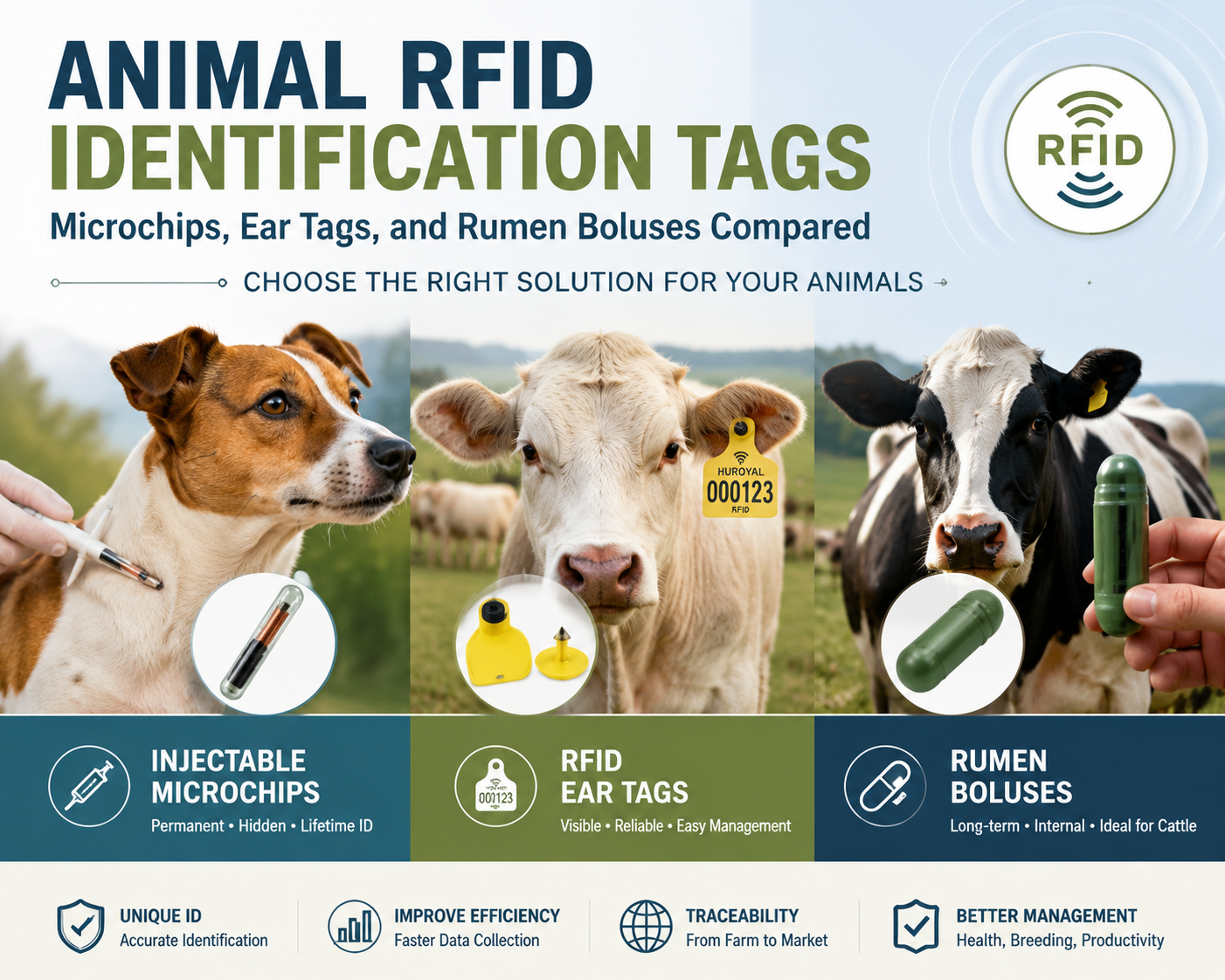
Although all three solutions use RFID technology to identify animals, they are designed for different applications. Their installation methods, reading performance, durability, and management advantages are different.
This article explains the differences between injectable RFID microchips, RFID ear tags, and RFID rumen boluses to help farms, veterinary organizations, distributors, and animal identification projects choose the right solution.
What Are the Three Main Types of Animal RFID Identification Tags?
Animal RFID identification products are mainly categorized according to where and how the RFID transponder is installed.
| Produkttyp | Installation Method | Main Application | Typical Animals |
|---|---|---|---|
| Injectable Glass RFID Microchip | Unter die Haut gespritzt | Permanent individual identification | Dogs, cats, small animals |
| RFID Ear Tag | Attached to animal ear | Livestock management and traceability | Cattle, sheep, goats, pigs |
| RFID Rumen Bolus | Administered orally into rumen | Long-term livestock identification | Cattle, buffalo, dairy animals |
The biggest difference between these solutions is the installation location.
Injectable microchips and rumen boluses provide hidden identification, while ear tags provide both electronic and visual identification.
Injectable Glass RFID Microchips
Injectable glass RFID microchips are small RFID transponders enclosed in a biocompatible glass tube.
They are implanted beneath the animal’s skin using a specialized injector.
Common sizes include:
- 1,25 × 7 mm
- 2,12 × 12 mm
- 2.12 × 13.3 mm
- 3 × 15 mm
Most animal injectable microchips operate at:
- 134.2 kHz LF RFID frequency
Professional animal RFID microchips usually comply with:
- ISO 11784
- ISO 11785
These standards ensure compatibility between RFID transponders and animal identification readers.
Structure of Injectable RFID Microchips
A typical glass tube animal RFID microchip contains:
- Biocompatible glass capsule
- RFID integrated circuit
- Kupferantennenspule
- Capacitor
- Protective sealing materials
The glass capsule protects the electronic components while allowing long-term implantation inside the animal.
Key Features of Injectable RFID Microchips
Permanent Animal Identification
Once implanted, the RFID microchip remains associated with the animal throughout its lifetime.
Compared with external tags, it has a much lower risk of being lost or removed.
Small and Safe Design
The compact size allows minimally invasive implantation.
The biocompatible glass material is designed to reduce irritation and improve long-term stability.
Accurate Individual Tracking
Each RFID microchip contains a unique identification number.
The ID can be retrieved using a compatible RFID reader.
Common Applications of Injectable RFID Microchips
Injectable animal microchips are mainly used for:
- Identifizierung von Haustieren
- Veterinary registration
- Animal recovery programs
- Laboratory animal tracking
- Breeding animal management
- Wildlife research
Advantages of Injectable RFID Microchips
- Dauerhafte Identifizierung
- Difficult to remove
- Invisible after implantation
- Lange Lebensdauer
- Suitable for individual animal management
Limitations of Injectable RFID Microchips
- Shorter reading distance compared with some external RFID tags
- Requires injection equipment
- Not ideal for large-scale livestock visual management
For large farms managing thousands of animals, RFID ear tags or rumen boluses are often more practical.
RFID-Ohrmarken
RFID ear tags are external animal identification devices attached to the animal’s ear.
They are one of the most widely used RFID solutions in livestock management.
A typical RFID ear tag includes:
- Plastic housing
- RFID-Transponder
- Printed identification information
- Attachment mechanism
Sie werden häufig verwendet für:
- Vieh
- Sheep
- Goats
- Schweine
Key Features of RFID Ear Tags
Electronic and Visual Identification
One of the biggest advantages of ear tags is that they provide both RFID identification and visible information.
The tag surface can include:
- Animal number
- Farm information
- Barcode
- QR-Code
- Logo
Farm workers can identify animals visually or electronically.
Suitable for Large Herd Management
RFID ear tags allow farmers to collect animal data quickly using handheld RFID readers.
Typische Anwendungsbereiche sind:
- Feeding records
- Zuchtmanagement
- Disease prevention
- Weight monitoring
- Livestock traceability
Flexible RFID Technology Options
RFID ear tags may use different frequencies depending on application requirements.
Common options include:
LF RFID Ear Tags
Häufigkeit:
134.2 kHz
Anwendungen:
- Identifizierung des Viehbestands
- Rückverfolgbarkeitsprogramme der Regierung
- Zuchtmanagement
UHF RFID Ear Tags
Häufigkeit:
860-960 MHz
Anwendungen:
- Größere Lesedistanz
- Automated livestock management
- Large-scale identification systems
Advantages of RFID Ear Tags
- Easy installation
- Visual identification available
- Suitable for large-scale farms
- Lower cost per animal
- Easy inventory management
Limitations of RFID Ear Tags
- Can be damaged
- May be lost during animal activity
- Visible and removable
For applications requiring the lowest possible loss rate, internal identification solutions may be preferred.
RFID Rumen Boluses
RFID rumen boluses are livestock identification devices designed to be swallowed by ruminant animals.
After administration, the bolus remains inside the animal’s rumen.
They are mainly used for:
- Vieh
- Dairy cows
- Buffalo
Structure of RFID Rumen Boluses
A typical RFID rumen bolus includes:
- High-density ceramic or polymer housing
- RFID-Transponder
- Protective structure
- Weight-balanced design
The design ensures the bolus remains inside the rumen and is not easily regurgitated.
Key Features of RFID Rumen Boluses
Long-Term Internal Identification
Because the RFID bolus remains inside the animal, it avoids many problems associated with external identification methods.
Low Risk of Loss
Compared with ear tags, rumen boluses have a significantly lower risk of accidental loss.
Suitable for Valuable Livestock
Sie werden häufig verwendet für:
- Dairy cattle management
- Züchtungsprogramme
- Food traceability
- Long-term livestock records
Advantages of RFID Rumen Boluses
- Internal identification
- Very low loss rate
- Lange Lebensdauer
- Suitable for cattle management
Limitations of RFID Rumen Boluses
- Larger size compared with injectable chips
- Requires professional administration
- Mainly suitable for large ruminants
Comparison of Three Animal RFID Identification Solutions
| Funktion | Injectable RFID Microchip | RFID Ear Tag | RFID Rumen Bolus |
|---|---|---|---|
| Installation | Injection | Ohrbefestigung | Oral administration |
| Identification type | Internal | External | Internal |
| Visibility | Invisible | Sichtbar | Invisible |
| Loss risk | Sehr niedrig | Mittel | Sehr niedrig |
| Typische Tiere | Pets, small animals | Rinder, Schafe, Ziegen | Cattle, buffalo |
| Leseabstand | Kurz | Mittel | Mittel |
| Hauptvorteil | Permanent ID | Visual + electronic management | Long-term internal tracking |
How to Choose the Right Animal RFID Identification Solution?
The best RFID solution depends on the animal species and management objectives.
For Pets and Companion Animals
Recommended:
Injectable RFID Microchips
Reasons:
- Dauerhafte Identifizierung
- International veterinary acceptance
- Cannot be easily removed
For Livestock Farms
Recommended:
RFID-Ohrmarken
Reasons:
- Easy herd management
- Visuelle Identifizierung
- Cost-effective deployment
For Dairy and Breeding Cattle
Recommended:
RFID Rumen Boluses
Reasons:
- Low loss rate
- Long-term tracking
- Suitable for valuable animals
For Government Animal Traceability Programs
The selection depends on:
- Local regulations
- Animal species
- Database requirements
- Reading equipment
Many national livestock identification programs combine RFID ear tags with other identification methods.
RFID Standards for Animal Identification
Professional animal RFID products usually follow international standards.
ISO 11784
Defines the structure of animal identification codes.
ISO 11785
Defines communication protocols between RFID readers and animal transponders.
Compliance with these standards allows RFID tags from different manufacturers to work with compatible readers.
Häufig gestellte Fragen
Are injectable RFID microchips and RFID ear tags the same?
No. Injectable microchips provide permanent hidden identification, while ear tags are designed for visible livestock management.
Which animal RFID tag has the lowest loss rate?
Injectable microchips and rumen boluses generally have lower loss rates because they are installed internally.
Can RFID ear tags be customized?
Yes. RFID ear tags can be customized with colors, printing, logos, identification numbers, and RFID programming options.
Are animal RFID microchips reusable?
No. Animal RFID microchips are normally programmed with a unique identification number and designed for permanent use.
Which RFID solution is best for cattle?
RFID ear tags and rumen boluses are both common choices for cattle. The best option depends on farm management requirements, regulations, and budget.
Abschluss
Injectable glass RFID microchips, RFID ear tags, and RFID rumen boluses are three important animal identification technologies with different advantages.
Injectable RFID microchips provide permanent identification for pets and individual animals. RFID ear tags are practical for large-scale livestock management because they combine electronic tracking with visual identification. RFID rumen boluses provide reliable long-term identification for cattle and dairy management.
Selecting the right RFID animal identification solution requires considering animal type, installation method, loss risk, management objectives, and regulatory requirements.
By choosing the appropriate RFID technology, farms, veterinary organizations, and animal management programs can improve traceability, increase operational efficiency, and build more reliable animal identification systems.