Access control systems have evolved significantly over the past two decades. What once relied on simple RFID credentials now demands stronger encryption, flexible credential management, and better protection against cloning and unauthorized access.
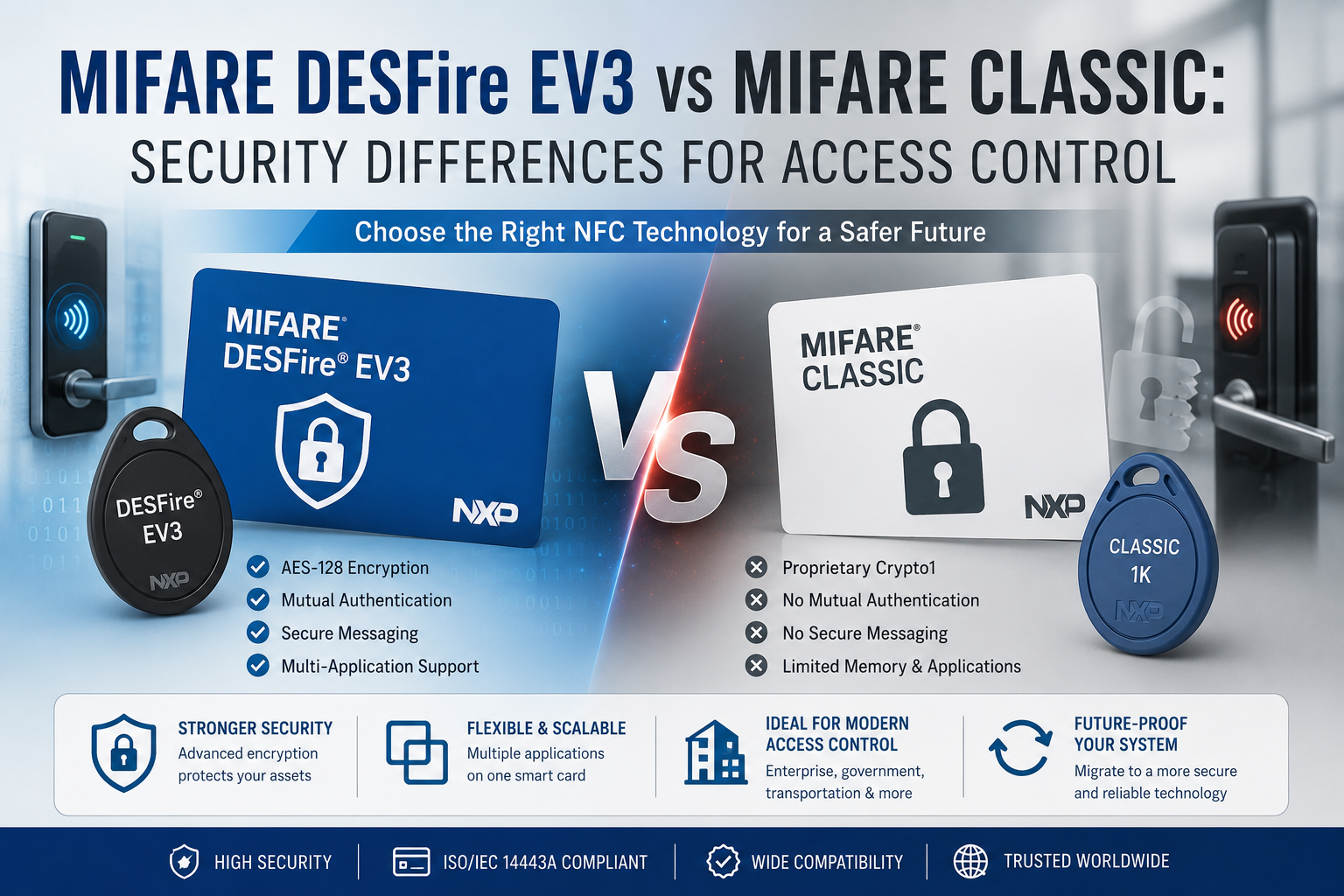
Among the most widely recognized contactless smart card technologies are MIFARE Clásico y MIFARE DESFire EV3. Although both operate at 13,56 MHz and are based on ISO/IEC 14443 standards, they are designed for very different security requirements.
MIFARE Classic has long been used in office buildings, schools, hotels, and transportation systems because of its affordability and broad ecosystem. However, advances in attack techniques have exposed weaknesses in its proprietary Crypto1 encryption, prompting many organizations to migrate to more secure technologies.
MIFARE DESFire EV3 represents the latest generation of secure contactless ICs from NXP, offering modern cryptography, mutual authentication, secure messaging, and multi-application support for demanding environments such as enterprise access control, public transportation, and government facilities.
This guide compares MIFARE DESFire EV3 and MIFARE Classic, explains their security differences, and provides practical guidance for selecting the right technology.
Understanding MIFARE Classic
MIFARE Classic was introduced in the 1990s and quickly became one of the world’s most widely deployed contactless smart card platforms.
Las aplicaciones típicas incluyen:
- Tarjetas de acceso a la oficina
- Employee identification
- Tarjetas llave de hotel
- School campuses
- Parking systems
- Tarjetas de afiliación
- Basic payment systems
The chip uses Crypto1, a proprietary stream cipher designed specifically for MIFARE Classic.
At the time of its introduction, this provided practical security for many commercial applications.
However, advances in cryptanalysis and the availability of inexpensive attack tools have significantly reduced its security for high-risk deployments.
Understanding MIFARE DESFire EV3
MIFARE DESFire EV3 is a modern secure smart card platform developed for applications requiring high levels of data protection and interoperability.
Unlike MIFARE Classic, DESFire EV3 supports internationally recognized cryptographic algorithms including:
- AES-128
- 3DES
- DES (for compatibility)
It also supports:
- Autenticación mutua
- Secure messaging
- Transaction protection
- Flexible file management
- Multiple independent applications
These capabilities make DESFire EV3 suitable for environments where credentials protect valuable assets or sensitive facilities.
Comparación de arquitecturas de seguridad
The most significant difference between the two technologies lies in their security architecture.
MIFARE Clásico
MIFARE Classic uses:
- Proprietary Crypto1 encryption
- Fixed memory sectors
- Sector keys
- Basic authentication
Although still functional in legacy systems, Crypto1 has been publicly analyzed and is no longer considered appropriate for applications requiring strong security.
MIFARE DESFire EV3
DESFire EV3 introduces multiple layers of security.
These include:
- Cifrado AES-128
- Autenticación mutua
- Secure communication sessions
- Encrypted data transfer
- Configurable access rights
- Anti-replay mechanisms
Instead of relying on proprietary cryptography, DESFire EV3 uses standardized algorithms that have undergone extensive security evaluation.
Encryption Differences
Encryption is one of the primary reasons organizations migrate from Classic to DESFire EV3.
MIFARE Clásico
Uses:
- Crypto1 proprietary cipher
Characteristics:
- Limited cryptographic strength
- Publicly documented attacks
- Vulnerable to cloning with readily available tools
MIFARE DESFire EV3
Supports:
- AES-128
- 3DES
- DES (legacy compatibility)
AES-128 is widely recognized as a modern encryption standard used in many government, enterprise, and financial applications.
Authentication Methods
Authentication determines whether a card and reader trust each other before exchanging information.
MIFARE Clásico
Authentication is sector-based.
The reader verifies the appropriate key before accessing each memory sector.
DESFire EV3
Authentication is significantly more sophisticated.
It supports:
- Autenticación mutua
- Session key generation
- Comunicación cifrada
- Secure command verification
This makes unauthorized credential duplication substantially more difficult.
Protection Against Card Cloning
Credential cloning is a major concern in physical access control.
MIFARE Clásico
Because Crypto1 has known weaknesses, unauthorized duplication has become possible using publicly available hardware and software in many scenarios.
Organizations protecting valuable facilities should carefully evaluate the risks associated with continued use.
MIFARE DESFire EV3
DESFire EV3 was specifically designed to resist modern cloning attacks.
Its stronger cryptography and authentication mechanisms significantly increase the difficulty of producing unauthorized credentials.
No security technology is immune to every attack, but DESFire EV3 offers substantially stronger protection than MIFARE Classic when deployed correctly.
Memory Structure
The two products also differ in how information is organized.
MIFARE Clásico
Memory is divided into fixed sectors.
Each sector contains blocks protected by keys.
This architecture works well for simple credential storage but offers limited flexibility.
DESFire EV3
Memory is organized using a file system.
Applications can create independent files with configurable access permissions.
This enables multiple services to coexist on the same card.
Por ejemplo:
- Building access
- Cafeteria payment
- Employee attendance
- Printing services
- Parking
can all operate securely using one credential.
Multi-Application Capability
One of DESFire EV3’s major advantages is application separation.
Different departments or service providers can manage independent applications without exposing each other’s data.
This makes DESFire EV3 particularly suitable for:
- Universities
- Hospitales
- Smart cities
- Transportation networks
- Enterprise campuses
MIFARE Classic provides only limited support for similar scenarios.
Typical Access Control Applications
MIFARE Clásico
Still commonly found in:
- Small office buildings
- Apartment complexes
- Sistemas heredados
- Basic employee identification
These deployments often remain in service because replacing readers and credentials requires investment.
MIFARE DESFire EV3
Increasingly selected for:
- Government facilities
- Airports
- Hospitales
- Financial institutions
- Enterprise headquarters
- Critical infrastructure
- High-security campuses
Organizations deploying new systems typically prioritize stronger long-term security.
Migration Considerations
Many organizations already have large installed bases of MIFARE Classic cards.
Migrating to DESFire EV3 requires planning.
Las consideraciones típicas incluyen:
- Compatibilidad con lectores
- Credential management software
- Card issuance process
- Backend integration
- User enrollment
- Security policies
Many modern readers support multiple technologies simultaneously, allowing gradual migration rather than immediate replacement.
MIFARE DESFire EV3 vs MIFARE Classic
| Característica | MIFARE Clásico | MIFARE DESFire EV3 |
|---|---|---|
| Frecuencia | 13,56 MHz | 13,56 MHz |
| Estándar | ISO/IEC 14443A | ISO/IEC 14443A |
| Cifrado | Crypto1 | AES-128, 3DES, DES |
| Autenticación mutua | No | Sí |
| Secure messaging | No | Sí |
| Soporte multiaplicación | Limitado | Sí |
| Cloning resistance | Baja | Much higher |
| Recommended for new secure systems | No | Sí |
Which Technology Should You Choose?
The answer depends on the security requirements of the project.
MIFARE Classic may still be acceptable for:
- Existing legacy installations
- Low-risk environments
- Budget-sensitive replacements
- Systems with limited security exposure
DESFire EV3 is generally the better choice for:
- New access control systems
- Enterprise campuses
- Proyectos gubernamentales
- Healthcare facilities
- Sistemas de transporte
- Critical infrastructure
- Multi-service smart cards
Organizations investing in new deployments should evaluate long-term security rather than focusing solely on initial card cost.
Preguntas frecuentes
Is MIFARE DESFire EV3 compatible with MIFARE Classic readers?
Not necessarily. Compatibility depends on the reader hardware and firmware. Many modern multi-technology readers support both card types, but legacy readers may require replacement.
Can MIFARE Classic still be used?
Yes. Many existing systems continue to operate successfully. However, organizations responsible for protecting sensitive facilities should carefully assess the security risks associated with older cryptographic technology.
Why is AES encryption important?
AES is an internationally recognized encryption standard that provides significantly stronger protection than proprietary legacy ciphers such as Crypto1.
Is DESFire EV3 more expensive?
Yes. DESFire EV3 cards generally cost more than MIFARE Classic cards because of their advanced security features and larger capabilities.
Should new access control systems choose DESFire EV3?
For most new projects requiring strong credential security, DESFire EV3 is the preferred option due to its modern cryptography, flexible application architecture, and enhanced resistance to cloning.
Best Practices for Secure Access Control
When deploying RFID-based access control systems:
- Select credentials with modern cryptography.
- Use secure key management procedures.
- Keep reader firmware updated.
- Protect backend credential databases.
- Regularly audit access permissions.
- Plan migration strategies for legacy technologies.
Security depends not only on the smart card itself but also on the complete access control ecosystem.
Conclusión
MIFARE Classic helped establish contactless smart card technology as a practical solution for access control and identification. However, evolving security requirements and advances in attack techniques have highlighted the limitations of its proprietary Crypto1 encryption.
MIFARE DESFire EV3 addresses these challenges with modern AES-based cryptography, mutual authentication, secure messaging, and flexible multi-application support. These capabilities make it well suited for organizations seeking stronger credential protection, improved lifecycle management, and future-ready access control systems.
For existing MIFARE Classic deployments, migration can often be planned in stages using compatible multi-technology readers. For new installations, DESFire EV3 provides a more secure foundation that aligns with today’s enterprise and infrastructure security expectations.