Product labels are evolving from simple identification tools into intelligent digital interfaces. Instead of carrying only a barcode or printed product information, many modern labels now combine multiple identification technologies on a single package.
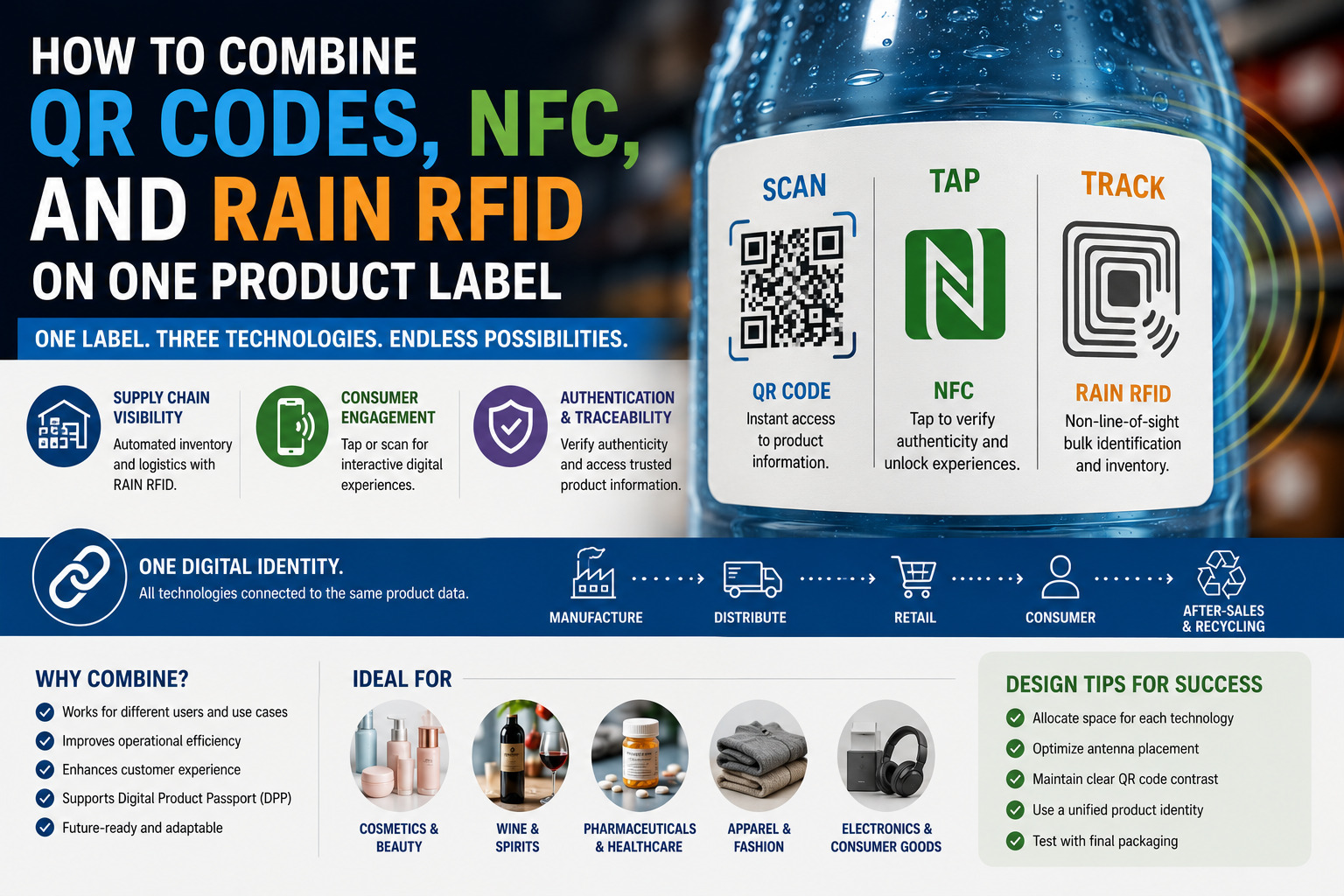
A hybrid smart label may include a QR code for smartphone scanning, an NFC tag for tap-to-connect experiences, and a RAIN RFID (UHF RFID) inlay for automated inventory and logistics. Each technology serves a different purpose, and together they create a connected product that supports the entire lifecycle—from manufacturing and distribution to retail, after-sales service, and recycling.
As initiatives such as GS1 Digital Link and Digital Product Passport (DPP) continue to gain momentum, manufacturers are increasingly evaluating how multiple data carriers can coexist on a single label rather than choosing only one. GS1’s guidance also recognizes that Digital Link can be delivered through QR codes, NFC, RFID, or a combination of these carriers depending on the business use case.
Why Combine Multiple Technologies?
No single identification technology is ideal for every scenario.
Warehouse operators require long-range, non-line-of-sight identification.
Consumers want instant access using their smartphones.
Brand owners need authentication, marketing, warranty registration, and product traceability.
Using only one technology often means compromising another business objective.
A hybrid label allows every stakeholder to interact with the same product in the most appropriate way.
Por ejemplo:
- Warehouse staff automatically identify products using RAIN RFID.
- Retail associates verify products with handheld RFID readers.
- Consumers scan a QR code or tap NFC with their smartphones.
- Service technicians retrieve maintenance records.
- Brand owners collect lifecycle data.
Instead of competing, the technologies complement one another.
The Role of Each Technology
Understanding the strengths of each technology helps determine how they should be combined.
Código QR
A QR code is a visual data carrier that can be scanned using nearly every smartphone camera.
Las aplicaciones típicas incluyen:
- Información sobre el producto
- Manuales de usuario
- Registro de la garantía
- Campañas de marketing
- Sustainability information
- Autenticación de productos
- Customer support
- Digital Product Passport access
Because QR codes require only printing, they remain the lowest-cost digital identification method.
Modern implementations increasingly use GS1 Digital Link, allowing a single QR code to connect different users to different information while maintaining one product identity.
NFC
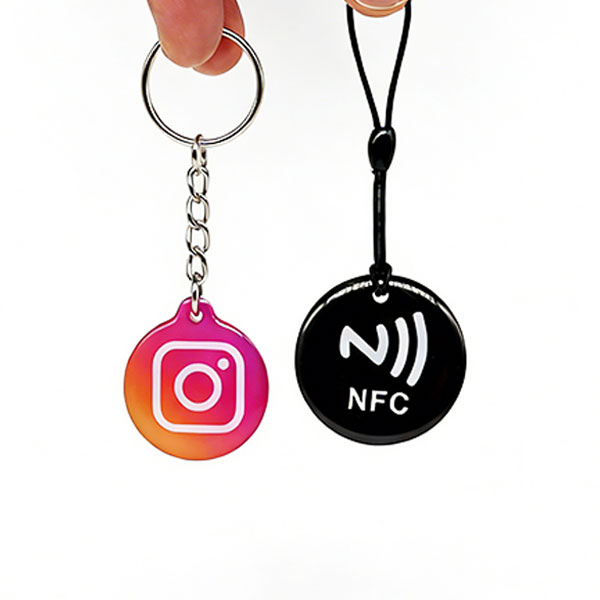
NFC operates at 13.56 MHz and enables close-range communication between the product and a smartphone.
Los usos típicos son:
- Premium product authentication
- Programas de fidelización
- Secure customer engagement
- Membership activation
- Digital certificates
- Interactive packaging
Unlike QR codes, NFC does not require camera alignment or adequate lighting. Users simply tap the package with a compatible phone.
NFC is particularly popular for cosmetics, luxury goods, wine, electronics, healthcare products, and premium consumer brands.
RAIN RFID
RAIN RFID uses passive UHF technology for long-range identification.
Unlike QR codes and NFC, it is designed primarily for operational efficiency rather than direct consumer interaction.
Las aplicaciones típicas incluyen:
- Manufacturing automation
- Inventario de almacén
- Centros de distribución
- Retail inventory accuracy
- Seguimiento de activos
- Case and pallet identification
- Tramitación de devoluciones
Multiple products can be read simultaneously without line of sight, making RAIN RFID the preferred choice for supply chain automation.
Why Not Replace One Technology with Another?
A common misconception is that one technology can replace all others.
In reality, each addresses different business requirements.
Por ejemplo:
A QR code cannot provide automatic bulk inventory reading.
RAIN RFID cannot easily deliver a consumer-friendly smartphone experience.
NFC is excellent for one-to-one interactions but is inefficient for reading hundreds of products on a pallet.
The most successful connected packaging projects use each technology where it creates the greatest value.
Typical Hybrid Label Architecture
A modern smart label often contains four independent components:
- Printed product graphics
- Código QR
- NFC antenna and chip
- RAIN RFID inlay
Although these elements coexist on one label, they may share the same digital identity within the backend system.
This means different scanning methods access different interfaces while referring to the same serialized product record.
One Product Identity Across Multiple Technologies
The key to a successful hybrid label is not placing several technologies on one package. It is ensuring they all represent the same product identity.
For example, one serialized item can be identified by:
- Código QR
- NFC UID
- EPC stored in the RAIN RFID chip
The backend system links these identifiers to one digital record.
This approach avoids inconsistent data and simplifies lifecycle management.
GS1 Digital Link is increasingly used as a common framework because it allows multiple data carriers—including QR codes, NFC, and RAIN RFID—to reference the same web-based product identity.
Design Considerations for Hybrid Labels
Adding multiple technologies to one label requires careful engineering.
Available Label Size
Every technology occupies physical space.
Designers must allocate room for:
- Código QR
- NFC antenna
- UHF antenna
- Human-readable information
- Marca
- Regulatory markings
Small cosmetic packaging may require compact antenna designs or custom layouts.
RF Interference
Although NFC and RAIN RFID operate on different frequencies, antenna placement still matters.
Poor layout can reduce reading performance.
Label designers should verify:
- Antenna spacing
- Interferencias metálicas
- Liquid effects
- Packaging material
- Folding areas
RF testing should always be performed using production packaging.
Printing Requirements
QR codes require sufficient contrast and print quality.
If variable serialization is used, printing systems must synchronize:
- QR content
- Codificación NFC
- RFID EPC encoding
Automated verification should confirm that all identifiers belong to the same product.
Choosing the Right Data Strategy
Successful hybrid labels rely on a unified data architecture.
Rather than creating separate databases for each technology, organizations should maintain one product identity that different carriers can access.
Typical data layers include:
- GTIN
- Serialized item number
- Production batch
- Manufacturing date
- Warranty status
- Authentication records
- Lifecycle history
This simplifies system integration across manufacturing, logistics, retail, and customer service.
Industry Applications
Productos de lujo
Luxury brands often combine:
- NFC for authentication
- QR codes for storytelling
- RAIN RFID for inventory accuracy
This supports anti-counterfeiting while improving retail operations.
Ropa
Fashion retailers increasingly deploy RAIN RFID for inventory management while using QR codes to deliver care instructions, sustainability information, and Digital Product Passport data.
Some premium collections also add NFC for authentication.
Electrónica de consumo
Electronic products may use:
- RFID for warehouse automation
- NFC for device pairing
- QR codes for setup instructions
The result is a seamless experience from factory to end user.
Wine and Spirits
Premium beverage brands frequently combine:
- NFC authentication
- QR marketing experiences
- RFID logistics tracking
This helps combat counterfeiting while supporting global distribution.
Productos farmacéuticos
Healthcare manufacturers may use:
- QR codes for serialization and patient information
- NFC for authentication
- RFID for hospital inventory and cold-chain logistics
Each technology serves different stakeholders throughout the supply chain.
Digital Product Passport and Future Regulations
Global regulations are accelerating the adoption of connected product labels.
Within Europe, Digital Product Passport initiatives encourage manufacturers to provide digital product information throughout the product lifecycle.
Rather than requiring a single technology, industry standards increasingly focus on maintaining one digital identity that can be accessed through different carriers depending on the user and the application. GS1 has identified QR codes with Digital Link as a primary consumer-facing carrier while also supporting NFC and RAIN RFID for additional supply-chain and lifecycle use cases.
Common Design Mistakes
Many first-generation smart labels encounter avoidable issues.
Typical mistakes include:
- Encoding different identifiers into QR, NFC, and RFID
- Ignoring RF interference during layout
- Choosing label size before antenna design
- Skipping production-line verification
- Treating marketing and logistics as separate systems
- Testing only laboratory samples rather than finished products
Successful deployments validate the complete label after printing, encoding, packaging, and shipping.
Preguntas frecuentes
Can one label contain QR, NFC, and RAIN RFID together?
Yes. Many connected packaging solutions integrate all three technologies into a single label, with each serving different operational and customer-facing purposes.
Do QR, NFC, and RFID need different product numbers?
Not necessarily. Most enterprise implementations map all three technologies to the same serialized product identity in the backend system.
Does adding multiple technologies increase label cost?
Yes, but the additional investment often delivers value through improved inventory visibility, customer engagement, authentication, and after-sales services. The appropriate combination depends on product value and business objectives.
Which technology should consumers use?
Consumers typically interact with QR codes or NFC because smartphones support them directly. RAIN RFID is generally intended for manufacturers, warehouses, logistics providers, and retailers.
Is a hybrid label suitable for every product?
Not always. Low-cost, high-volume consumer goods may only require QR codes, while premium products, regulated industries, and enterprise supply chains often benefit from combining multiple technologies.
Buenas prácticas
When planning a hybrid smart label:
- Define the business objective for each technology.
- Maintain a single serialized product identity.
- Design the label and antenna layout together.
- Validate RF performance on the final packaged product.
- Synchronize printing and chip encoding.
- Test throughout manufacturing, logistics, retail, and consumer use.
A well-designed hybrid label should improve operations without making the user experience more complicated.
Conclusión
The future of product labeling is not about choosing between QR codes, NFC, or RAIN RFID. It is about combining their strengths within a unified digital identity.
QR codes provide universal smartphone access, NFC delivers secure and intuitive consumer interaction, and RAIN RFID enables high-speed automation across manufacturing, logistics, and retail. Together, they create a connected product that supports traceability, authentication, customer engagement, and regulatory compliance throughout the entire product lifecycle.
As connected packaging, GS1 Digital Link, and Digital Product Passport initiatives continue to expand, hybrid labels will become an increasingly practical solution for brands seeking to bridge physical products with digital services while maintaining efficient supply chain operations.