RFID technology has become an essential identification solution in industries such as manufacturing, logistics, healthcare, automotive, retail, and asset management. However, when RFID tags are applied to metal surfaces or liquid-filled objects, standard RFID labels may experience reduced reading distance, unstable communication, or complete reading failure.
Metal and liquid are two of the most challenging application environments for RFID systems because they directly affect electromagnetic wave transmission and antenna performance.
To achieve reliable RFID identification in these environments, manufacturers need to optimize tag structures through special antenna designs, shielding materials, spacing layers, and protective housings.
This article explains how metal and liquid interfere with RFID performance and introduces practical anti-interference RFID tag design solutions for industrial applications.
Why Do Metal and Liquid Affect RFID Performance?
An RFID system communicates through electromagnetic signals between the RFID reader and RFID tag.
A typical RFID system includes:
- Lector RFID
- Antena RFID
- etiqueta RFID
- Data management software
The RFID reader sends electromagnetic energy to activate the RFID tag. The tag antenna receives this energy and communicates stored information back to the reader.
However, the surrounding environment can affect the electromagnetic field and change RFID performance.
The most common interference sources include:
- Superficies metálicas
- Liquids
- High-density materials
- Industrial environments with electromagnetic noise
These factors may influence:
- Antenna resonance frequency
- Signal strength
- Distancia de lectura
- Communication stability
How Metal Interferes With RFID Tags
Metal is one of the biggest challenges for RFID applications because conductive materials can interfere with antenna operation.
Standard RFID labels are usually designed for non-metal surfaces such as cardboard, plastic, and wood. When directly attached to metal, their performance can decrease significantly.
RFID Signal Reflection and Antenna Detuning
When an RFID tag is placed on a metal surface, the metal reflects electromagnetic waves generated by the RFID reader.
This reflection changes the electromagnetic environment around the antenna and causes antenna detuning.
Antenna detuning means the RFID tag antenna no longer operates at its designed frequency.
El resultado puede incluir:
- Shorter reading distance
- Unstable communication
- Reduced identification accuracy
- Complete tag failure
Reduced Reading Distance on Metal Surfaces
A standard UHF RFID label may achieve several meters of reading distance under ideal conditions.
However, when attached directly to metal:
- The antenna performance decreases
- The RFID chip receives less energy
- The communication range becomes unstable
Therefore, standard RFID labels are not recommended for:
- Steel equipment
- Contenedores metálicos
- Maquinaria industrial
- Componentes de automoción
Why Standard RFID Labels Fail on Metal
A normal RFID label usually contains:
- Paper or PET surface material
- Incrustación RFID
- Aluminum antenna
- Capa adhesiva
When placed directly on metal, the metal surface affects antenna performance and prevents stable RFID communication.
For metal applications, specially designed anti-metal RFID tags are required.
Anti-Metal RFID Tag Design Solutions
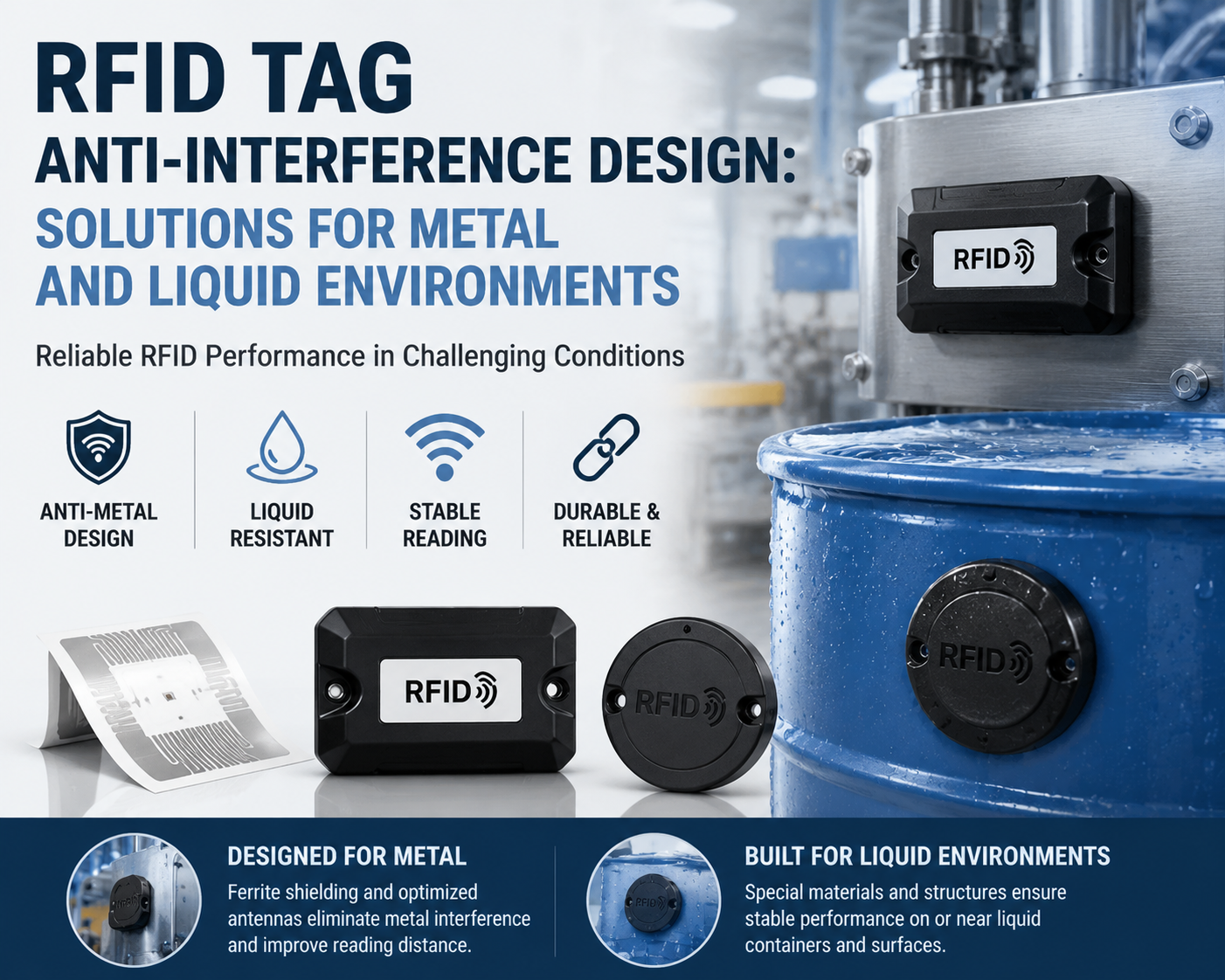
Anti-metal RFID tags are designed to maintain stable RFID performance when attached to conductive surfaces.
The main design technologies include:
- Capas de blindaje de ferrita
- Special antenna structures
- Protective housings
- Air gap optimization
Ferrite Layer Shielding Technology
Ferrite material is one of the most common solutions used in anti-metal RFID tags.
The ferrite layer creates separation between the RFID antenna and the metal surface.
Its main functions include:
- Reducing electromagnetic interference
- Preventing antenna detuning
- Improving signal stability
- Increasing reading reliability
Ferrite-backed RFID tags are widely used for:
- Industrial equipment tracking
- Metal container identification
- Gestión de herramientas
- Factory asset tracking
Special Antenna Design for Metal Applications
RFID tags used on metal require specially tuned antenna designs.
Compared with standard RFID labels, anti-metal RFID tags may use:
- Optimized antenna dimensions
- Special impedance matching designs
- Customized UHF antenna structures
The antenna design must consider:
- Frecuencia de funcionamiento
- Tag size
- Metal surface characteristics
- Required reading distance
Rigid Housing Protection Design
For harsh industrial environments, RFID tags are often protected with rigid housings.
Common housing materials include:
- ABS plastic
- Polycarbonate (PC)
- Engineering plastics
Las ventajas incluyen:
- Resistencia a los impactos
- Protección impermeable
- Resistencia química
- Larga vida útil
Air Gap Structure Optimization
Some anti-metal RFID tags use an air gap structure to improve electromagnetic performance.
By creating physical distance between the RFID antenna and the metal surface, the electromagnetic interference can be reduced.
The advantages of air gap structures include:
- Improved signal transmission
- Mayor distancia de lectura
- More stable RFID communication
- Better performance on different metal surfaces
Air gap designs are commonly used in:
- Seguimiento de activos industriales
- Warehouse equipment management
- Vehicle identification
- Outdoor metal asset management
RFID Tags for Liquid Environments
Liquid environments create another major challenge for RFID applications.
RFID tags are widely used on liquid containers, including:
- Beverage bottles
- Chemical containers
- Envases farmacéuticos
- Oil drums
- Laboratory sample containers
However, liquids can absorb and affect electromagnetic energy, especially in UHF RFID applications.
Why Liquid Affects RFID Signals
Different materials interact differently with RFID electromagnetic waves.
Water-based liquids have high dielectric properties, which can absorb RF energy and change antenna performance.
When a standard RFID tag is attached to a liquid container, possible problems include:
- Distancia de lectura reducida
- Lower signal strength
- Unstable communication
- Failed tag identification
Frequency Selection for Liquid Applications
Choosing the correct RFID frequency is important for liquid applications.
LF RFID Tags
Frecuencia:
134,2 kHz
Ventajas:
- Good penetration capability
- Less affected by water
- Stable performance in challenging environments
Aplicaciones típicas:
- Identificación de animales
- Seguimiento industrial
- Special identification systems
HF RFID Tags
Frecuencia:
13,56 MHz
Ventajas:
- Better performance near liquids
- Widely supported technology
- Suitable for short-range identification
Aplicaciones típicas:
- Pharmaceutical products
- Envases inteligentes
- NFC applications
- Healthcare management
Etiquetas RFID UHF
Frecuencia:
860-960 MHz
Ventajas:
- Larga distancia de lectura
- Escaneado rápido de inventarios
- Suitable for supply chain applications
However, UHF RFID tags require special antenna designs when applied to liquid containers.
Aplicaciones típicas:
- Liquid container tracking
- Gestión de inventarios de almacén
- Visibilidad de la cadena de suministro
Material Selection for Anti-Interference RFID Tags
The material structure of an RFID tag directly affects its durability, protection level, and reliability in harsh environments.
PET RFID Tags
PET is commonly used as a durable RFID label surface material.
Las ventajas incluyen:
- Buena resistencia química
- Excellent mechanical strength
- Resistencia a altas temperaturas
- Good printing performance
PET RFID tags are suitable for:
- Identificación de equipos industriales
- Gestión de activos
- Long-term tracking applications
ABS Industrial RFID Tags
ABS is widely used for rugged RFID tags requiring strong mechanical protection.
Las ventajas incluyen:
- Resistencia a los impactos
- Protección impermeable
- Resistencia a la intemperie
- Strong structural protection
ABS RFID tags are commonly used for:
- Seguimiento de maquinaria pesada
- Vehicle identification
- Herramientas industriales
- Instalaciones al aire libre
Flexible Anti-Metal RFID Labels
Flexible anti-metal RFID labels combine a flexible structure with shielding materials.
They are designed for applications requiring low-profile installation.
Las ventajas incluyen:
- Easy installation
- Suitable for curved surfaces
- Lightweight structure
- Flexible application options
Las aplicaciones típicas incluyen:
- Metal pipes
- Cilindros
- Equipos electrónicos
- Herramientas industriales
Standard RFID Tags vs Anti-Metal RFID Tags
| Característica | Standard RFID Tags | Etiquetas RFID antimetal |
|---|---|---|
| Suitable surface | Plastic, cardboard, wood | Superficies metálicas |
| Diseño de antenas | Standard antenna | Optimized antenna structure |
| Shielding layer | No shielding | Ferrite or special shielding materials |
| Performance on metal | Pobre | Excelente |
| Durabilidad | Medio | Alto |
| Industrial applications | Limitado | Highly recommended |
How to Choose the Right RFID Tag for Metal and Liquid Applications?
Selecting the correct RFID tag depends on the application environment, target material, required reading distance, and expected service life.
Metal Equipment Tracking
Recommended RFID solutions:
- Etiquetas RFID antimetal
- ABS industrial RFID tags
- UHF RFID asset tags
Aplicaciones típicas:
- Factory equipment
- Production machines
- Armarios eléctricos
- Herramientas industriales
Liquid Container Identification
Recommended RFID solutions:
- Liquid-compatible RFID tags
- Optimized UHF RFID tags
- Etiquetas HF RFID
Aplicaciones típicas:
- Chemical containers
- Beverage packaging
- Seguimiento farmacéutico
- Laboratory samples
Industrial Asset Management
Industrial asset management requires RFID tags that can maintain stable performance in harsh working environments.
The RFID tag should provide:
- Larga vida útil
- Mechanical protection
- Resistencia al agua
- Resistencia química
- Reliable reading performance
Common tracked assets include:
- Manufacturing equipment
- Herramientas
- Vehicles
- Artículos de transporte retornables
- Industrial containers
Healthcare and Laboratory Applications
Healthcare and laboratory environments require RFID tags with high reliability and material compatibility.
Algunas consideraciones importantes son:
- Small tag size
- Resistencia química
- Sterilization requirements
- Reliable identification accuracy
Las aplicaciones típicas incluyen:
- Medical equipment tracking
- Laboratory sample management
- Pharmaceutical inventory control
- Healthcare asset management
RFID Tag Testing Methods for Harsh Environments
Before mass production, RFID tags designed for metal and liquid environments should be tested under real application conditions.
Proper testing ensures stable performance and reduces application risks.
Reading Distance Testing
Reading distance is one of the most important performance indicators for RFID tags.
Testing should evaluate:
- Maximum reading distance
- Different reader power settings
- Different installation positions
- Multiple tag orientations
Environmental Reliability Testing
Industrial RFID tags often need to withstand harsh environments.
Common reliability tests include:
- Pruebas de estanqueidad
- Pruebas de resistencia a la temperatura
- Chemical resistance testing
- Impact resistance testing
- Long-term aging testing
Multi-Angle Reading Performance Testing
In real applications, RFID tags may not always face the reader directly.
Testing should evaluate RFID performance under different conditions:
- Different tag angles
- Different reader positions
- Multiple tag environments
- Different installation distances
Frequently Asked Questions About Anti-Interference RFID Tags
Can RFID tags work on metal surfaces?
Yes. However, standard RFID labels usually cannot perform well on metal surfaces. Anti-metal RFID tags use special structures such as ferrite layers, shielding materials, and optimized antennas to maintain reliable communication on metal objects.
Why does water reduce RFID reading distance?
Water and other liquids can absorb electromagnetic energy and change antenna characteristics. This effect is especially significant for UHF RFID tags operating at 860-960 MHz frequencies.
What is the best RFID tag for metal assets?
For metal assets, anti-metal RFID tags with ferrite shielding, optimized antenna designs, or rugged ABS housings are usually the best choice.
The final selection depends on:
- Required reading distance
- Entorno de instalación
- Temperatura de funcionamiento
- Vida útil prevista
Can UHF RFID tags be used on liquid containers?
Yes. UHF RFID tags can be used on liquid containers when they are specially designed for liquid environments.
Solutions may include:
- Customized antenna designs
- Optimized tag structures
- Special installation methods
What is the difference between RFID labels and anti-metal RFID tags?
RFID labels are mainly designed for non-metal surfaces such as cardboard, plastic, and wood.
Anti-metal RFID tags include additional shielding structures and optimized designs that allow stable operation on metal surfaces.
Do all RFID tags require special designs for harsh environments?
No. Standard RFID labels are suitable for general applications such as retail products, logistics packaging, and warehouse cartons.
Special anti-interference RFID designs are mainly required for:
- Metal assets
- Liquid containers
- Outdoor equipment
- Industrial environments
Conclusión
Metal and liquid environments create significant challenges for RFID tag performance. Standard RFID labels may experience reduced reading distance or communication failure when applied to these materials.
Anti-metal RFID tags solve metal interference problems through ferrite shielding, optimized antenna structures, spacing designs, and protective housings.
For liquid applications, selecting the correct RFID frequency and designing suitable antenna structures are essential for reliable identification.
Choosing the right RFID tag requires evaluating:
- Target material
- Entorno operativo
- Required reading distance
- Installation conditions
- Vida útil prevista
With proper anti-interference design, RFID technology can provide reliable identification solutions for industrial assets, manufacturing equipment, healthcare systems, logistics operations, and complex supply chains.