


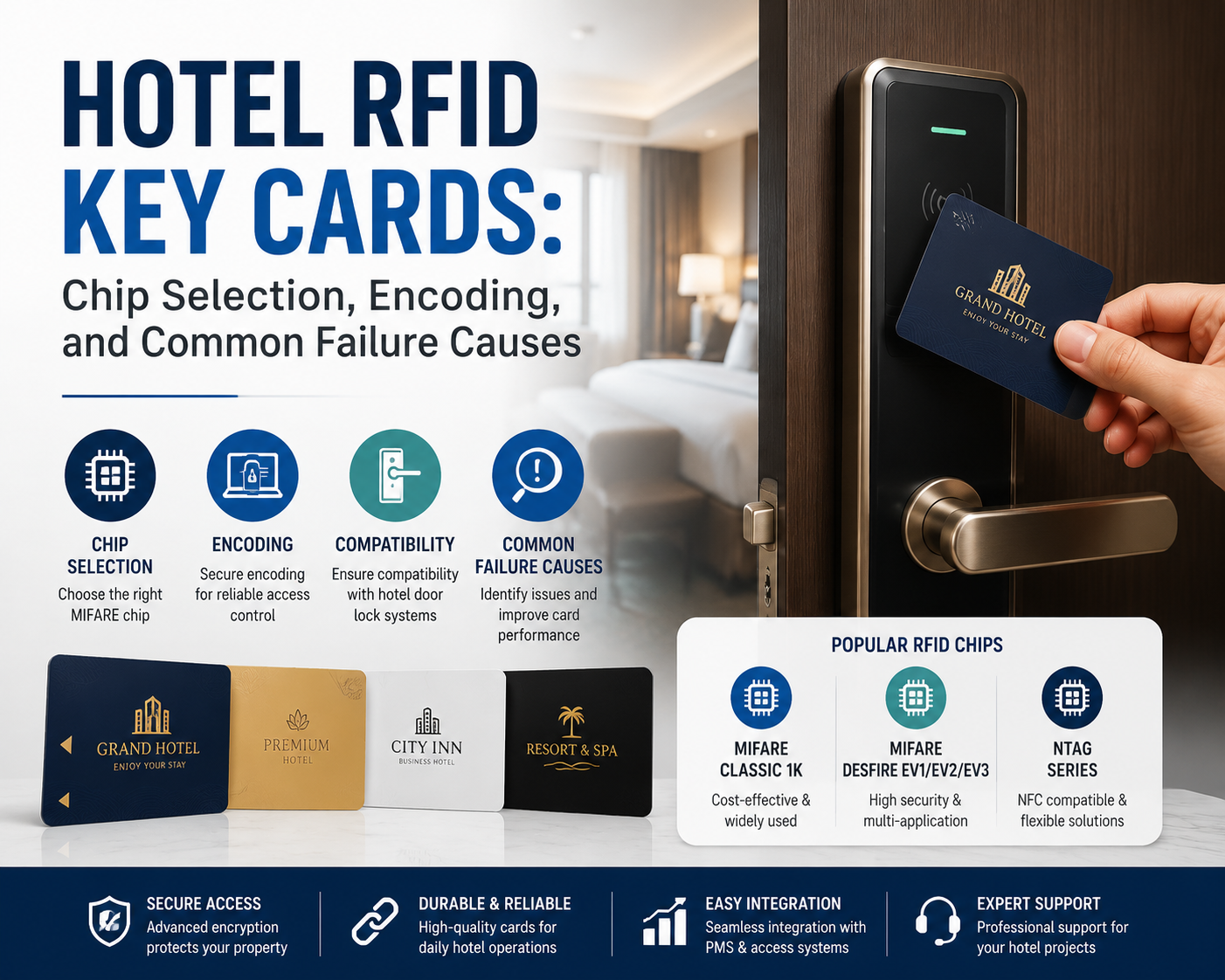
Hotel key cards are one of the most visible applications of RFID technology in the hospitality industry. From boutique hotels to international hotel chains, RFID key cards have replaced traditional magnetic stripe cards because they provide better durability, faster access, and improved security management.
However, not all RFID hotel key cards are the same. The selected RFID chip, card encoding method, compatibility with door lock systems, and manufacturing quality all affect the reliability of a hotel access control system.
When hotels experience problems such as cards not opening doors, inconsistent reading, or frequent card replacement, the cause is often related to incorrect chip selection, improper encoding, or system compatibility issues.
This guide explains how hotel RFID key cards work, how to select the right RFID chip, how encoding is performed, and the most common reasons why hotel cards fail.
What Are Hotel RFID Key Cards?
Hotel RFID key cards are contactless smart cards used to provide guests with secure access to hotel rooms and other facilities.
Unlike traditional magnetic stripe cards, RFID cards communicate wirelessly with electronic door locks through radio frequency technology.
A typical hotel RFID key card consists of:
- PVC or PET card body
- RFID integrated circuit (IC)
- Bobina de antena
- Printed surface design
- Protective overlay
When a guest checks in, the hotel management system writes access information to the RFID card. The guest then presents the card near the door lock reader, which verifies the stored information and grants access.
How Do Hotel RFID Key Cards Work?
The complete access process includes several steps.
1. Guest Check-In
The front desk system assigns:
- Número de habitación
- Check-in time
- Checkout time
- Permisos de acceso
2. Card Encoding
The encoder writes encrypted access data to the RFID card.
3. Door Lock Verification
Cuando el invitado toca la tarjeta:
- The reader detects the RFID signal
- The lock verifies authentication data
- The door opens if the information is valid
4. Access Record Management
Many hotel systems record:
- Opening time
- Failed attempts
- Card activity history
This helps hotels manage security and troubleshoot problems.
Common RFID Chips Used for Hotel Key Cards
The RFID chip is the most important component of a hotel key card.
The correct choice depends on:
- Door lock system compatibility
- Requisitos de seguridad
- Memory requirements
- Hotel management platform
Common RFID chips include:
MIFARE Classic 1K
MIFARE Classic 1K has been widely used in hotels because of its low cost and broad compatibility.
Características:
- 13.56 MHz frequency
- 1 KB memory
- ISO/IEC 14443A compatibility
- Widely supported by many hotel lock systems
Ventajas:
- Affordable
- Mature ecosystem
- Easy card availability
Limitaciones:
- Uses Crypto1 security technology
- Not recommended for high-security new deployments
It is still commonly found in existing hotel installations.
MIFARE Classic 4K
MIFARE Classic 4K provides larger memory capacity.
Compared with Classic 1K:
- More memory sectors
- Suitable for applications requiring additional data storage
However, it shares similar security limitations.
MIFARE DESFire EV1 / EV2 / EV3
MIFARE DESFire products are designed for applications requiring stronger security.
Features include:
- Cifrado AES
- Autenticación mutua
- Secure messaging
- Soporte multiaplicación
Ventajas:
- Higher security level
- Better protection against cloning
- Suitable for premium hotels and enterprise applications
Aplicaciones típicas:
- Hoteles de lujo
- Resort properties
- Integrated access systems
NTAG and NFC Cards
Some hotels use NFC-compatible cards for mobile interaction or smart services.
Las aplicaciones incluyen:
- Mobile check-in
- Digital guest services
- Marketing interaction
However, compatibility with existing hotel door lock systems must be confirmed before deployment.
How to Choose the Right Hotel RFID Card Chip?
Selecting a chip should not be based only on price.
Hotels should evaluate the following factors.
1. Door Lock System Compatibility
The first question should always be:
“Which RFID chip does the existing door lock system support?”
Different manufacturers may support different chip technologies.
Before ordering cards, confirm:
- Lock brand
- Reader model
- Encoder compatibility
- Plataforma de software
A technically advanced card cannot work if it is incompatible with the hotel system.
2. Requisitos de seguridad
Different hotels have different security needs.
Por ejemplo:
| Hotel Type | Tecnología recomendada |
|---|---|
| Budget hotel | MIFARE Classic (existing systems) |
| Business hotel | MIFARE Classic / DESFire depending on system |
| Luxury hotel | MIFARE DESFire EV2/EV3 |
| Integrated smart campus | DESFire EV3 |
New projects should generally consider modern secure technologies.
3. Memory Requirements
Most hotel room access only requires limited data storage.
However, larger systems may require additional functions:
- Restaurant payment
- Acceso al aparcamiento
- Gym membership
- Employee access
Multi-application cards may require DESFire technology.
Hotel RFID Key Card Encoding Process
Encoding is the process of writing access information into the RFID card.
The typical workflow includes:
Step 1: Card Initialization
The blank RFID card is recognized by the encoder.
Step 2: Data Writing
The system writes:
- Room information
- Valid time period
- Permisos de acceso
Step 3: Encryption and Authentication
Security keys protect the card data.
Paso 4: Verificación
The encoded card is tested before being issued.
Professional systems usually include automatic verification to reduce card errors.
Common Causes of Hotel RFID Key Card Failure
Although RFID cards are highly reliable, failures can occur.
The most common causes include:
1. Wrong RFID Chip Selection
This is one of the most frequent problems.
Ejemplo:
A hotel orders MIFARE Classic cards, but their locks require another RFID technology.
Resultado:
- Card cannot be read
- Door does not open
- Encoder cannot write data
Solución:
Always confirm compatibility before purchasing.
2. Incorrect Card Encoding
Encoding errors may occur because of:
- Incorrect software settings
- Wrong encryption keys
- Incorrect access permissions
- Encoder malfunction
Solución:
Check the complete card issuance process.
3. Damaged RFID Antenna
RFID cards rely on an internal antenna coil.
Physical damage can occur from:
- Excessive bending
- Cutting
- High pressure
- Poor manufacturing quality
Symptoms:
- Card cannot be detected
- Reader shows no response
Solución:
Use quality cards from reliable manufacturers.
4. Card and Door Lock System Mismatch
Even if the RFID frequency is the same, compatibility is not guaranteed.
Factors include:
- Tipo de chip
- Encryption method
- Key management system
- Software hotelero
5. Demagnetization Misunderstanding
Unlike magnetic stripe cards, RFID cards are not affected by normal magnetic fields.
However, guests may still experience failures caused by:
- Daños físicos
- Expired authorization
- Incorrect encoding
6. Poor Card Manufacturing Quality
Low-quality cards may have:
- Weak antenna connection
- Poor lamination
- Incorrect chip placement
- Unstable performance
Hotel environments require thousands of daily card operations, so manufacturing consistency is important.
Hotel RFID Card Customization Options
Hotels commonly customize cards with:
Printing Design
Including:
- Hotel logo
- Brand colors
- Room instructions
- Promotional messages
Material de la tarjeta
Options:
- Standard PVC
- Materiales ecológicos
- PET cards
- Wooden RFID cards
Chip Selection
Las opciones incluyen:
- MIFARE Clásico
- MIFARE DESFire
- Chips NFC
Additional Functions
Cards can also support:
- Códigos QR
- Impresión de códigos de barras
- Signature panels
- Custom numbering
Hotel RFID Key Card Quality Checklist
Before purchasing, hotels should confirm:
Technical Information
- RFID chip model
- Frecuencia
- Capacidad de memoria
- Protocol compatibility
Manufacturing Quality
- Antenna testing
- Rendimiento en lectura
- Lamination quality
- Printing durability
Compatibilidad del sistema
- Door lock compatibility
- Encoder compatibility
- Software compatibility
Custom Requirements
- Artwork approval
- Embalaje
- Delivery quantity
- Análisis de muestras
Preguntas frecuentes
Are all hotel RFID key cards universal?
No. RFID cards must match the hotel door lock and management system requirements.
Can MIFARE DESFire EV3 replace MIFARE Classic?
It depends on the door lock system. Some systems support migration, while older systems may require hardware updates.
Why does my hotel key card stop working?
Common reasons include expired authorization, incorrect encoding, damaged cards, or system compatibility issues.
How long do RFID hotel cards last?
High-quality RFID cards can typically withstand repeated use for many years under normal conditions.
Can hotels customize RFID key card designs?
Yes. Hotels commonly customize card printing, materials, chip selection, and packaging.
Conclusión
Hotel RFID key cards are not simply printed plastic cards. They are part of a complete access control ecosystem that includes RFID chips, encoding systems, electronic locks, and security management software.
Choosing the right RFID technology requires balancing compatibility, security, cost, and future expansion needs.
For existing hotels, compatibility with current door lock systems is the priority. For new hotel projects, more secure technologies such as MIFARE DESFire EV3 provide stronger protection and better long-term scalability.
By selecting the correct RFID chip, ensuring proper encoding, and working with a reliable RFID card manufacturer, hotels can achieve a secure and reliable guest access experience.


