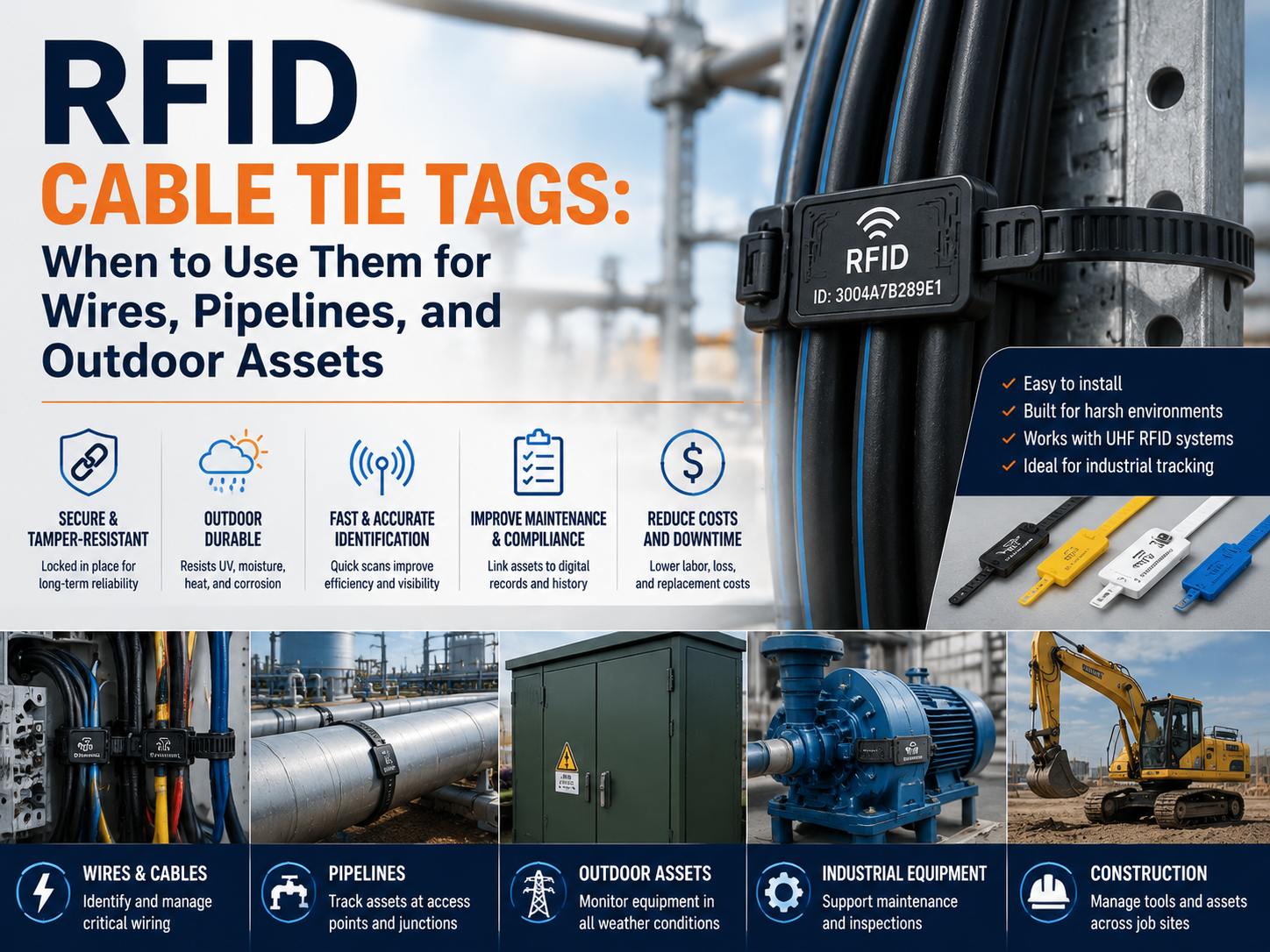
RFID cable tie tags, also known as RFID zip tie tags, are specialized fastening tags designed to both secure and identify assets. Unlike traditional adhesive labels or rigid RFID tags, cable tie tags integrate a locking mechanism that allows the tag to be physically attached to wires, pipelines, tools, and outdoor equipment.
This combination of mechanical fastening and digital identification makes them useful in environments where durability, tamper resistance, and long-term asset tracking are required.
However, they are not a universal solution. Their performance depends on material selection, installation method, and the specific environment in which they are used.
What Are RFID Cable Tie Tags?
RFID cable tie tags consist of two main components:
- A flexible or rigid locking strap (similar to a zip tie)
- An embedded RFID chip and antenna module
Once locked, the tag cannot be easily removed without cutting the strap, which helps prevent unauthorized transfer or tampering.
Each tag carries a unique identifier linked to a digital asset record, which may include:
- Identyfikator zasobu
- Installation location
- Historia konserwacji
- Inspection schedule
- Ownership information
- Environmental exposure records
These tags are commonly used in industrial environments where assets are exposed to vibration, heat, moisture, or outdoor conditions.
When Should You Use RFID Cable Tie Tags?
RFID cable tie tags are not necessary for every tracking application. They are most effective in specific scenarios where other tag types fail or become unreliable.
1. Wire and Cable Identification
In electrical installations, cables and wiring systems often require long-term identification.
RFID cable tie tags are suitable when:
- Multiple cables run through complex systems
- Labels are likely to fall off or degrade
- Visual identification is insufficient
- Maintenance teams need fast asset lookup
Aplikacje obejmują:
- Centra danych
- Industrial control panels
- Power distribution systems
- Telecom infrastructure
- Factory automation systems
They help technicians quickly identify cable routes and maintenance history without tracing physical lines manually.
2. Pipeline and Utility Network Tracking
Pipelines present a challenging tracking environment because they are often buried, exposed outdoors, or installed in inaccessible locations.
RFID cable tie tags are used for:
- Water pipelines
- Gas distribution systems
- Oil and chemical transport lines
- Underground utility networks
In these cases, tags are typically installed at:
- Access points
- Valve locations
- Junctions
- Inspection points
The goal is not to track the entire pipeline continuously, but to create identifiable checkpoints that support maintenance and inspection workflows.
3. Outdoor Asset Management
Outdoor environments expose assets to UV radiation, rain, dust, and temperature fluctuations.
RFID cable tie tags are commonly used on:
- Construction equipment
- Utility poles
- Street lighting systems
- Solar installations
- Telecommunications towers
- Temporary outdoor structures
The locking mechanism ensures that the tag remains attached even under vibration or mechanical stress.
4. Industrial Equipment and Maintenance Tracking
In manufacturing and heavy industry, many assets require periodic inspection and servicing.
Cable tie tags are useful for:
- Motors and pumps
- Systemy przenośników
- HVAC equipment
- Wyposażenie bezpieczeństwa
- Portable industrial tools
They support preventive maintenance programs by linking physical assets to maintenance schedules and service records.
Advantages of RFID Cable Tie Tags
Strong Physical Attachment
Unlike adhesive labels, cable tie tags are mechanically secured. This makes them suitable for:
- Vibration-heavy environments
- Outdoor exposure
- Irregular surfaces
Odporność na manipulacje
Once installed, the tag cannot be removed without breaking the strap. This improves asset integrity and reduces unauthorized transfers.
Flexible Installation
Cable tie tags can be installed without screws, adhesives, or specialized mounting hardware.
Suitable for Non-Flat Surfaces
They can be attached to:
- Rury
- Bundled cables
- Curved surfaces
- Irregular equipment frames
Improved Traceability
When integrated into an RFID system, each tag supports:
- Location tracking
- Maintenance history logging
- Inspection compliance
- Asset lifecycle monitoring
Limitations of RFID Cable Tie Tags
Despite their advantages, cable tie tags have constraints that must be considered.
Not Ideal for High-Temperature Metal Contact
Some tags may degrade or perform poorly in extreme heat environments unless specifically designed for industrial use.
One-Time Installation
Once locked, they cannot be repositioned. Incorrect installation requires cutting and replacement.
Limited Read Performance in Dense Environments
If installed near metal structures or tightly bundled cables, signal performance may be affected depending on tag design.
Higher Cost Than Basic Labels
Compared to printed labels or adhesive RFID inlays, cable tie tags are more expensive per unit.
RFID Frequency Selection for Cable Tie Tags
The effectiveness of cable tie tags depends heavily on RFID frequency and system design.
RFID UHF
Most industrial cable tie tags use UHF RFID due to:
- Duży zasięg odczytu
- Możliwość skanowania zbiorczego
- Suitability for asset tracking systems
HF RFID / NFC
Less common but useful in:
- Close-range verification
- Maintenance authentication
- Controlled access environments
Aktywne RFID
Used in specialized cases where real-time location tracking is required, especially for high-value outdoor assets.
Najlepsze praktyki instalacji
Proper installation is critical for performance and reliability.
Positioning
Tags should be placed:
- Away from metal interference when possible
- In a consistent orientation for scanning zones
- In accessible locations for maintenance checks
Avoid Signal Blockage
Do not install tags:
- Inside metal enclosures
- Directly against conductive surfaces (unless on-metal designed)
- Under insulating layers that block RF signals
Standardization
Organizations should define installation standards to ensure:
- Consistent read performance
- Easier system integration
- Predictable maintenance workflows
Use Cases Across Industries
RFID cable tie tags are used across multiple sectors:
Budownictwo
- Temporary wiring systems
- Śledzenie sprzętu
- Site utilities
Energy and Utilities
- Pipeline checkpoints
- Electrical grid maintenance
- Substation equipment tracking
Produkcja
- Production line cables
- Industrial machinery
- Maintenance assets
Telecommunications
- Fiber optic routing
- Infrastruktura sieciowa
- Outdoor telecom assets
Transportation Infrastructure
- Railway systems
- Airport ground equipment
- Traffic control systems
Integration with RFID Asset Management Systems
Cable tie tags become more powerful when integrated into enterprise systems.
They typically connect with:
- CMMS (Computerized Maintenance Management Systems)
- Systemy ERP
- Platformy zarządzania aktywami
- Inspection and compliance software
- EPCIS-based traceability systems
This enables organizations to link physical assets with digital records, including maintenance schedules, inspection history, and operational status.
ROI Considerations
The return on investment for RFID cable tie tags depends on:
- Zmniejszenie utraty aktywów
- Lower maintenance downtime
- Improved inspection compliance
- Faster troubleshooting
- Reduced labor for asset identification
They are particularly cost-effective in environments where manual identification of assets is time-consuming or error-prone.
Wnioski
RFID cable tie tags are a practical solution for tracking wires, pipelines, and outdoor industrial assets where durability and tamper resistance are required.
They are not a universal RFID format, but in the right scenarios, they provide a reliable bridge between physical infrastructure and digital asset management systems.
Organizations should evaluate environmental conditions, installation constraints, and read requirements before deployment to ensure consistent performance and long-term value.