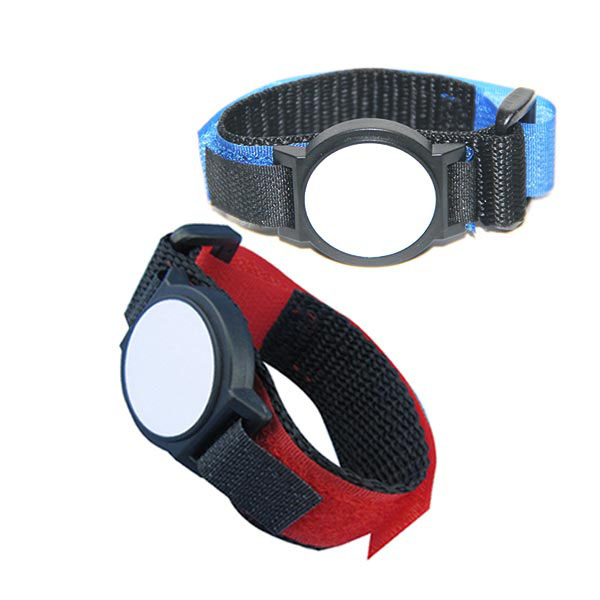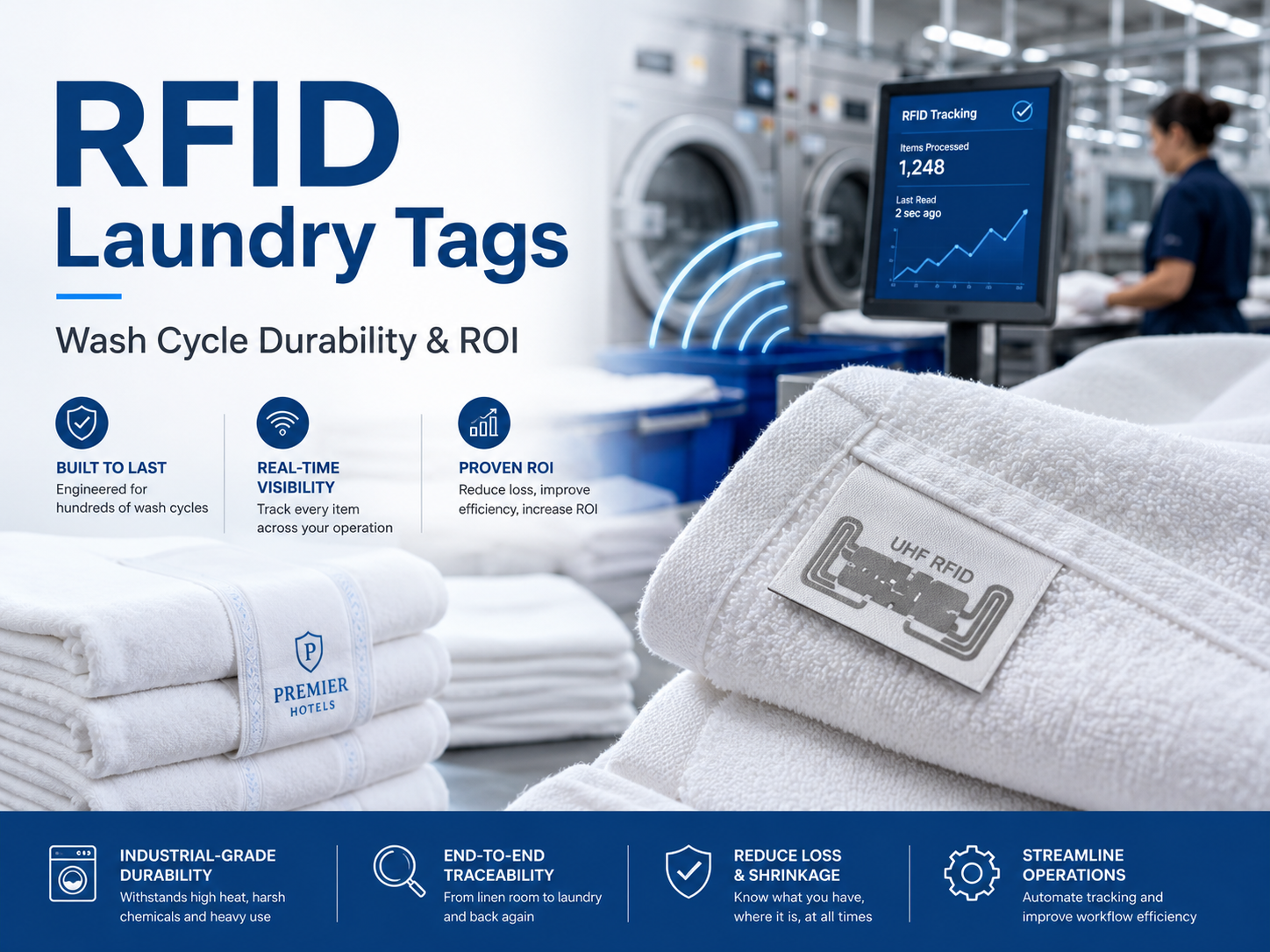
RFID laundry tags are designed to survive conditions that would quickly destroy ordinary RFID labels: repeated washing, high-temperature drying, chemical exposure, water extraction, ironing and sterilization.
However, “washable RFID tag” is a broad product description. A tag intended for consumer clothing may only tolerate a limited number of home washes, while an industrial RFID laundry tag may remain operational through hundreds of commercial laundry cycles.
For hotels, hospitals, uniform rental companies and industrial laundries, the more important question is not simply how long the tag lasts. It is whether the tag can generate enough operational savings during its service life to justify the investment.
In most high-volume textile operations, the answer depends on three factors:
- The actual durability of the selected RFID tag
- The value and circulation frequency of the textiles
- Whether RFID data is integrated into daily laundry operations
How Many Wash Cycles Can an RFID Laundry Tag Withstand?
A properly designed industrial RFID laundry tag will typically withstand around 200 commercial wash cycles. Some products are rated for more than 250 cycles or approximately three years of normal industrial use.
For example, HID specifies that its LinTRAK textile tags can withstand up to 200 commercial washing cycles. Zebra also provides a 200-cycle rating for its washable UHF laundry tag under defined washing, drying, ironing and pressure conditions. Other industrial laundry tag manufacturers advertise service lives exceeding 250 wash cycles.[1][2][3]
A practical benchmark is therefore:
| RFID tag category | Typical wash durability | Suitable applications |
|---|---|---|
| Standard apparel RFID label | Limited home-wash durability | Retail garments and consumer apparel |
| Entry-level washable RFID tag | Around 50–100 cycles | Light-duty uniforms and reusable garments |
| Industrial RFID laundry tag | Around 200 cycles | Hotels, hospitals, laundries and uniform services |
| Heavy-duty laundry tag | 250+ cycles | High-frequency industrial textile circulation |
These figures should be treated as product-specific ratings rather than a universal guarantee. The number printed on a data sheet is normally based on controlled test conditions. Actual service life depends on the full laundry process.
Why Industrial Laundry Is So Demanding
An RFID laundry tag is exposed to more than water and detergent. During a commercial laundry cycle, the tag may experience:
- Washing temperatures between 60°C and 90°C
- Suszenie w wysokiej temperaturze
- Steam finishing and ironing
- Strong detergents, bleach, alkalis and disinfectants
- Repeated bending, twisting and abrasion
- Ekstrakcja wody pod wysokim ciśnieniem
- Autoclave or sterilization processes
- Impact from metal drums and other textile items
Zebra’s washable laundry tag specification, for example, lists resistance to washing temperatures up to 100°C, drying at 180°C, ironing at 210°C and high extraction pressure under defined test conditions.[2]
This is why a standard adhesive RFID label should not be used as a substitute for a purpose-built laundry tag. Even when the RFID chip survives, the antenna, protective housing or attachment method may fail.
Industrial Laundry Tags and Home-Wash RFID Labels Are Not the Same
One of the most common purchasing mistakes is assuming that every RFID label described as “washable” is suitable for industrial laundry.
Some apparel RFID labels are designed to remain readable through a limited number of household washing and drying cycles. Avery Dennison, for example, describes one durable printed fabric RFID label as suitable for approximately 10 to 12 home wash and dry cycles.[4]
That may be adequate for retail apparel identification, but it is far below the requirements of a hospital, hotel or commercial laundry.
Before selecting a tag, buyers should confirm whether the wash-cycle rating refers to:
- Domestic washing or commercial washing
- Water washing or dry cleaning
- Washing only or washing plus drying and ironing
- Normal detergent or industrial chemicals
- Standard extraction or high-pressure extraction
- A laboratory test or a commercial field deployment
A tag that survives 200 low-temperature laboratory washes may not necessarily survive 200 complete industrial processing cycles.
What Determines the Actual Lifespan of an RFID Laundry Tag?
Temperatura prania
Higher temperatures accelerate material degradation. The protective textile, silicone or polymer housing must prevent moisture and heat from damaging the chip and antenna connection.
Drying and ironing temperature
Drying and ironing can expose the tag to higher temperatures than the washing stage. A tag rated for 90°C washing may still fail if it cannot tolerate tunnel finishing or industrial ironing.
Substancje chemiczne
Bleach, disinfectants, alkalis and specialty detergents can weaken the tag housing or attachment layer. Chemical resistance should be evaluated against the laundry’s actual chemical formulation.
Extraction pressure
Industrial washer extractors apply substantial pressure to remove water. Pressure can crack rigid housings or damage the connection between the RFID chip and antenna.
Metoda dołączania
RFID laundry tags are commonly:
- Sewn directly onto the textile
- Sewn inside a hem or fabric pocket
- Heat-sealed onto the textile
- Embedded during textile manufacturing
An unsuitable attachment method can fail before the RFID component reaches the end of its rated life.
Tag placement
Tags placed near metal fasteners, thick folded seams or areas subject to repeated mechanical stress may have reduced readability or durability.
For flat linen, a tag is often placed in a corner or hem. For garments, it may be installed in a collar, side seam or concealed fabric pocket. The final position should be tested with both handheld and fixed readers.
Textile replacement cycle
In many applications, the textile wears out before the RFID tag does. A hotel towel, hospital gown or industrial uniform may be removed because of stains, fabric damage or appearance standards while the tag is still functional.
For this reason, the best RFID tag is not necessarily the tag with the highest possible wash-cycle rating. It is the tag whose reliable service life matches or exceeds the expected life of the textile.
How RFID Laundry Tracking Works
Each RFID laundry tag contains a unique digital identifier. The identifier is linked to information in a laundry management system, such as:
- Textile type
- Customer or department
- Size and model
- Purchase or issue date
- Number of wash cycles
- Current location or process stage
- Assigned employee
- Inspection status
- Retirement status
Unlike barcodes, UHF RFID tags do not need to be individually aligned with a scanner. Multiple tagged items can be identified together when they pass through a tunnel reader, doorway, laundry cart station or counting table.
A typical workflow may include:
- Soiled textiles are received and automatically counted.
- Items are associated with a customer, department or facility.
- Textiles move through washing, drying and finishing.
- Clean items are counted during sorting and packing.
- Delivery quantities are verified before dispatch.
- Returns, missing items and incorrect sorting are recorded.
- Wash-count data is used to identify aging textiles.
The tag alone does not create these benefits. Readers, antennas, software, workflow design and data discipline are equally important.
Are RFID Laundry Tags Worth the Investment?
For high-volume textile operations, RFID laundry tags can be worth the investment when they solve measurable operational problems.
The strongest business cases normally come from four areas.
1. Lower Textile Loss
Hotels, hospitals and rental laundries frequently lose visibility once linen leaves a central storage area. Items may remain in guest rooms, hospital departments, staff lockers, delivery vehicles or customer facilities.
Without item-level identification, the business may know that inventory is missing but not where the losses are occurring.
RFID creates movement records at selected control points. This allows operators to identify unusual loss rates by customer, department, route or textile type.
In one industrial laundry case reported by Impinj, RFID data helped the operator identify where linen was located across the laundry and customer sites. The system also made it easier to detect trends when a particular customer experienced unusually high losses.[5]
Reduced textile loss is often the largest source of RFID return on investment because the same losses repeat every year.
2. Faster Counting and Lower Labor Requirements
Manual linen counting is slow and vulnerable to errors, especially when employees must handle every item individually.
UHF RFID allows large groups of textiles to be counted without direct line of sight. Readers can be installed at receiving points, sorting tables, packaging stations, storage areas and dispatch doors.
In the Les Lavandières de Provence implementation, automated RFID counting allowed hundreds of items to be counted in seconds. Some process areas no longer required employees to perform time-consuming manual counts.[5]
The financial benefit should not be calculated only as employee reduction. RFID can also allow existing employees to process more laundry, reduce overtime, resolve disputes faster and focus on quality-control work.
3. Reduced Safety Stock and Overstocking
When inventory data is unreliable, managers often purchase or rent more textiles than necessary.
Extra inventory is used as protection against:
- Brakujące elementy
- Delayed returns
- Inaccurate counts
- Uneven distribution
- Uncertain customer stock
- Poor visibility between facilities
RFID can show how many items are clean, soiled, in transit, at a customer site or waiting for repair.
Nordland Hospital reportedly reduced its circulating uniform inventory by 20,000 garments after implementing RFID-based uniform distribution. The project was expected to reduce rental costs by €175,000 over ten years, while textile waste fell by approximately 70%.[6]
Results from one facility should not be treated as a universal forecast, but the case demonstrates how inventory visibility can affect both purchasing and rental expenses.
4. Better Textile Lifecycle Management
Without RFID, textiles are often replaced based on estimates, visual checks or batch-level assumptions.
RFID software can record the number of processing cycles associated with each item. Operators can then compare textile quality with actual wash history.
This information supports:
- Planned textile replacement
- Quality grading
- Warranty analysis
- Supplier comparison
- Wash-process optimization
- More consistent customer service
A textile that fails after 40 cycles can be distinguished from one that has completed 180 cycles. This creates better purchasing data and can help identify problems with materials, chemicals or processing conditions.
Calculating RFID Laundry System ROI
The cost of an RFID laundry project usually includes more than the tags.
Typical investment categories include:
- Etykiety RFID do prania
- Tag encoding and installation
- Ręczne lub stacjonarne czytniki RFID
- Antennas and reading stations
- Laundry management software
- Integration with ERP or rental systems
- Przeprojektowanie procesu
- Employee training
- Maintenance and technical support
A basic annual benefit calculation can be expressed as:
Annual RFID benefit = reduced textile losses + labor savings + reduced inventory costs + avoided billing errors + additional service revenue
The estimated payback period can then be calculated as:
Payback period in months = total initial investment ÷ annual net savings × 12
For example, consider a laundry operation that estimates:
- $30,000 per year in reduced textile replacement
- $18,000 per year in counting and reconciliation labor savings
- $12,000 per year in reduced excess inventory
- $5,000 per year in avoided delivery and billing disputes
The total estimated annual benefit would be $65,000.
If the complete RFID project costs $90,000 and annual software and maintenance costs are $10,000, the estimated annual net benefit would be $55,000.
The simplified payback period would be:
$90,000 ÷ $55,000 × 12 = approximately 19.6 months
This is only a planning model. A credible business case should use the organization’s own loss records, labor rates, textile values and process volumes.
When RFID Laundry Tags Are Usually Worth It
RFID investment is more likely to be justified when an organization has:
- Thousands of textile items in circulation
- High-value uniforms or specialized garments
- Repeated unexplained linen losses
- Significant manual counting labor
- Multiple customers, departments or locations
- Frequent disputes about delivered quantities
- Excess safety stock
- A textile rental or managed-service model
- A need to document wash counts or textile history
- Plans to expand processing volume without equivalent labor growth
RFID may be less attractive when:
- The textile inventory is very small
- Items are low-value and rarely lost
- Laundry volume is limited
- The workflow has only one storage and processing location
- Manual counting requires little time
- The business is unwilling to change its operational procedures
- The RFID data will not be reviewed or used
The technology produces value through decisions and process control. Installing tags without defining how the data will be used is unlikely to produce a strong return.
How to Select the Right RFID Laundry Tag
A supplier should provide more than a general claim that the tag is waterproof or washable.
Request documentation covering:
Wash-cycle rating
Confirm the rated number of complete commercial laundry cycles and the conditions used during testing.
Temperature resistance
Review washing, drying, ironing, tunnel finishing and sterilization limits separately.
Odporność chemiczna
Provide the supplier with information about detergents, bleach, disinfectants and cleaning agents used in the facility.
Odporność na ciśnienie
Confirm compatibility with washer extractors, presses and other high-pressure equipment.
RFID frequency and protocol
For UHF systems, verify regional frequency compatibility and support for standards such as EPC Class 1 Gen 2 or ISO/IEC 18000-63.
Read performance
Test the tag inside realistic stacks, laundry bags, carts and textile bundles. A long read distance in open air does not guarantee reliable bulk reading in a dense laundry environment.
Opcje dołączania
Evaluate sewing, heat-sealing, pouch installation and hem embedding according to textile construction and production volume.
Certyfikaty
Depending on the application, buyers may require material-safety documentation, OEKO-TEX certification, RoHS or REACH declarations, and MRI compatibility for certain healthcare environments.
Run a Pilot Before Full Deployment
A controlled pilot is the most reliable way to determine whether an RFID laundry tag will survive the intended process and generate useful data.
The pilot should include representative textile types and the most demanding laundry conditions.
Środek:
- Tag read rate before washing
- Tag read rate after repeated cycles
- Physical attachment failure
- Performance in wet and dry conditions
- Bulk-reading accuracy
- Incorrect or stray reads
- Counting time
- Labor requirements
- Textile loss rate
- Inventory variance
- User acceptance
A useful pilot should test the complete system rather than only the tag. A durable tag cannot compensate for poor antenna placement, incorrect reader settings or software that does not match the workflow.
Final Answer: How Long Do RFID Laundry Tags Last?
For most industrial applications, a realistic specification is approximately 200 commercial wash cycles, with some heavy-duty RFID laundry tags rated for more than 250 cycles.
However, rated wash cycles should not be evaluated in isolation. Washing temperature, drying, ironing, chemicals, extraction pressure, tag placement and attachment method all influence real-world performance.
Final Answer: Are RFID Laundry Tags Worth It?
RFID laundry tags are generally worth considering for operations with large textile inventories, high loss rates, repeated counting labor or poor visibility across multiple locations.
The investment becomes easier to justify when RFID can:
- Reduce linen and uniform replacement
- Automate receiving and dispatch counts
- Lower excess inventory
- Improve billing accuracy
- Track wash cycles and textile age
- Increase processing capacity
- Provide customers with more transparent service data
For a small operation with limited inventory and low losses, the infrastructure cost may outweigh the savings.
The correct decision should therefore be based on a pilot and a measurable ROI model—not on the price of the tag alone.
Często zadawane pytania
Can RFID laundry tags survive industrial washing?
Yes. Purpose-built industrial RFID laundry tags are designed to tolerate commercial washing, drying, chemicals, pressure and ironing. Many are rated for approximately 200 complete commercial wash cycles.
Can RFID tags go through a dryer?
Industrial laundry tags can usually withstand high-temperature drying, but the permitted temperature and exposure time vary by product. The supplier’s technical data sheet should be checked before deployment.
Do RFID laundry tags have batteries?
Most laundry tracking systems use passive UHF RFID tags. These tags do not contain batteries and receive power from the RFID reader’s radio signal.
What happens when an RFID laundry tag fails?
The item may no longer be detected at RFID reading points. The tag can sometimes be replaced, depending on how it was attached. Systems should include exception-handling procedures for unreadable or physically damaged tags.
Can RFID laundry tags count wash cycles?
The tag does not normally calculate wash cycles by itself. The software records each time the item passes through a designated laundry process or reading point and associates that event with the tag’s unique identifier.
Is RFID better than barcodes for laundry management?
RFID is generally more suitable for high-volume operations because multiple items can be read without direct line of sight. Barcodes may remain adequate for small inventories or processes where items are already handled individually.
How quickly can an RFID laundry system pay for itself?
There is no universal payback period. It depends on textile losses, labor costs, inventory size, system cost and the extent to which RFID data is used. Operators should calculate payback using their own historical data and validate assumptions through a pilot project.