Animal RFID microchips are widely used for pet identification, livestock traceability, breeding management, laboratory animal tracking, and wildlife conservation. While many buyers purchase standard products, distributors, veterinary brands, and government projects often require customized specifications that better suit their local markets.
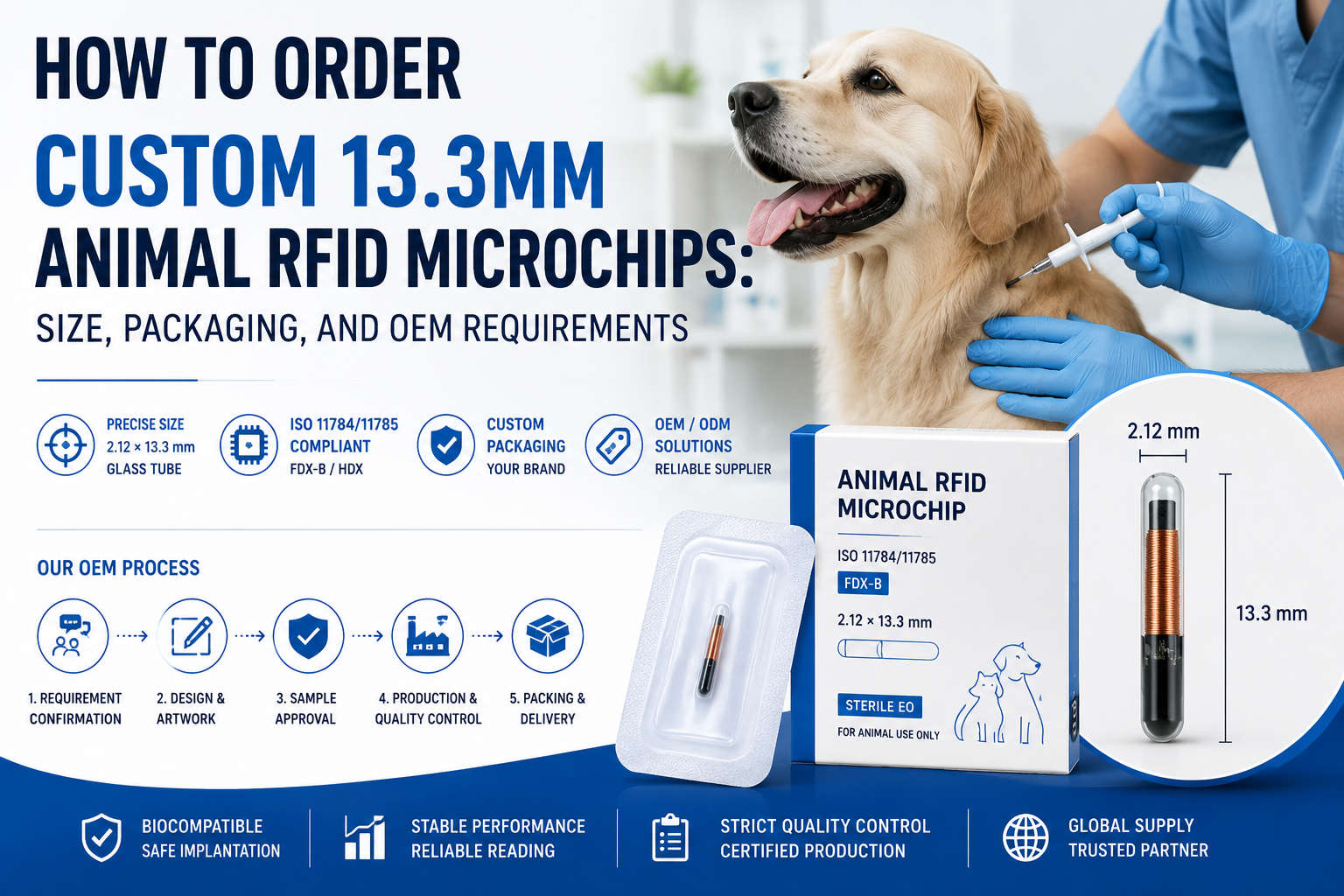
One of the most common requests manufacturers receive is for 2.12 × 13.3 mm animal RFID microchips with customized packaging, branding, or numbering. In many cases, customers also ask whether the package can display the exact chip size or include their own logo and product information.
Ordering a custom animal RFID microchip involves more than selecting a chip size. It requires careful planning of RFID specifications, packaging, regulatory compliance, and OEM production details.
This guide explains the key decisions buyers should make before placing an OEM order for 13.3 mm animal RFID microchips.
Why Choose a Custom Animal RFID Microchip?
Standard products are suitable for many applications, but OEM customization provides greater flexibility for distributors, veterinary suppliers, and private-label brands.
A custom solution allows buyers to align the product with their own technical requirements and branding strategy.
Typical reasons for customization include:
- Matching existing veterinary injectors
- Creating a private-label product line
- Standardizing product specifications across multiple markets
- Printing company logos and branding
- Displaying customized product information on the packaging
- Meeting project-specific identification requirements
For long-term distributors, customized products also help establish stronger brand recognition and reduce direct product comparisons.
Understanding the 2.12 × 13.3 mm Specification
Animal RFID microchips are typically identified by their physical dimensions.
The format is:
Diameter × Length
Therefore, a 2.12 × 13.3 mm microchip consists of:
- Glass tube diameter: approximately 2.12 mm
- Glass tube length: approximately 13.3 mm
Inside the biocompatible glass capsule are:
- RFID integrated circuit
- Miedziana cewka antenowa
- Capacitor
- Protective sealing materials
The glass capsule protects the electronic components while allowing permanent implantation beneath the animal’s skin.
Compared with shorter transponders, a 13.3 mm glass tube provides additional internal space for antenna design while remaining suitable for a wide range of companion animal and livestock applications.
Which RFID Specifications Should Be Confirmed?
Before production begins, buyers should define the RFID technology requirements.
Częstotliwość pracy
Most animal identification projects use:
- 134.2 kHz Low Frequency (LF)
This frequency is internationally recognized for animal identification.
Protokół komunikacyjny
Most export markets require compliance with:
- ISO 11784
- ISO 11785
These standards ensure interoperability between compliant microchips and readers.
Technologia RFID
Depending on project requirements, the microchip may support:
- FDX-B
- HDX
FDX-B remains the most widely used option for companion animal identification.
Chip Number Programming
Manufacturers can typically provide:
- Factory-programmed unique IDs
- Customer-specified numbering ranges
- Country or project-specific coding requirements
- ICAR manufacturer code implementation where applicable
Programming requirements should be confirmed before production.
Can the Packaging Display “2.12 × 13.3 mm”?
Yes, but this is an important distinction.
The physical microchip size i printed packaging information are two separate manufacturing processes.
A manufacturer can produce a 2.12 × 13.3 mm RFID microchip using an existing production line. However, if the customer wants the package to clearly display “2.12 × 13.3 mm”, the packaging artwork usually needs to be updated.
Customized packaging may require:
- New artwork design
- Printing plate preparation
- Sample approval
- Minimum order quantity
- Production scheduling
Because packaging is printed separately from the RFID microchip itself, the requested size marking is not automatically included unless specified during the order process.
OEM Packaging Options
Many buyers choose to customize both the product and the packaging to strengthen their brand identity.
Common customization options include:
Product Label
- Model produktu
- Częstotliwość
- Chip size
- Kod kreskowy
- Kod QR
- Numer partii
Company Branding
- Customer logo
- Brand colors
- Private-label packaging
- Product illustrations
Technical Information
- Zgodność z normami ISO
- Sterilization information
- Product specifications
- User instructions
- Data produkcji
Customized packaging helps distributors create a more professional appearance while simplifying inventory management.
Standard vs. OEM Animal RFID Microchips
| Cecha | Standard Product | OEM Custom Product |
|---|---|---|
| Glass tube size | Standard options | Customer specified |
| RFID programming | Factory default | Custom numbering available |
| Opakowanie | Standard | Private label |
| Product labeling | Standard | Customized |
| Company logo | Producent | Customer logo |
| Packaging size marking | Standard | Custom artwork available |
OEM production offers greater flexibility, particularly for distributors and veterinary brands developing proprietary product lines.
Typical Customization Workflow
Although every project differs, the OEM process generally follows several stages.
Step 1: Confirm Product Specifications
The customer defines:
- Glass tube size
- Częstotliwość RFID
- Communication protocol
- Chip technology
- Zastosowanie
Step 2: Confirm Programming Requirements
The manufacturer verifies:
- Number format
- ID allocation
- Coding requirements
- Data programming
Step 3: Packaging Design
Artwork is prepared based on customer requirements, including:
- Logo
- Product size
- Product description
- Kod kreskowy
- Regulatory information
Step 4: Sample Approval
Prototype products are evaluated before mass production.
Typical inspections include:
- Reading performance
- Dimension verification
- Packaging accuracy
- Sterility confirmation
Step 5: Mass Production
After approval, production proceeds according to the confirmed specifications.
Common Animal RFID Microchip Sizes
Different applications may require different transponder dimensions.
| Rozmiar | Typical Application |
|---|---|
| 1,25 × 7 mm | Birds, laboratory animals, small pets |
| 2,12 × 12 mm | Zwierzęta towarzyszące |
| 2.12 × 13.3 mm | Dogs, cats, breeding animals, livestock |
| 3 × 15 mm | Large livestock applications |
The most suitable size depends on implantation equipment, animal species, and project requirements.
Questions to Ask Before Placing an OEM Order
Before confirming production, buyers should discuss several important details with the manufacturer.
These include:
- Is the requested glass tube size available?
- Which RFID chip will be used?
- Does the product comply with ISO 11784/11785?
- Can the numbering format be customized?
- Can the package display the required dimensions?
- What packaging formats are available?
- Are sample approvals required?
- What are the production lead time and minimum order quantity?
Clarifying these points early helps prevent delays and avoids unnecessary packaging revisions.
Często zadawane pytania
Can I order 2.12 × 13.3 mm animal RFID microchips?
Yes. Many manufacturers offer this specification for companion animal and livestock identification projects.
Can the package be printed with “2.12 × 13.3 mm”?
Yes. If the standard package does not already include this information, customized artwork and printing are generally required.
Does changing the packaging affect the RFID chip?
No. Packaging customization and RFID chip production are independent processes.
Can I add my own company logo?
Yes. Most OEM manufacturers offer private-label packaging for qualified production orders.
Can RFID numbering be customized?
Yes. Depending on project requirements, manufacturers can often provide customized numbering ranges and data programming.
Choosing an Experienced OEM Manufacturer
Selecting the right supplier involves more than comparing product prices.
A qualified OEM manufacturer should be able to support:
- Stable RFID chip programming
- Consistent glass tube quality
- ISO-compliant manufacturing
- Sterile production processes
- Flexible packaging customization
- Technical support during product development
Working with an experienced manufacturer can simplify product launches and reduce risks during international procurement.
Wnioski
Ordering a custom 13.3 mm animal RFID microchip involves much more than choosing a physical size. Buyers should also consider RFID specifications, chip programming, packaging design, branding, and regulatory requirements to ensure the final product meets both technical and commercial objectives.
For distributors, veterinary suppliers, and animal identification projects, early communication with the manufacturer regarding size, packaging artwork, and OEM requirements helps streamline production and minimize revisions.
Whether the goal is to launch a private-label product or support a large-scale identification program, a well-planned OEM process can deliver a solution tailored to the needs of the target market.