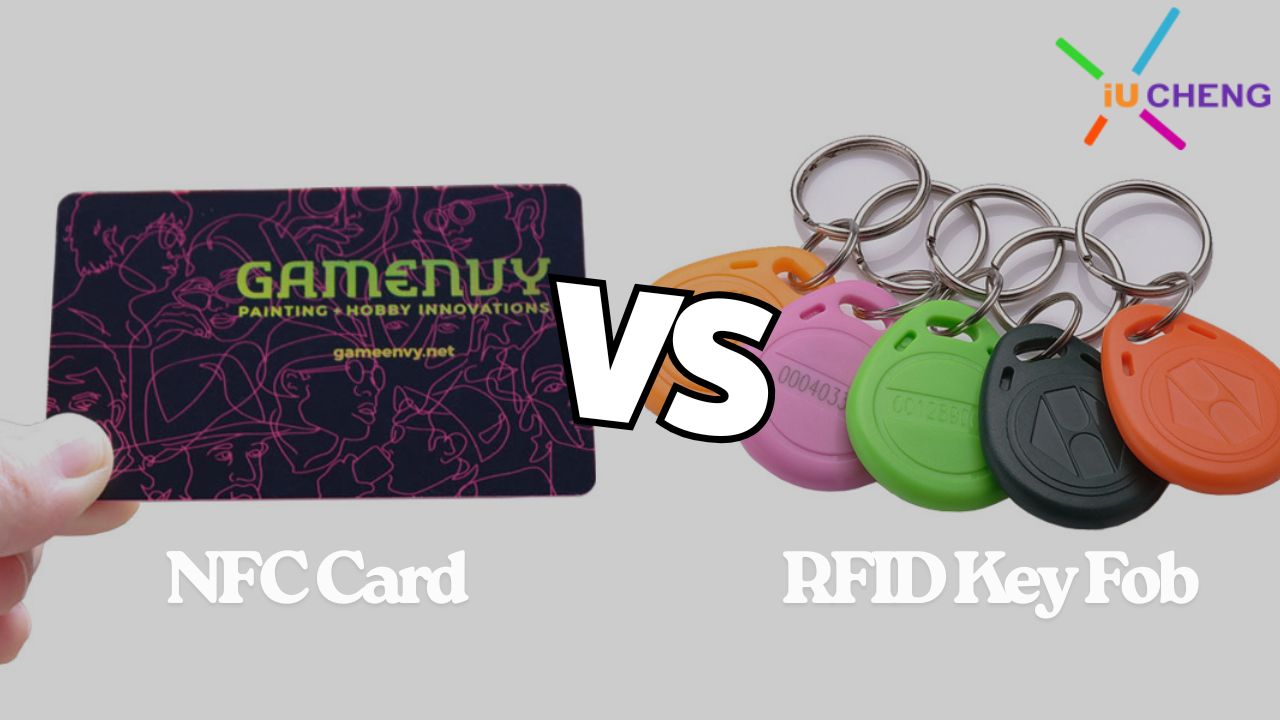
Access control systems are a cornerstone of modern security, whether in corporate offices, industrial facilities, or educational institutions. Two common technologies powering these systems are RFID Key Fobs and NFC Cards. Understanding their differences, advantages, and ideal applications is essential for designing efficient, reliable, and secure access control solutions.
How RFID Key Fobs Work
RFID Key Fobs are small, portable devices with embedded chips that communicate wirelessly with a reader. Depending on the system, they operate at low frequency (125 kHz), high frequency (13.56 MHz), or ultra-high frequency (860–960 MHz).
Advantages of RFID Key Fobs include:
- Durability – ABS construction withstands daily wear and industrial environments.
- Multi-chip compatibility – Supports TK4100, EM4200, EM4305, MIFARE S50/S70, NTAG213/215/216, and more.
- Customization – Options for silk printing, barcodes, QR codes, serial numbers, and chip encoding.
- Ease of Use – Convenient for users to carry and swipe for authentication.
How NFC Cards Work
NFC (Near Field Communication) Cards are similar in concept but typically operate at 13.56 MHz (HF) only. They are widely used in environments where proximity-based authentication and mobile integration are important. Key features include:
- Compact form factor – Standard card size fits wallets or ID holders.
- Mobile integration – Can be emulated by smartphones for contactless access.
- High compatibility – Works with NFC-enabled readers and smart devices.
NFC cards are excellent for scenarios where users prefer card-based access or require integration with mobile devices.
Key Differences Between RFID Key Fobs and NFC Cards
| Feature | RFID Key Fob | NFC Card |
|---|---|---|
| Frequency Options | LF, HF, UHF | HF only |
| Form Factor | Keychain, small portable device | Standard card |
| Durability | Very high; industrial-ready | Moderate; wallet-friendly |
| Customization | Silk printing, encoding, colors | Limited printing and encoding options |
| Mobile Integration | Limited | Supported (smartphone emulation possible) |
| Ideal Use Cases | Industrial, corporate, attendance, multi-door systems | Office, schools, mobile-integrated access |
Choosing the Right Solution
When deciding between RFID Key Fobs and NFC Cards, consider:
- Environment – Industrial vs office; harsh conditions favor durable key fobs.
- User Preference – Employees who prefer cards or smartphones may prefer NFC.
- Frequency & System Compatibility – Ensure devices match existing readers and protocols (ISO14443A, ISO11784/785, ISO18000-6C).
- Customization Needs – For branding or multi-site deployment, key fobs often offer more options.
- Integration with Existing Infrastructure – Evaluate whether mobile access or multi-door systems are required.
Learn more about Access Control Solutions compatible with our RFID Key Fobs.
Real-World Application Scenarios
- Corporate Offices – Both RFID Key Fobs and NFC Cards streamline employee access, visitor management, and attendance tracking.
- Industrial Facilities – Key fobs offer superior durability for factories and warehouses with harsh conditions.
- Educational Institutions – NFC cards integrate with student IDs and mobile apps, while key fobs are ideal for staff and campus security.
- Parking & Transportation – RFID Key Fobs provide convenient vehicle access, while NFC Cards can integrate with mobile apps and campus ID systems.
Conclusion
Both RFID Key Fobs and NFC Cards play crucial roles in modern access control. Choosing the right solution depends on your environment, system requirements, user preferences, and customization needs. For industrial and multi-door access control, RFID Key Fobs remain a robust and versatile choice, while NFC Cards offer convenient integration for mobile and card-based systems.