


Metal assets create one of the most demanding environments for RFID deployment.
A standard UHF RFID label that performs well on cardboard, plastic, or paper may lose most of its read range when placed directly on metal. The metal surface changes the behavior of the tag antenna, reflects radio waves, and can prevent the RFID chip from receiving enough energy to respond.
For this reason, industrial asset tracking projects usually require a tag specifically designed for metal surfaces.
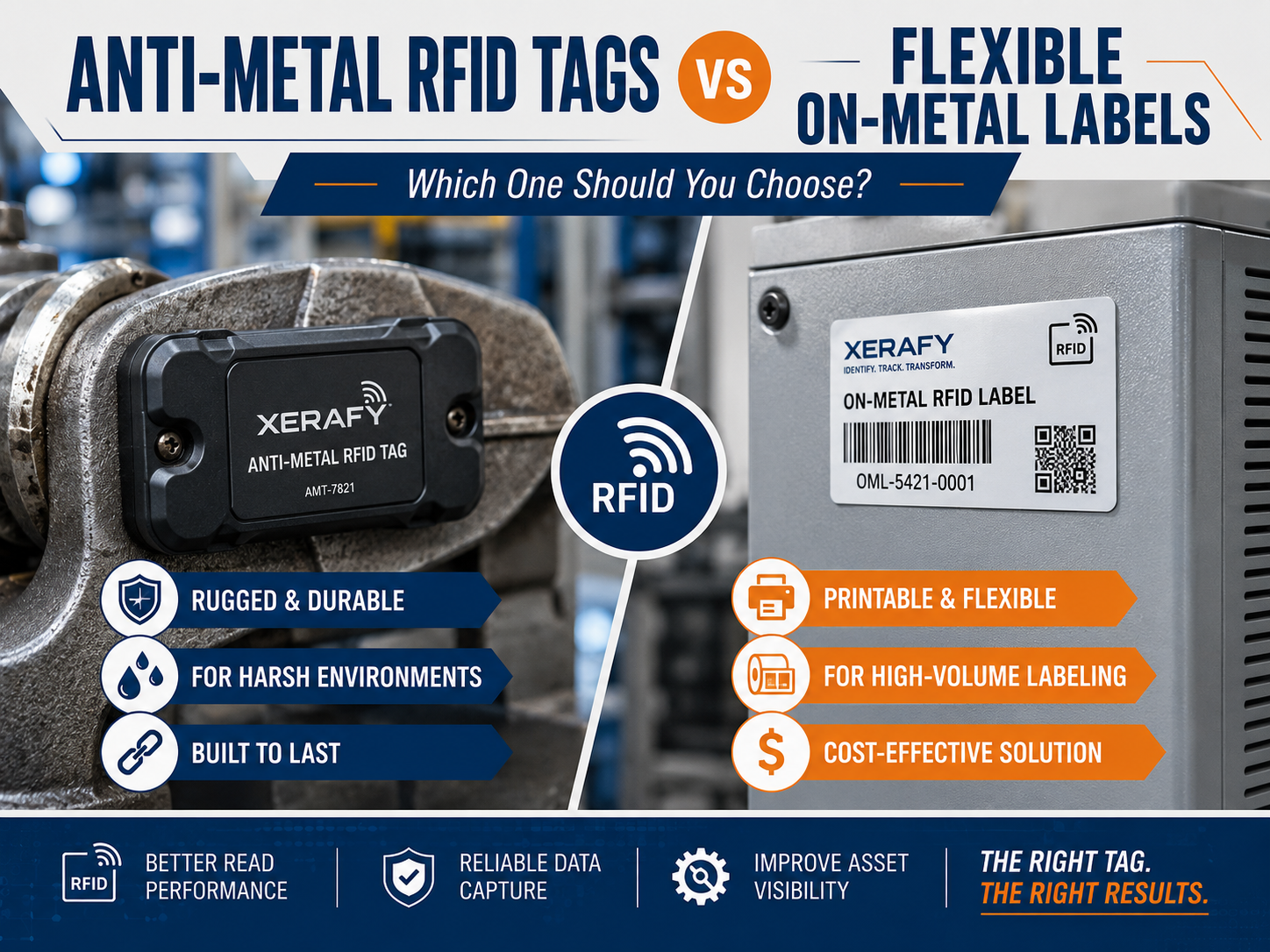
Two of the most common options are anti-metal RFID hard tags and flexible on-metal RFID labels. Both can identify metal assets, but they are built for different operating conditions, installation methods, and cost structures.
Choosing between them requires more than comparing the maximum read distance in a datasheet. The correct decision depends on the asset surface, environmental exposure, required service life, installation process, available space, printing requirements, and expected reading method.
What Is an Anti-Metal RFID Tag?
An anti-metal RFID tag is an RFID transponder engineered to operate when mounted directly on a metallic surface.
The term is commonly used for rigid or semi-rigid industrial tags containing:
- An RFID chip
- A tuned antenna
- A spacer, dielectric layer, or shielding structure
- A protective plastic, ceramic, PCB, or composite housing
The internal structure separates and tunes the antenna relative to the metal surface. In many designs, the metal asset becomes part of the tag’s operating environment rather than simply being treated as an obstacle.
Anti-metal tags are available in several formats, including:
- Rugged ABS hard tags
- PCB tags
- Ceramic tags
- High-temperature tags
- Embedded tags
- Bolt-mounted tags
- Screw-mounted tags
- Weldable or bracket-mounted tags
They are generally selected for long-term tracking of tools, machines, molds, vehicles, returnable transport items, containers, and other industrial assets.
What Is a Flexible On-Metal RFID Label?
A flexible on-metal RFID label is a thin RFID label designed to work on metal while retaining the convenience of an adhesive label.
It normally contains:
- A printable face material
- An RFID inlay
- A thin RF isolation or foam layer
- A pressure-sensitive adhesive backing
Unlike a rigid industrial tag, the label can bend to a limited degree and conform to flat or gently curved surfaces.
Flexible on-metal labels may be supplied on rolls and encoded or printed using a compatible RFID printer. Depending on the product construction, the visible surface can carry:
- Asset numbers
- Штрих-коды
- QR-коды
- Company logos
- Warning text
- Human-readable serial numbers
This combination of RFID and visual identification makes flexible labels attractive for IT equipment, gas cylinders, metal cabinets, electrical equipment, indoor machinery, medical assets, and other applications requiring a low-profile tag.
The Main Difference Is Not Simply Hard Versus Soft
The difference between the two formats is best understood as a trade-off between protection and process efficiency.
A rugged anti-metal tag prioritizes:
- Механическая прочность
- Длительный срок службы
- Resistance to impact and chemicals
- Secure mounting
- Reliable performance in severe conditions
A flexible on-metal label prioritizes:
- Low profile
- Fast adhesive installation
- Roll-format handling
- Printable identification
- Lower unit and installation cost
- Suitability for high-volume tagging
Neither option is automatically better. Each is optimized for a different type of deployment.
Anti-Metal RFID Tags vs Flexible On-Metal Labels
| Selection factor | Anti-metal RFID hard tag | Flexible on-metal RFID label |
|---|---|---|
| Physical construction | Rigid or semi-rigid housing | Thin, flexible label construction |
| Typical attachment | Screws, rivets, bolts, adhesive or brackets | Pressure-sensitive adhesive |
| Механическая прочность | Высокий | Умеренный |
| Impact resistance | Usually better | More limited |
| Resistance to chemicals | Strong in suitably rated models | Depends on face material and laminate |
| Outdoor service life | Better for long-term exposure | Suitable only when properly rated |
| Curved surfaces | Model-dependent | Better on gentle curves |
| Printable surface | Limited or customized | Usually designed for printing |
| Roll-format encoding | Generally unavailable | Commonly available |
| Installation speed | Медленнее | Быстрее |
| Removal resistance | High with mechanical mounting | Depends on adhesive and surface |
| Profile above asset | Thicker | Thinner |
| Typical unit cost | Выше | Нижний |
| Best use | Severe industrial environments | High-volume, lower-profile identification |
Read Range: Hard Tags Are Not Always Automatically Better
Rugged anti-metal tags are often associated with longer read ranges, but tag format alone does not determine performance.
Read range is affected by:
- Tag dimensions
- Конструкция антенны
- RFID chip sensitivity
- Рабочая частота
- Asset size
- Metal composition
- Mounting orientation
- Мощность считывателя
- Antenna polarization
- Surrounding equipment
- Nearby tags and metal surfaces
A larger flexible on-metal label may outperform a very small hard tag under the same conditions. Similarly, a properly tuned hard tag mounted on a large steel asset may deliver stronger performance than a label constrained by limited surface area.
Manufacturers should therefore avoid selecting a product only because its datasheet shows the longest maximum distance.
The relevant question is whether the tag can be read consistently in the intended workflow.
Например:
- A handheld inspection process may need a reliable read at one or two meters.
- A warehouse portal may require detection at several meters while the asset is moving.
- A tool cabinet may require a carefully controlled short read zone.
- A maintenance technician may only need close-range verification.
A tag that reads farther than necessary can sometimes create unwanted reads from adjacent assets.
Долговечность и устойчивость к воздействию окружающей среды
Environmental exposure is one of the clearest dividing lines between the two formats.
When a Rugged Anti-Metal Tag Is Better
A hard anti-metal tag is usually the safer choice when assets are exposed to:
- Repeated impact
- Heavy vibration
- Pressure washing
- Oils and lubricants
- Industrial cleaning agents
- Outdoor weather
- Extreme temperature changes
- Continuous UV exposure
- Абразия
- Mud, dust, or concrete residue
The housing protects the RFID inlay and provides a more stable mounting structure.
Приложения могут включать:
- Строительная техника
- Oil and gas equipment
- Производственные инструменты
- Metal pallets
- Railway components
- Waste containers
- Mining equipment
- Industrial molds and dies
The tag material and ingress protection rating still need to be checked. The word “rugged” does not mean that every hard tag can withstand every chemical, temperature, or cleaning process.
When a Flexible Label Is Sufficient
A flexible on-metal label can be suitable when assets operate in a more controlled environment, such as:
- Офисы
- Data centers
- Больницы
- Laboratories
- Indoor factories
- Equipment rooms
- Склады
Примеры включают:
- Laptops
- Servers
- Metal cabinets
- Медицинские изделия
- Electrical panels
- Indoor tools
- Office equipment
- Gas or liquid containers
An overlaminate can improve resistance to abrasion, moisture, cleaning, and printed-image wear. However, the complete construction must be evaluated, including the adhesive, foam layer, face material, printing ribbon, and protective laminate.
Installation Method
Installation has a direct effect on both performance and project cost.
Installing Anti-Metal Hard Tags
Rigid tags may be attached using:
- Screws
- Rivets
- Bolts
- Industrial adhesive
- Cable ties
- Metal brackets
- Embedded mounting
Mechanical fastening provides strong retention and makes the tag difficult to remove accidentally. It is often preferred for long-life assets or environments where adhesives may fail.
The disadvantages are additional labor and the possibility that the asset must be drilled or modified.
Installation teams may need:
- Электроинструменты
- Mounting templates
- Approved fasteners
- Surface preparation materials
- Safety procedures
For leased assets, pressure vessels, certified equipment, or thin metal panels, drilling may not be permitted.
Installing Flexible On-Metal Labels
Flexible labels are normally installed with pressure-sensitive adhesive.
The process is faster:
- Clean and dry the surface.
- Remove oil, dust, rust, or loose paint.
- Peel away the release liner.
- Place the label in the approved position.
- Apply firm pressure.
- Allow the adhesive to reach its specified bond strength.
This approach is suited to projects involving hundreds or thousands of similar assets.
Adhesive installation is only reliable when the label is matched to the surface. Powder-coated metal, textured paint, oily machinery, curved pipes, and low-surface-energy coatings may require different adhesives or additional testing.
Flat and Curved Metal Surfaces
Flexible on-metal labels are often selected for curved assets, but flexibility has limits.
Suitable applications may include:
- Gas cylinders
- Metal drums
- Pipes
- Tool handles
- Curved equipment housings
The bend radius must not place excessive stress on the antenna, chip connection, or foam isolation layer.
A label designed for a large cylinder may not work reliably when wrapped tightly around a narrow cable, rod, or small-diameter pipe.
Rigid tags can also be used on curved surfaces when they include:
- A curved housing
- A mounting bracket
- Cable-tie slots
- A flexible attachment base
The tag should not be forced into a shape it was not designed to maintain.
Printing and Human-Readable Identification
Flexible labels have a major advantage when the project requires both RFID and visible identification.
Compatible labels can be printed and encoded with:
- Asset ID
- Серийный номер
- Штрих-код
- QR-код
- Department
- Inspection date
- Safety information
- Company branding
This creates a dual-identification system. RFID supports automatic or non-line-of-sight data capture, while the printed information provides a visual reference and backup scanning method.
Hard tags can also carry visible information through:
- Лазерная гравировка
- Screen printing
- Molded markings
- Printed plates
- Durable barcode labels
However, customization is normally performed during production rather than printed on demand at the deployment site.
For organizations that need to encode and print tags as assets are registered, flexible labels may provide a more efficient workflow.
Tag Size and Available Mounting Space
Small assets create difficult design compromises.
Reducing the tag size usually reduces the available antenna area, which may affect read performance. This is especially important on metal, where the antenna and isolation structure must operate within a limited footprint.
Flexible labels are useful when the available surface is broad but the tag must remain thin.
Small ceramic, PCB, or specialized hard tags are often better when:
- The mounting area is very limited
- The asset has a recess for tag installation
- The tag must survive repeated impact
- The label cannot extend beyond the asset edge
Примеры включают:
- Hand tools
- Surgical instruments
- Small machine components
- Metal fixtures
- Автомобильные запчасти
A sample should always be tested on the real asset. A metal plate used in a laboratory does not necessarily represent the geometry of a finished tool or machine component.
High-Temperature Applications
Standard flexible on-metal labels are not usually the first choice for continuous high-temperature exposure.
Heat can affect:
- Adhesive strength
- Foam isolation materials
- Face films
- Печать
- Antenna connections
- RFID chip packaging
Special high-temperature labels do exist, but their ratings should be examined carefully. A short peak-temperature rating is not the same as continuous operation at that temperature.
Rugged PCB, ceramic, or specially encapsulated tags are generally more appropriate for:
- Paint shops
- Autoclaves
- Metal fabrication
- Компоненты двигателя
- Mold tracking
- Heat-treatment processes
The full temperature cycle matters. A tag may experience rapid heating, cooling, thermal shock, steam, pressure, and chemical cleaning during the same operating process.
Resistance to Tampering and Unauthorized Removal
Mechanically mounted anti-metal tags generally offer better retention and tamper resistance.
A tag installed with bolts or rivets cannot be removed as easily as an adhesive label. It is therefore a stronger choice for:
- High-value assets
- Аренда оборудования
- Outdoor infrastructure
- Tools shared between sites
- Assets exposed to theft or unauthorized relocation
Flexible labels can still support tamper evidence when designed with:
- Destructible face materials
- Void adhesives
- Frangible constructions
- Cut patterns
- Transfer indicators
Tamper-evident is not the same as tamper-proof. The purpose is usually to show that removal has been attempted rather than physically preventing removal.
Сравнение стоимости
Flexible on-metal labels normally have a lower unit cost and faster installation process.
They may also reduce operational costs because they can be:
- Supplied in rolls
- Printed and encoded in-house
- Applied without drilling
- Installed during existing labeling processes
Hard anti-metal tags usually cost more because of their housing, specialized construction, and mounting hardware.
The purchase price should not be evaluated separately from service life.
A lower-cost label that needs frequent replacement may be more expensive over the full life of an industrial asset. Conversely, using a heavy-duty tag on indoor IT equipment may add cost without providing meaningful operational value.
The lifecycle calculation should include:
- Tag price
- Printing or customization
- Installation labor
- Mounting hardware
- Replacement rate
- Expected asset life
- Read failure costs
- Maintenance requirements
- Asset downtime
Choose Anti-Metal Hard Tags When
A rigid anti-metal RFID tag is usually the better choice when:
- The asset operates outdoors for several years.
- The tag will face impact, vibration, abrasion, or chemicals.
- Mechanical fastening is required.
- The asset is high value or difficult to replace.
- The tag must resist accidental or unauthorized removal.
- The application involves high temperatures.
- The asset is washed or cleaned aggressively.
- A rigid housing can fit without interfering with asset operation.
- Long service life is more important than the lowest initial cost.
Typical applications include heavy machinery, molds, tools, metal containers, railway assets, construction equipment, oil and gas equipment, and reusable industrial transport assets.
Choose Flexible On-Metal Labels When
A flexible on-metal label is usually the better choice when:
- A thin tag profile is required.
- Assets are deployed mainly indoors.
- The tag must be printed with text, barcodes, or QR codes.
- Thousands of assets need to be tagged efficiently.
- Adhesive attachment is acceptable.
- The surface is flat or gently curved.
- Environmental exposure is moderate.
- In-house RFID printing and encoding are required.
- The deployment has strict unit-cost targets.
Typical applications include servers, laptops, metal cabinets, laboratory equipment, hospital assets, indoor machinery, cylinders, electrical panels, and warehouse equipment.
When a Flexible Label Should Not Be Used
A flexible on-metal label may not be appropriate when:
- The surface is continuously oily or contaminated.
- The tag is exposed to repeated scraping or impact.
- The asset is pressure-washed frequently.
- The mounting area becomes extremely hot.
- The label must be installed on a sharp bend.
- Long-term outdoor exposure exceeds the material rating.
- Removal of the tag would create a serious security risk.
- The adhesive cannot bond reliably to the asset coating.
In these situations, a rugged tag with mechanical attachment is generally more reliable.
When a Hard Tag May Be Unnecessary
A rugged anti-metal tag may be excessive when:
- The asset remains in a clean indoor environment.
- Visual printing is required for each individual tag.
- The expected service life is short.
- The project involves very high tag volumes.
- The asset has no suitable mounting holes or tag clearance.
- Installation labor must be minimized.
- A low-profile appearance is important.
Selecting the strongest available tag is not always good engineering. The goal is to meet the application requirement at an acceptable lifecycle cost.
Questions to Ask Before Selecting an On-Metal RFID Tag
Before requesting samples or quotations, define the following:
About the Asset
- What is the asset made from?
- Is the surface flat, curved, painted, coated, or textured?
- How much mounting space is available?
- Can the asset be drilled?
- Does the tag need to remain below a height limit?
About the Environment
- Will the tag be used indoors or outdoors?
- What are the minimum and maximum temperatures?
- Will it be exposed to chemicals, oils, UV light, water, or steam?
- Will it face impact, abrasion, vibration, or pressure washing?
- How long should the tag remain in service?
About RFID Performance
- What reading distance is actually required?
- Will the system use handheld or fixed readers?
- Will assets be stationary or moving?
- How closely will tagged assets be stored?
- Which regional UHF frequency band will be used?
- Are unwanted reads from nearby assets a concern?
About Identification and Data
- Is EPC memory sufficient?
- Is additional user memory required?
- Must each tag carry a barcode or serial number?
- Will tags be encoded before delivery or on site?
- Is password protection or a specific chip feature required?
About Installation
- Can the tag be attached with adhesive?
- Are screws, rivets, bolts, or cable ties permitted?
- Who will install the tags?
- How much installation time is acceptable?
- Does the surface require cleaning or preparation?
These questions are more useful than asking only for the longest read range or the lowest price.
How to Test Both Options
A controlled comparison should use the actual assets, readers, and operating environment.
The evaluation should include:
- Apply candidate tags to representative assets.
- Allow adhesive-mounted samples to reach full bond strength.
- Test all required orientations.
- Measure performance with the intended handheld or fixed reader.
- Test assets individually and in realistic groups.
- Repeat tests near machinery, racks, vehicles, and other metal structures.
- Expose samples to expected temperature, moisture, cleaning, vibration, and impact.
- Recheck read performance after environmental conditioning.
- Inspect attachment strength and physical damage.
- Record both successful reads and unintended reads.
Testing should focus on repeatability rather than the best result obtained under ideal conditions.
A reliable tag is one that performs consistently throughout the real operating process.
Can One Project Use Both Tag Types?
Many industrial RFID systems use both.
For example, a manufacturer may use:
- Flexible on-metal labels for indoor cabinets and IT assets
- Rugged hard tags for outdoor machinery
- Small ceramic tags for tools
- High-temperature PCB tags for molds
- Printable labels for metal returnable containers
Using several tag formats does not create a problem as long as they follow a consistent data structure and operate with the same RFID reader infrastructure.
The physical tag should be selected according to the asset rather than forcing every asset into one standard format.
Окончательная рекомендация
Choose an anti-metal hard tag when environmental resistance, mechanical protection, secure mounting, and long service life are the main priorities.
Choose a flexible on-metal label when low profile, fast application, printable identification, and high-volume deployment are more important.
The final decision should not be based on product category names alone. “Anti-metal tag” and “flexible on-metal label” cover a wide range of constructions with different adhesives, housings, chips, antennas, frequency tuning, and environmental ratings.
Start with the asset, operating environment, read process, and required service life. Then compare products through real-world testing.
The correct RFID tag is not necessarily the most rugged or the longest-reading option. It is the tag that remains attached, survives the application, and produces consistent reads at every required business point.


