


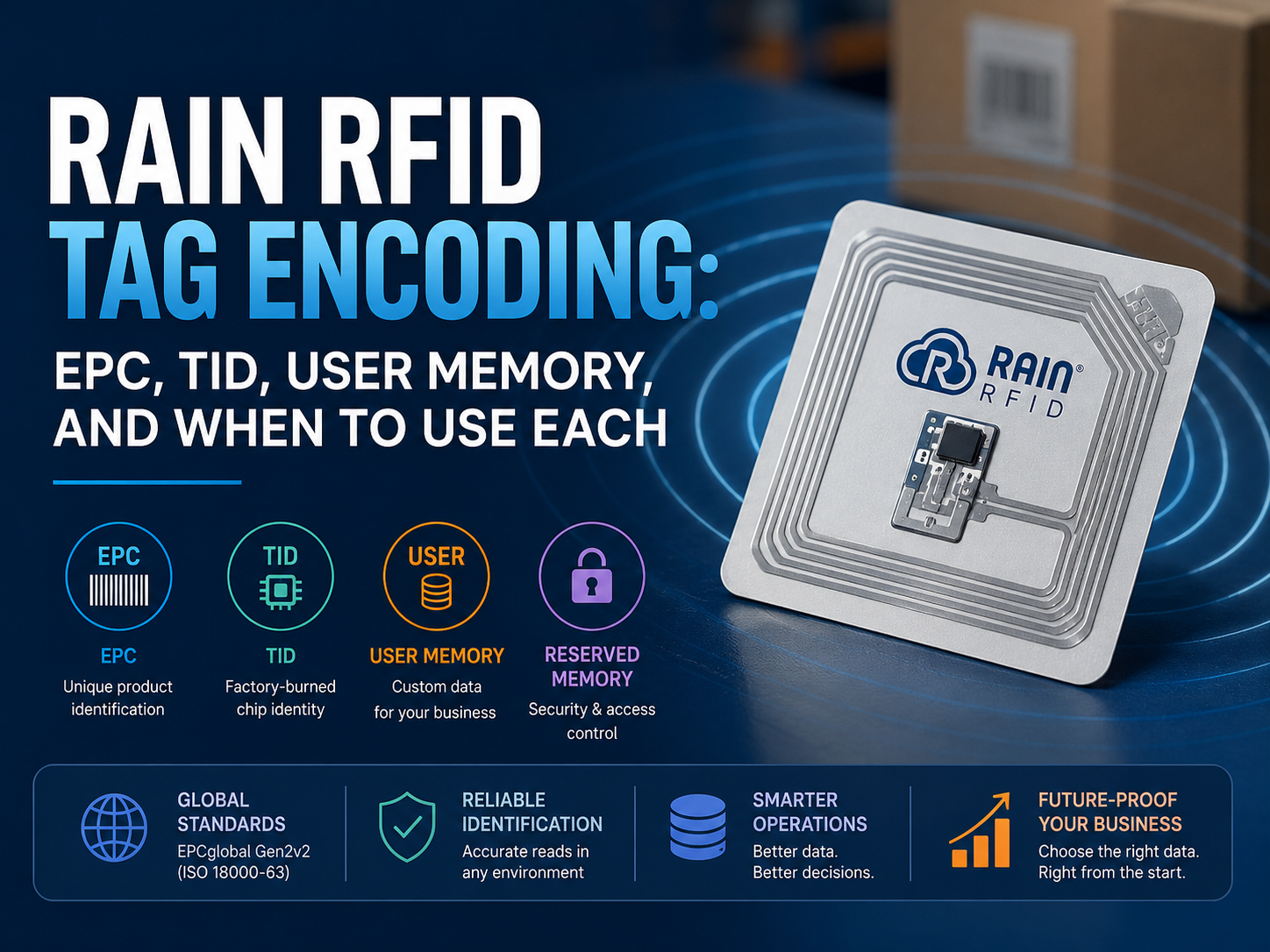
Before deploying millions of RFID tags across a supply chain, one small decision often creates the biggest headaches later: what data should actually be written into the tag?
Many companies simply ask their supplier to “encode the EPC” without fully understanding what that means. Others discover too late that they need additional information for maintenance records, anti-counterfeiting, or closed-loop asset tracking.
RAIN RFID tags contain several independent memory banks, each designed for a different purpose. The four terms buyers encounter most often are EPC, TID, User Memory, and Reserved Memory. Understanding the role of each one helps avoid costly rework and ensures compatibility with retailers, logistics partners, and enterprise software.
This guide explains what each memory area does, when you should use it, and common mistakes that manufacturers and system integrators should avoid.
What Is RAIN RFID Tag Encoding?
RAIN RFID is based on the EPCglobal Gen2v2 (ISO 18000-63) standard and operates in the UHF frequency range. Unlike a barcode, an RFID tag can store multiple pieces of information inside different memory sections.
A typical RFID chip is divided into four memory banks:
| Memory Bank | Назначение | Can Be Modified? |
|---|---|---|
| Зарезервировано | Passwords for locking and killing tags | Да |
| EPC | Main identification number | Да |
| TID | Chip manufacturer’s unique ID | Usually No |
| Память пользователя | Additional custom data | Yes (if available) |
Not every RFID chip includes User Memory, and the available capacity varies by chip model.
For most retail and logistics projects, only the EPC memory is actively encoded.
EPC Memory: The Standard for Supply Chain Identification
EPC stands for Electronic Product Code. It is the primary identifier that RFID readers capture during inventory counting, warehouse operations, and retail checkout processes.
Think of EPC as the RFID equivalent of a serial number.
An EPC typically contains:
- Company Prefix
- Item Reference
- Unique Serial Number
When Should You Use EPC?
EPC should be used whenever the goal is unique product identification.
Типичные области применения включают:
- Apparel retail
- Управление складскими запасами
- Отслеживание паллет и коробок
- Pharmaceutical serialization
- Automotive parts logistics
- E-commerce fulfillment
Large retailers such as Walmart, Decathlon, and many fashion brands require suppliers to encode standardized EPC numbers into every RFID label before shipment.
Because EPC is the field most RFID software expects to read, it should remain concise, standardized, and unique.
TID Memory: The Factory-Burned Chip Identity
TID stands for Tag Identifier.
Unlike EPC, the TID is permanently programmed by the RFID chip manufacturer during production. In most chips, it cannot be modified by the end user.
A TID usually contains information such as:
- Chip manufacturer
- Chip model
- Unique silicon serial number
For example, an RFID reader may retrieve a TID that identifies the chip as being manufactured by companies like NXP, Impinj, or EM Microelectronic.
Because every TID is globally unique, some organizations use it as an additional layer of authentication.
When Should You Use TID?
TID is particularly valuable for:
Anti-counterfeiting
Counterfeit tags may copy the EPC but cannot duplicate the original chip’s TID.
High-value asset management
Industrial equipment, medical devices, and aerospace components often verify both EPC and TID.
RFID quality control
Manufacturers sometimes use TID data during production testing to confirm the correct chip type has been assembled.
However, TID should generally not replace EPC as the main business identifier because many enterprise systems are built around EPC standards.
User Memory: Space for Custom Business Data
User Memory is optional storage available on certain RFID chips.
Depending on the chip model, User Memory may range from 32 bits to several kilobytes.
Unlike EPC, which follows standardized structures, User Memory can contain almost any information the application requires.
Примеры включают:
- История технического обслуживания
- Production batch numbers
- Инспекционные записи
- Asset ownership data
- Manufacturing dates
- Internal database keys
- Sensor readings
A laundry RFID tag, for example, might use User Memory to record wash cycles or maintenance status.
An industrial gas cylinder tracking system could store service dates directly on the tag.
When Should You Use User Memory?
User Memory works best in closed-loop systems where one organization controls both the tags and the software.
К типичным примерам относятся:
- Textile rental services
- Hospital equipment tracking
- Returnable transport items (RTIs)
- Управление инструментами
- Manufacturing work-in-process tracking
- Library automation systems
If multiple external partners need to read the tags, storing business-critical information only in User Memory may create compatibility problems.
Reserved Memory: Security Features Most People Ignore
Reserved Memory contains two password areas:
Kill Password
A Kill Password permanently disables the RFID tag, making it unreadable.
Retailers occasionally use this feature to protect customer privacy after purchase, although it is less common today.
Access Password
An Access Password prevents unauthorized users from modifying the tag’s data.
It can lock EPC or User Memory against accidental or malicious changes.
Most RFID deployments leave Reserved Memory unused, but high-security environments may enable these features.
EPC vs TID vs User Memory: Which One Should You Choose?
The answer depends entirely on the project.
| Пример использования | Recommended Memory |
|---|---|
| Розничные запасы | EPC |
| Global product serialization | EPC |
| Anti-counterfeit verification | EPC + TID |
| Отслеживание промышленных активов | EPC + User Memory |
| Управление прачечной | EPC + User Memory |
| Медицинское оборудование | EPC + TID + User Memory |
| Internal factory tracking | EPC or User Memory |
| Записи о техническом обслуживании | Память пользователя |
For most B2B RFID projects, EPC should always be present. TID provides hardware-level authenticity, while User Memory adds application-specific flexibility.
Common Encoding Mistakes
Writing Too Much Data Into User Memory
Some companies try to store complete product records inside the RFID chip.
This usually creates unnecessary complexity. In most cases, storing a unique EPC and retrieving additional information from a database is faster and easier to maintain.
Using TID as the Business Identifier
Although TID is unique, it was not designed to serve as the primary business key.
ERP and WMS platforms typically expect EPC values.
Ignoring Future Compatibility
A custom encoding scheme may work internally but fail when products enter retailer or logistics partner networks.
Following EPCglobal standards makes future integrations much easier.
Choosing Chips Without User Memory
Many low-cost RFID labels include no User Memory at all.
If your application may require custom data storage later, selecting a chip with sufficient User Memory from the beginning can avoid expensive hardware replacement.
How RFID Manufacturers Usually Deliver Encoded Tags
Professional RFID manufacturers typically offer several encoding options:
- Blank tags
- EPC-only encoding
- EPC with printed barcode matching
- EPC plus User Memory encoding
- Customer-supplied database import
- Serialized encoding based on GS1 standards
For large retail deployments, manufacturers often receive a spreadsheet containing serial ranges and automatically encode millions of unique EPC numbers during production.
Quality control systems then verify that the printed information, barcode, and RFID data all match before shipment.
Заключительные размышления
EPC, TID, and User Memory are not competing technologies—they serve different purposes inside the same RFID tag.
For most supply chain applications, EPC acts as the primary identifier that connects the physical product to digital records. TID provides an immutable hardware identity that supports authentication and quality control. User Memory offers additional flexibility for specialized applications where custom information must travel with the asset itself.
The most successful RFID projects are usually the simplest ones: use EPC for identification, rely on backend databases for detailed information, and reserve User Memory for cases where offline data storage genuinely adds value.
As RFID adoption expands across retail, manufacturing, healthcare, and industrial sectors, understanding these memory structures is becoming just as important as selecting the right tag or reader. A well-planned encoding strategy today can prevent integration problems and costly system redesigns in the future.


