


In warehouse RFID projects, readers, tags, and software often receive the most attention. However, one component can have a surprisingly large impact on system performance: the RFID antenna.
Many RFID deployment issues that appear to be caused by tags or readers are actually related to antenna selection. Among the most important antenna characteristics is polarization.
Understanding the difference between linear and circular polarization can help warehouse operators improve read rates, reduce missed scans, and maximize the return on investment of an RFID system.
Whether you are designing a pallet tracking portal, an inventory management system, or a warehouse automation project, choosing the right antenna polarization is essential.
What Is RFID Antenna Polarization?
Polarization describes the orientation of the electromagnetic wave transmitted by an RFID antenna.
When a UHF RFID reader sends energy to a tag, that energy travels through space in a specific pattern. The direction of the electric field determines the antenna’s polarization.
The two most common UHF RFID antenna polarizations are:
- Linear Polarization
- Circular Polarization
Each has advantages and disadvantages depending on the application.
The best choice depends on factors such as tag orientation, read distance requirements, warehouse layout, and operational workflows.
Why Polarization Matters in RFID Systems
An RFID tag must receive enough energy from the reader antenna to activate its chip and send data back.
If the tag and antenna are properly aligned, communication is efficient.
If they are misaligned, signal strength drops significantly.
In a warehouse environment, products may be:
- Stacked on pallets
- Rotated during transportation
- Loaded onto forklifts
- Positioned on metal shelving
- Packed in various orientations
Because tag orientation constantly changes, antenna polarization directly affects read reliability.
A poor antenna choice can lead to:
- Missed inventory counts
- Incomplete pallet reads
- Уменьшенный диапазон считывания
- Slower operational processes
- Higher labor costs
This is why antenna polarization should be evaluated early in any RFID project.
Understanding Linear Polarization
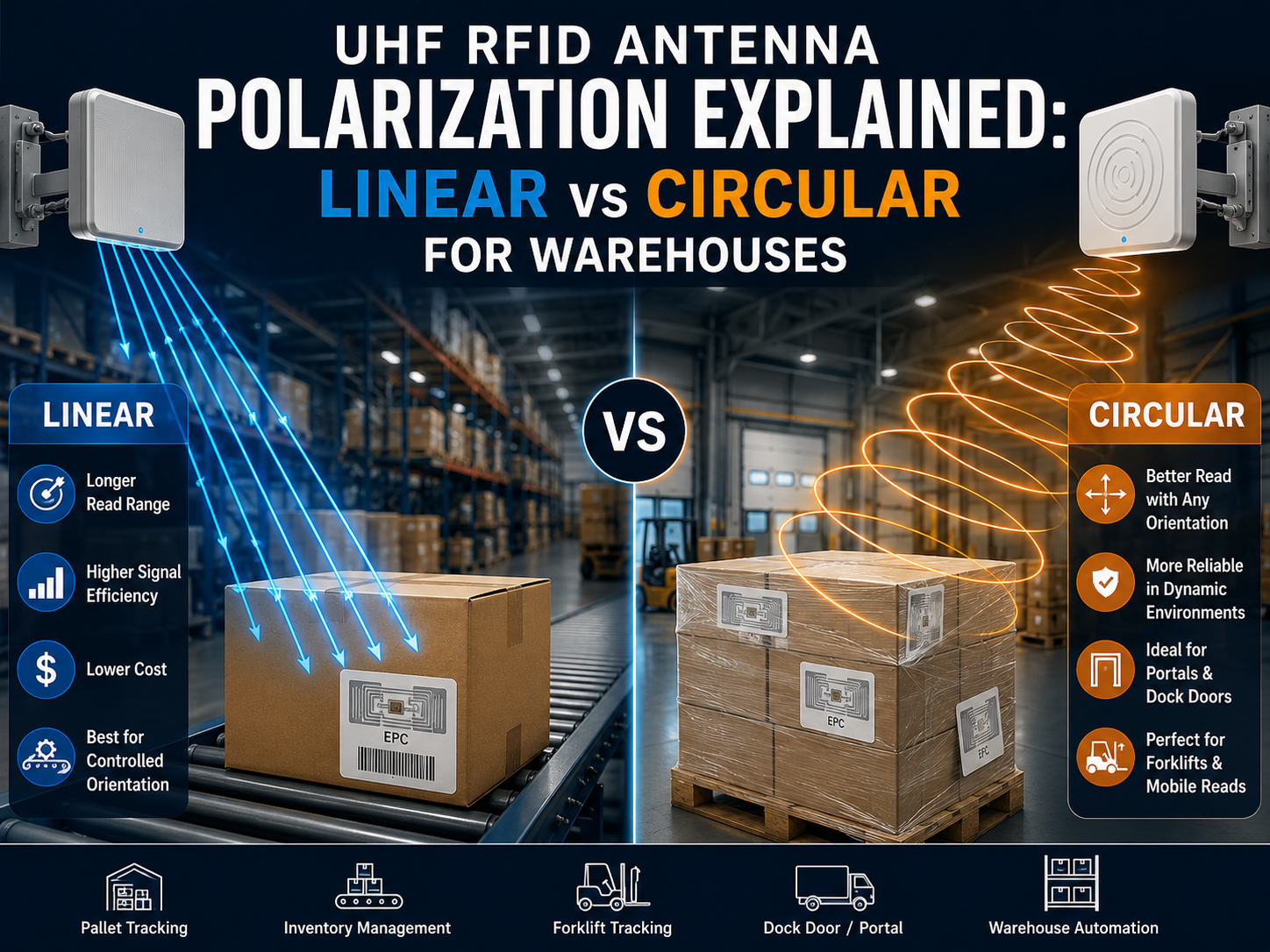
A linear polarized antenna transmits radio waves in a single plane.
The electric field travels in one fixed direction, usually:
- Vertical
- Horizontal
For maximum performance, the RFID tag antenna should be aligned with the reader antenna’s polarization.
If both are aligned, signal transfer is highly efficient.
If the tag is rotated 90 degrees relative to the reader antenna, performance can drop dramatically.
How Linear Polarization Works
Imagine shining a flashlight through a narrow slot.
The light travels in one direction.
Similarly, a linear antenna concentrates RF energy in a specific orientation.
This creates stronger signal intensity and greater read range when alignment is correct.
Advantages of Linear Polarized RFID Antennas
Longer Read Range
Linear antennas typically offer the greatest read distance when the tag orientation is known.
Because RF energy is concentrated in a single plane, less energy is wasted.
Many long-range RFID systems use linear antennas to maximize performance.
Higher Signal Efficiency
When tag orientation matches the antenna, communication efficiency is excellent.
This often results in:
- Faster tag reads
- Better sensitivity
- Improved read accuracy
Lower Cost
Linear antennas are usually less expensive than circular polarized antennas.
For large installations involving dozens of antennas, this cost difference can be significant.
Better for Controlled Environments
Applications with predictable tag orientation benefit greatly from linear polarization.
Примеры включают:
- Конвейерные системы
- Производственные линии
- Automated packaging stations
- Access control lanes
Disadvantages of Linear Polarized RFID Antennas
Sensitive to Tag Orientation
This is the biggest limitation.
If tags are rotated relative to the antenna, read performance decreases.
In real warehouses, products are rarely positioned perfectly.
Greater Risk of Missed Reads
Random pallet loading and mixed carton orientations can create blind spots.
A tag positioned incorrectly may not be detected even if it is within range.
Understanding Circular Polarization
Circular polarized antennas transmit radio waves that rotate continuously.
The electric field spins in a circular motion while traveling through space.
This allows the antenna to communicate with tags in multiple orientations.
Circular polarization comes in two forms:
- Right-Hand Circular Polarization (RHCP)
- Left-Hand Circular Polarization (LHCP)
For most warehouse applications, the difference between RHCP and LHCP is less important than the overall benefit of orientation flexibility.
How Circular Polarization Works
Instead of transmitting energy in one fixed direction, the antenna rotates the RF field.
As a result, the signal can interact with RFID tags regardless of how they are positioned.
This makes circular antennas extremely popular in logistics and warehouse environments.
Advantages of Circular Polarized RFID Antennas
Better Read Performance with Random Tag Orientation
Warehouse operators rarely control how every product is placed.
Circular polarization helps ensure reliable reads even when tags are:
- Tilted
- Rotated
- Mounted vertically
- Mounted horizontally
This flexibility significantly improves operational reliability.
Reduced Installation Complexity
Because alignment is less critical, installation becomes easier.
System integrators spend less time adjusting antenna angles and tag positions.
Improved Portal Performance
Dock doors and RFID portals often process mixed products with varying tag orientations.
Circular antennas are usually the preferred solution because they increase the likelihood of reading every tag.
Ideal for Mobile Operations
Forklift-mounted readers and handheld RFID readers frequently encounter tags from different angles.
Circular polarization provides more consistent results in these situations.
Disadvantages of Circular Polarized RFID Antennas
Reduced Maximum Read Range
Compared with a perfectly aligned linear antenna, circular antennas generally sacrifice some read distance.
The antenna distributes energy across multiple orientations, reducing peak signal strength.
Higher Cost
Circular antennas are typically more expensive than linear models.
However, the improvement in read reliability often justifies the additional investment.
Linear vs Circular: Which Is Better for Warehouses?
There is no universal answer.
The best choice depends on how products move through the warehouse.
Choose Linear Polarization When:
- Tag orientation is consistent
- Maximum read range is required
- Conveyor systems are used
- Production lines follow a fixed process
- Cost optimization is important
Choose Circular Polarization When:
- Tag orientation varies
- Pallets contain mixed products
- Forklifts move products frequently
- Warehouse operations are dynamic
- Read reliability is the top priority
For most modern warehouses, circular polarization is often the safer choice.
The small reduction in maximum range is usually outweighed by higher overall read rates.
Real Warehouse Examples
Example 1: Conveyor-Based Carton Tracking
A distribution center uses RFID to track cartons moving along a conveyor.
Each carton is positioned consistently with the RFID label facing forward.
In this scenario, a linear antenna provides:
- Большая дальность считывания
- Higher signal efficiency
- Lower hardware costs
This is an ideal application for linear polarization.
Example 2: Pallet Tracking at Dock Doors
A logistics company receives pallets from multiple suppliers.
Tags may be placed on different sides of cartons.
Some labels face outward while others face inward.
A circular antenna allows the portal to read tags regardless of orientation.
This significantly improves receiving accuracy.
Example 3: Forklift RFID Systems
A warehouse installs RFID readers on forklifts to track pallet movement.
The angle between reader and tag constantly changes.
Circular polarization delivers more reliable performance because alignment cannot be controlled.
Can You Combine Linear and Circular Antennas?
Absolutely.
Many large warehouses use both types.
A common deployment strategy includes:
Circular Antennas For
- Двери дока
- Shipping portals
- Receiving stations
- Forklift systems
- General inventory tracking
Linear Antennas For
- Conveyor lines
- Fixed scanning stations
- Automated manufacturing cells
- Controlled workflows
This hybrid approach allows companies to maximize performance while controlling costs.
Other Factors That Affect Antenna Performance
Polarization is important, but it is not the only factor.
Warehouse managers should also evaluate:
Antenna Gain
Higher gain antennas typically provide longer read distances but narrower coverage areas.
Beam Width
Antenna beam patterns influence how much area is covered.
Mounting Location
Poor placement can create dead zones.
Металлические помехи
Warehouse racks and machinery can reflect RF signals.
Reader Power Settings
Excessive power may create unwanted reads.
Tag Quality
Even the best antenna cannot compensate for poorly designed RFID tags.
A complete site survey is often necessary to optimize performance.
Best Practices Before Purchasing RFID Antennas
Before ordering antennas for a warehouse deployment:
- Define expected read distances.
- Analyze tag orientations.
- Identify metal and liquid interference.
- Test multiple antenna types.
- Perform pilot installations.
- Measure actual read rates.
- Compare total system performance instead of theoretical specifications.
Testing in a real warehouse environment will always provide more useful information than laboratory data sheets.

О компании XIUCHENG RFID
XIUCHENG RFID специализируется на производстве широкого спектра RFID продуктов, включая RFID силиконовые напульсники, Tyvek напульсники, тканевые напульсники, эластичные напульсники, виниловые напульсники, RFID бирки для прачечных, бирки для животных и RFID карты. Вся продукция производится под строгим контролем качества и с использованием передовых технологий производства.
Благодаря 12-летнему опыту в области разработки браслетов, дизайна меток, управления качеством и взаимоотношений с клиентами мы создали прочный фундамент для поставки надежных и высокопроизводительных RFID-решений.
Заключительные размышления
RFID antenna polarization is one of the most important factors influencing warehouse RFID performance.
Linear polarization delivers excellent read range and efficiency when tag orientation is controlled. Circular polarization provides superior flexibility and reliability when tags are positioned unpredictably.
For conveyor-based operations with consistent label placement, linear antennas often provide the best value.
For pallet tracking, dock doors, inventory management, and general warehouse automation, circular antennas are typically the preferred choice because they reduce missed reads and simplify deployment.
The most successful RFID warehouses rarely choose antennas based solely on specifications. Instead, they evaluate actual operational requirements, conduct field testing, and select the polarization that matches real-world conditions.
By understanding the strengths and limitations of both linear and circular polarization, buyers can design RFID systems that deliver higher read accuracy, better operational efficiency, and long-term reliability.


