In the world of wireless identification, metal has historically been the “arch-nemesis” of Radio Frequency Identification (RFID). If you’ve ever tried to place a standard RFID sticker on a laptop, a steel beam, or an aluminum container, you likely noticed that the tag simply stopped working.
This is where Anti-Metal RFID Tags (also known as metal-mount tags) come into play. But what makes them different, and how do they overcome the laws of physics? Let’s dive deep into the technology that makes tracking metal assets possible.
The “Metal Problem”: Why Standard RFID Fails
To understand anti-metal tags, we must first understand why standard tags fail on metallic surfaces. RFID technology relies on electromagnetic fields to transmit data. When a standard RFID tag is placed on metal, two major issues occur:
- Reflection and Interference: Metal surfaces reflect the RF energy sent by the reader, creating interference that prevents the tag’s antenna from receiving the signal.
- Eddy Currents: The electromagnetic field from the reader induces “Eddy currents” in the metal surface. These currents create a counter-magnetic field that cancels out the RFID signal, effectively “de-tuning” the tag’s antenna.
How Does an Anti-Metal RFID Tag Work?
Anti-metal RFID tags are specifically engineered to function on or even inside metal. The secret lies in the shielding material placed between the RFID chip/antenna and the metallic surface.
1. The Isolation Layer (Ferrite/Spacer)
Most anti-metal tags use a layer of ferrite foil or a high-dielectric synthetic material. This layer acts as an insulator that prevents the metal from interfering with the antenna. It “tricks” the antenna into thinking it is in free space or uses the metal surface itself to actually enhance the signal’s reflected gain in some UHF designs.
2. Physical Design
Unlike paper-thin stickers, anti-metal tags are often thicker. This physical gap (offset) is calculated precisely to ensure the tag’s frequency remains stable. For example, a tag tuned for $13.56 \text{ MHz}$ (NFC/HF) or $860 \text{–} 960 \text{ MHz}$ (UHF) must maintain that resonance even when mounted on a conductive surface.
Types of Anti-Metal RFID Tags
Depending on the application, these tags come in various form factors:
A. Hard RFID Tags (ABS or PCB)
These are rugged tags encased in hard plastic (ABS) or printed circuit boards (PCB). They are designed for industrial use, offering high resistance to impact, chemicals, and extreme temperatures.
-
Best for: Manufacturing equipment, shipping containers, and heavy machinery.
B. Flexible Anti-Metal Labels
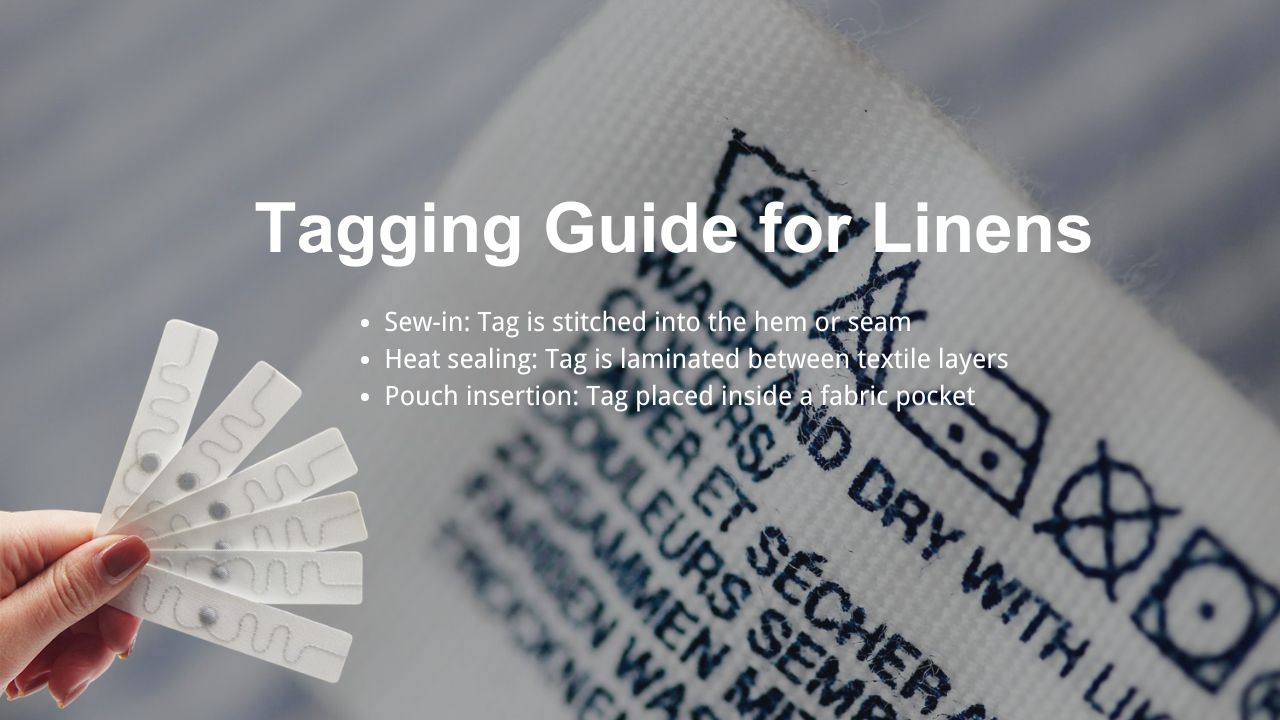
A relatively recent innovation, these are thin, printable labels with a thin ferrite layer. They can be fed through specialized RFID printers.
-
Best for: IT asset tracking (laptops, servers) and curved metal surfaces.
C. PCB Tags
Small, rigid tags that offer excellent read ranges despite their compact size.
-
Best for: Small tool tracking and weapon management.
D. Epoxy Anti-Metal Tags
These combine the durability of epoxy resin with an anti-metal backing. As discussed in our previous post, these are perfect for consumer-facing environments where aesthetics matter.
Key Technical Specifications
When selecting an anti-metal tag, you must consider the frequency and the mounting environment:
| Feature | Low Frequency (LF) | High Frequency (HF/NFC) | Ultra-High Frequency (UHF) |
| Frequency Range | $125 \text{ kHz}$ | $13.56 \text{ MHz}$ | $860 \text{–} 960 \text{ MHz}$ |
| Read Range | Very Short (< 10 cm) | Short (10 cm – 1 m) | Long (Up to 10m+) |
| Data Rate | Low | Moderate | High |
| Metal Resistance | Naturally good | Requires ferrite layer | Requires complex shielding |
| Typical Use | Animal ID, Access Control | Payments, NFC, Library | Logistics, Tool Tracking |
Common Applications of Metal-Mount RFID
1. IT Asset Management
Data centers use flexible anti-metal labels to track servers, blade switches, and racks. This allows for near-instantaneous audits of millions of dollars worth of equipment.
2. Manufacturing and Molds
In automotive or aerospace manufacturing, molds and tools are extremely expensive. Anti-metal PCB tags can withstand the high heat and pressure of the production line while tracking the tool’s lifecycle.
3. Oil and Gas Industry
Pipes, valves, and drilling equipment are subjected to salt water, mud, and extreme pressure. Ruggedized UHF anti-metal tags allow companies to track these assets across global supply chains.
4. Smart Retail and Consumer Tech
Placing an NFC tag on a stainless steel refrigerator or a metal-bodied laptop for “Tap-to-Support” services requires an anti-metal layer to ensure the smartphone can read the tag.
How to Choose the Right Anti-Metal Tag
To ensure your project succeeds, ask these four questions during the procurement phase:
- What is the read range requirement? (UHF is needed for long distances; NFC for close-range smartphone interaction).
- How will it be attached? (3M adhesive, screws, or rivets?)
- What is the environment? (Will it be exposed to chemicals, UV light, or $200^\circ\text{C}$ temperatures?)
- Is the surface flat or curved? (Rigid PCB tags won’t work on pipes; flexible labels are required).
Conclusion
Understanding what an anti-metal RFID tag is is the first step toward digitizing your industrial or high-tech environment. By utilizing ferrite shielding and specialized antenna designs, these tags turn problematic metal surfaces into high-functioning data points.