


Industrial laundry environments are among the most hostile conditions RFID tags can face. High temperatures, mechanical stress, moisture, and aggressive chemicals quickly degrade conventional materials. Yet PPS RFID laundry tags are engineered to survive hundreds of industrial washing cycles while maintaining stable RF performance.
This article explains why PPS RFID laundry tags work where others fail, from material science to mechanical design and real-world laundry processes.
The Challenges of Industrial Washing for RFID Tags
Commercial and industrial laundry processes typically involve:
- Washing temperatures up to 90°C
- High-pressure water jets
- Strong alkaline detergents and bleaching agents
- Repeated mechanical compression and friction
- High-speed extraction and drying
For RFID tags embedded in textiles, failure can occur in several ways:
- Microchip damage due to thermal stress
- Antenna deformation under compression
- Water ingress leading to corrosion
- Chemical degradation of encapsulation materials
Only tags specifically designed for these conditions can maintain long-term reliability.
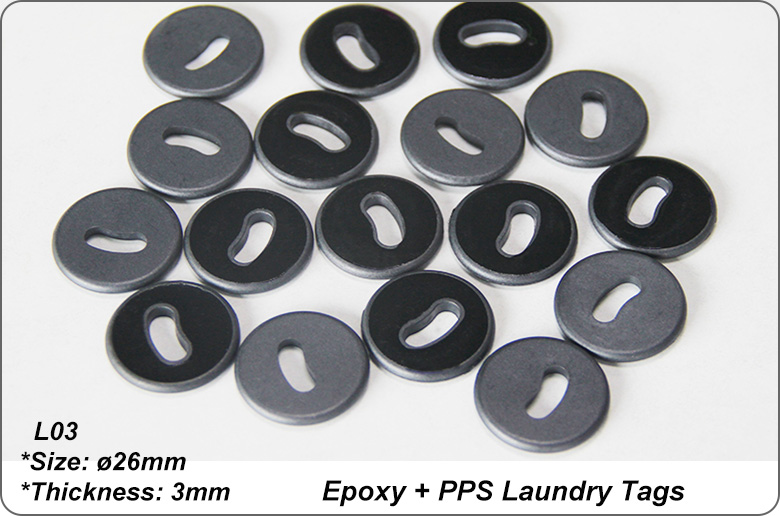
Why PPS Is Used in RFID Laundry Tags
Material Properties of PPS (Polyphenylene Sulfide)
PPS is a high-performance engineering plastic commonly used in automotive and aerospace components. Its properties make it particularly suitable for RFID laundry tags:
- High thermal stability with minimal deformation
- Excellent chemical resistance to detergents and solvents
- Low moisture absorption
- High mechanical strength under compression
Unlike silicone or epoxy-based housings, PPS does not soften or swell during repeated wash cycles.
Fully Encapsulated Tag Construction
PPS RFID laundry tags are fully encapsulated on both sides, creating a sealed structure that protects internal components.
Key design characteristics include:
- Hermetic sealing to prevent water ingress
- Rigid structure to protect the RFID chip and antenna
- Uniform material thickness to avoid stress concentration
This encapsulation ensures consistent performance even after long-term exposure to harsh environments.
Mechanical Resistance During Washing
During washing and drying, RFID tags are subjected to intense mechanical forces:
- Compression from stacked textiles
- Impact from rotating drums
- Friction against metal and fabric surfaces
PPS RFID laundry tags are engineered to withstand:
- Axial compression forces up to 1000 N
- Radial compression forces up to 500 N
These limits exceed typical stresses found in industrial laundry processes, preventing internal damage and antenna breakage.
Protection Against Water and Chemicals
IP68 Sealing Performance
PPS RFID laundry tags typically achieve IP68 protection, meaning:
- Complete resistance to water ingress
- Stability under high-pressure washing (up to 45 bar)
- Long-term submersion without performance degradation
Chemical Resistance
PPS is resistant to:
- Alkaline detergents
- Bleaching agents
- Common dry-cleaning chemicals
This prevents cracking, swelling, or material fatigue over time.
RF Performance Stability After Repeated Wash Cycles
Durability alone is not enough. RFID laundry tags must maintain reliable RF characteristics.
PPS RFID laundry tags are designed to:
- Maintain antenna geometry under thermal and mechanical stress
- Preserve consistent activation field strength
- Support high anti-collision performance for bulk reading
In practice, this enables:
- Fast tunnel or gate reading
- Accurate batch counting
- Stable performance across LF, HF, and UHF systems
Comparison: PPS vs Silicone RFID Laundry Tags
| Feature | PPS RFID Laundry Tag | Silicone RFID Laundry Tag |
|---|---|---|
| Heat resistance | Excellent | Moderate |
| Chemical resistance | Excellent | Limited |
| Mechanical stability | High | Medium |
| Long-term deformation | Minimal | Possible |
| Typical service life | Longer | Shorter |
While silicone tags are suitable for lighter-duty applications, PPS tags are preferred for high-volume, high-temperature industrial laundries.
Real-World Applications
PPS RFID laundry tags are widely used in:
- Hotel and hospitality linen management
- Hospital and healthcare textile tracking
- Industrial workwear rental services
- Laundry logistics and textile circulation systems
Their durability allows operators to track textile assets throughout their entire lifecycle.
Conclusion
PPS RFID laundry tags survive industrial washing because they are engineered specifically for it. The combination of PPS material properties, full encapsulation, mechanical strength, and chemical resistance ensures long-term reliability where conventional RFID tags fail.
For industrial laundries that demand accuracy, automation, and durability, PPS RFID laundry tags remain one of the most reliable identification technologies available.


