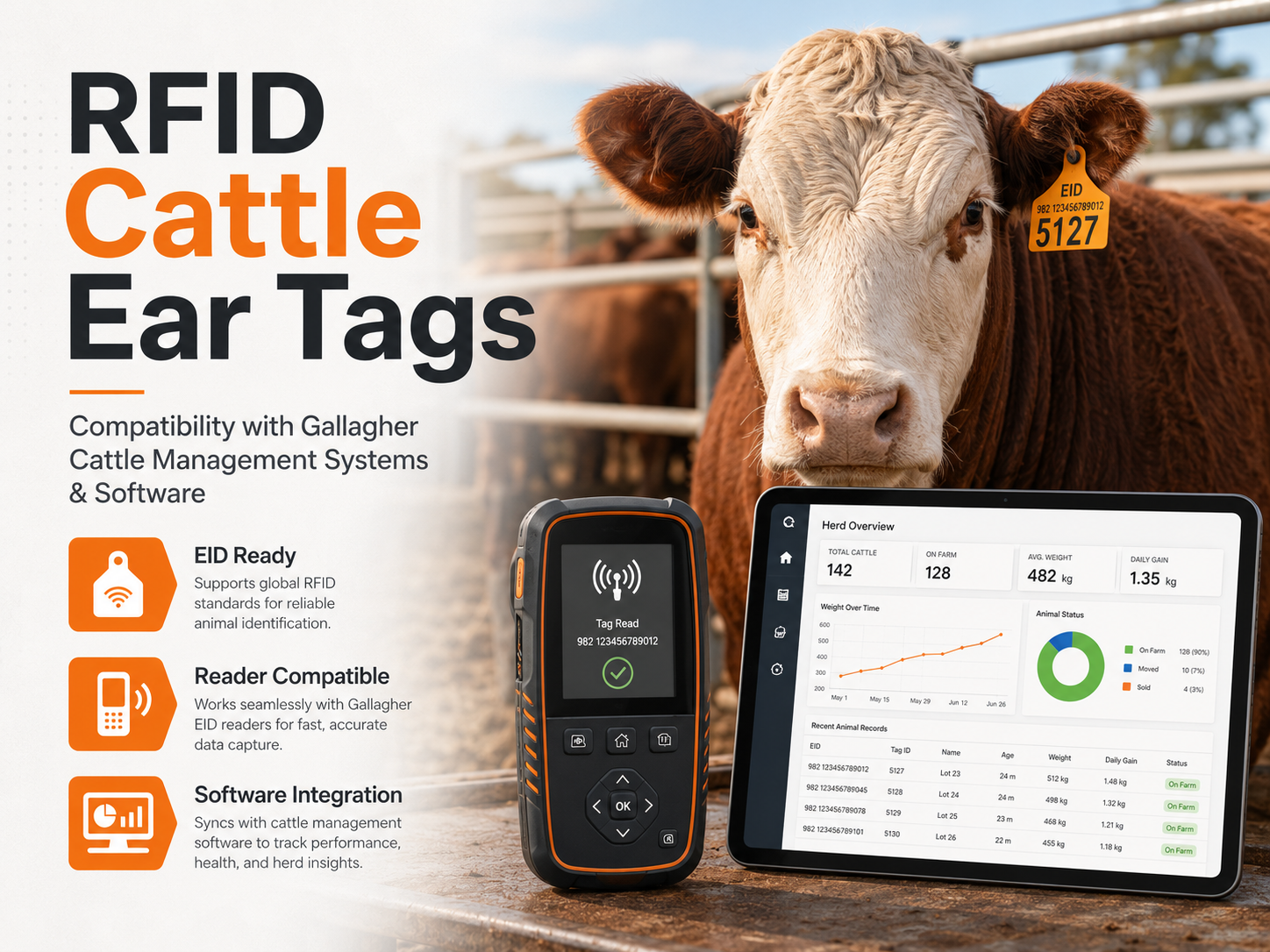
Electronic identification is no longer limited to recording a number against an animal. On modern cattle farms, an RFID ear tag can connect an individual animal with its weight history, health treatments, breeding records, movements and performance data.
Gallagher, a New Zealand agricultural technology company founded in 1938, offers an ecosystem that combines electronic identification readers, livestock weighing equipment and animal management software. Its cattle management solutions are used to collect EID numbers and connect those numbers with individual animal records.
This creates an important purchasing question for cattle farmers, livestock equipment distributors and RFID ear tag suppliers:
Can a third-party RFID cattle ear tag work with Gallagher readers, weigh scales and cattle management software?
In many cases, the answer is yes—provided that the tag uses the correct frequency, protocol and identification format.
However, technical readability, software compatibility and regulatory approval are separate issues. An ear tag may be readable by Gallagher equipment without being officially approved for use under a national livestock traceability programme.
This guide explains how compatibility works and what should be verified before ordering cattle EID tags in bulk.
What Is the Gallagher Cattle Management Ecosystem?
Gallagher Animal Management is a New Zealand-based provider of electric fencing, livestock weighing, electronic identification and farm data-management products.
Its cattle identification and performance-management ecosystem may include:
- Electronic cattle ear tags
- Handheld EID readers
- Fixed EID antenna panels
- Livestock weigh scales
- Load bars and weighing platforms
- Drafting and sorting systems
- Mobile Anwendungen
- Web-based animal management software
Gallagher’s current Animal Performance platform is designed to bring together animal identification, weight and management data. Farmers can use the system to monitor individual animals as well as broader herd trends.
The important point is that the RFID ear tag does not communicate directly with the software.
The normal data path is:
RFID cattle ear tag → EID reader or weigh scale → animal record → Gallagher Animal Performance software
Understanding this data flow makes compatibility easier to evaluate.
What Does “Compatible with Gallagher” Actually Mean?
The phrase “compatible with Gallagher” can refer to several different things.
1. The Gallagher reader can identify the RFID ear tag
The reader must support the tag’s operating frequency and communication protocol.
For most cattle EID systems, this means a low-frequency transponder operating at approximately 134.2 kHz and conforming to the relevant ISO animal identification standards.
2. The reader receives a valid electronic identification number
The tag must contain a correctly encoded and unique animal identification number.
The number should not be duplicated, incorrectly structured or overwritten with unrelated data.
3. The identification number can be associated with cattle records
Once read, the EID number can be linked with information such as:
- Visual ear tag number
- Animal name
- Breed
- Sex
- Date of birth
- Mob or group
- Live weight
- Daily weight gain
- Pregnancy status
- Health treatments
- Drafting group
- Movement history
- Parent and offspring information
4. The data can be transferred to Gallagher software
Depending on the Gallagher hardware being used, animal data may be transferred through Bluetooth, Wi-Fi, USB or another supported connection.
The software normally receives the EID number and its associated records from the reader or weigh scale. It does not normally need to know which company physically manufactured the plastic ear tag.
5. The ear tag meets local regulatory requirements
Technical compatibility does not automatically make a tag legally acceptable.
National livestock traceability programmes may require:
- Approved tag manufacturers
- Assigned manufacturer codes
- Government-approved numbering
- Specific colours or printed information
- Tamper-evident construction
- Laboratory certification
- Official registration before use
This distinction is especially important in New Zealand, where cattle and deer identification is managed under the National Animal Identification and Tracing programme.
The Main Technical Requirement: ISO 11784 and ISO 11785
Gallagher identifies its livestock EID readers as capable of reading ISO electronic identification tags, including HDX and FDX-B transponders.
The two principal standards are:
ISO 11784
ISO 11784 defines the code structure used for radio-frequency identification of animals.
It determines how information such as the country or manufacturer code and individual animal number is organized within the transponder.
ISO 11785
ISO 11785 defines how the RFID transponder and reader communicate.
It covers the technical communication methods used for animal identification devices, including HDX and FDX-B technologies.
A cattle ear tag intended for use with Gallagher EID equipment should normally conform to both standards.
A supplier should be able to provide documentation showing:
- RFID technology used
- Betriebsfrequenz
- ISO conformance
- Manufacturer code
- Product code
- ICAR certification status, where applicable
- Individual electronic number format
- Production and encoding controls
A statement such as “134.2 kHz RFID tag” is not sufficient on its own. Two tags may operate at a similar frequency while using different data structures or protocols.
HDX and FDX-B Cattle Ear Tags
Gallagher’s livestock EID readers support the two main ISO animal identification technologies: HDX and FDX-B.
What Is an HDX Ear Tag?
HDX means Half Duplex.
An HDX transponder receives energy from the reader and sends its identification data during a separate part of the communication cycle.
HDX cattle ear tags are widely used in livestock management applications and are available for individual animal identification, weighing and traceability.
What Is an FDX-B Ear Tag?
FDX-B means Full Duplex-B.
An FDX-B transponder transmits its data while it is being energized by the reader field.
FDX-B is also widely used in electronic livestock identification and is supported by many handheld and fixed cattle readers.
Will Gallagher Equipment Read Both Types?
Gallagher states that products such as its HR5 handheld EID reader, SmartReader systems and EID antenna panels can read both HDX and FDX-B electronic identification tags.
Therefore, a correctly manufactured ISO-compliant HDX or FDX-B cattle tag should generally be technically readable by corresponding Gallagher equipment.
This does not mean that every tag will provide identical field performance.
Read reliability can also be affected by:
- Transponder quality
- Entwurf einer Antenne
- Ear tag dimensions
- Transponder orientation
- Größe der Leseantenne
- Animal movement speed
- Nearby metal structures
- Electrical interference
- Reader installation
- Multiple animals entering the reading zone
- Tag placement in the ear
Compatibility should be verified using the exact reader, antenna and farm environment planned for deployment.
Compatibility with Gallagher HR Handheld EID Readers
Gallagher handheld readers are used when farmers or operators need to scan animals individually.
The HR5 Hand Held EID Reader and Data Collector can read ISO animal electronic identification numbers and supports both HDX and FDX-B tags.
The reader can be used to:
- Scan an RFID cattle ear tag
- Display the animal’s EID number
- Associate a visual ID with the EID
- Record animal traits
- Create session records
- Add notes and alerts
- Link mothers with offspring
- Receive animal information
- Connect EID data with weight records
- Transfer session data to compatible software
For basic compatibility, the cattle ear tag must return a valid EID number when placed within the reader’s effective reading area.
A third-party tag does not usually need to contain special “Gallagher software” inside the chip. The reader is collecting a standardized animal identification number.
The software integration occurs after the reader has collected the number.
Compatibility with Gallagher Fixed EID Readers
Fixed readers are often installed around:
- Cattle crushes
- Weighing platforms
- Raceways
- Drafting gates
- Loading areas
- Treatment stations
Gallagher antenna panels and reader controllers are designed to identify tagged animals as they move through a controlled reading zone.
Gallagher specifies that relevant antenna-panel systems read ISO EID ear tags and support both HDX and FDX-B.
Fixed-reader compatibility depends on more than chip protocol. Installation quality has a major effect on performance.
Factors to test include:
Antenna location
The antenna should be positioned so that the animal’s ear tag passes through a strong and consistent reading field.
Metallische Interferenz
Cattle yards contain gates, crushes, rails and structural steel. Incorrect antenna placement near large metal components may reduce reading performance.
Electrical interference
Motors, variable-frequency drives, electric fences, cables and other equipment can introduce noise.
Tierfluss
A reader installed for one animal at a time may perform differently if several cattle enter the reading zone together.
Reading speed
The system must have enough time to energize and read the transponder as the animal moves past the antenna.
Tag position
Ear tag location and orientation influence how the transponder couples with the reader field.
A tag that reads reliably with a handheld reader at close range may require further testing in a fixed walk-through system.
Compatibility with Gallagher TWR Weigh Scales and Readers
Gallagher TWR systems combine livestock weighing and electronic identification.
Depending on the selected model and configuration, a TWR system can use an integrated EID reader or connect to a compatible antenna panel.
When a tagged animal enters the weighing area, the system can associate the electronic ear tag number with:
- Live weight
- Previous weight
- Weight gain
- Drafting criteria
- Animal traits
- Health information
- Management alerts
- Session data
The RFID tag itself generally provides the EID number. The weigh scale and software provide the additional management functions.
This means that an ear tag does not need to store weight or health information in its chip. Those records are held in the management system and linked to the tag number.
For a third-party cattle tag, the critical requirement remains a valid and readable ISO electronic ID.
Compatibility with Gallagher TW Weigh Scales
Gallagher TW weigh scales are data collectors without an integrated reader in some configurations.
An external handheld reader, antenna panel or reader controller may be connected to the weigh scale.
The typical process is:
- The cattle ear tag is scanned.
- The EID number is transferred to the weigh scale.
- The animal is weighed.
- The weight is linked to the EID number.
- The combined record is stored in the session.
- The data is synchronized with the management platform.
When evaluating compatibility, buyers should confirm both sides of the connection:
- The cattle ear tag must be readable by the selected EID reader.
- The selected reader must be able to communicate with the weigh scale.
A tag can be technically readable but still appear incompatible if the reader and weigh scale have not been paired or configured correctly.
Compatibility with Gallagher Animal Performance Software
Gallagher Animal Performance is a web and mobile animal data-management platform.
The platform is designed to help farmers track livestock performance from herd-level trends down to individual animal records.
Depending on the hardware and software plan, users may be able to access:
- Individual animal profiles
- EID and visual ID records
- Weight history
- Average daily gain
- Treatment information
- Mob performance
- Drafting records
- Breeding data
- Animal notes
- Alerts
- Session history
- Performance reports
The ear tag does not connect directly to the web or mobile application.
Instead, the workflow is normally:
- A Gallagher-compatible reader scans the EID tag.
- The reader or weigh scale creates an animal record.
- Additional data is attached to the EID number.
- The hardware synchronizes the session with Animal Performance.
- The user reviews the animal through the mobile or web application.
From the software’s perspective, the EID number functions as the primary link to the individual animal.
As long as the number is read correctly and transferred through supported Gallagher hardware, the physical brand of the ear tag may not prevent the number from being used in the software.
Do RFID Cattle Ear Tags Need Special Software Encoding?
In most livestock applications, an ISO cattle ear tag is not encoded like a general-purpose NFC tag or UHF inventory label.
The transponder contains a permanently programmed animal identification code. This code is normally assigned and controlled during manufacturing.
The tag supplier should not simply enter arbitrary customer numbers into the RFID memory.
Correct encoding requires:
- An authorized manufacturer code or country-code structure
- A unique electronic number
- Control against duplicate numbers
- Correct bit structure
- Correct protocol
- Matching visual information where required
- Traceable production records
Farm information such as weight, breed and treatments is not normally stored inside the ear tag. It remains in the livestock management database.
This is important because livestock RFID tags are intended to provide a persistent identity, not act as a large portable storage device.
Visual ID and Electronic ID Must Be Managed Correctly
Many cattle ear tags include both:
- An electronic identification number stored in the RFID transponder
- A visible number printed or laser-marked on the tag
The visual ID makes it possible to identify an animal without a reader. The electronic ID allows automatic data collection.
These two numbers may be the same, partially related or completely different, depending on the identification programme and farm workflow.
Gallagher hardware can be used to link a visual ID with an EID. This supports situations such as:
- Adding a farm management number
- Replacing a lost tag
- Cross-referencing an existing visual tag
- Searching for an animal by visual number
- Confirming that the correct animal has been scanned
Suppliers should verify that visual printing, electronic encoding and customer data files remain correctly matched throughout production.
One mismatched number can attach the wrong performance or treatment history to an animal.
New Zealand NAIT Requirements
Gallagher originated in New Zealand, where cattle and deer are covered by the National Animal Identification and Tracing programme.
Under NAIT requirements, official identification devices must be approved for the programme.
A generic ISO-compliant ear tag may be technically readable by a Gallagher scanner but still not qualify as an official NAIT tag.
These are two separate questions:
Can the Gallagher reader scan the tag?
This is a technical compatibility question involving ISO conformance, HDX or FDX-B technology and reader performance.
Can the tag legally be used as an official NAIT identification device?
This is a regulatory approval question determined by New Zealand’s NAIT authority.
For official New Zealand livestock identification, farmers should purchase the correct NAIT-approved tags through authorized channels.
RFID tag suppliers should not advertise a product as “NAIT approved” unless that exact device has received the required approval.
ICAR Certification and RFID Device Quality
The International Committee for Animal Recording acts as the registration authority for ISO 11784 and ISO 11785 animal identification systems.
ICAR maintains registries of RFID devices that have been tested for conformance with these standards.
An ICAR certificate can help a buyer verify:
- Manufacturer identity
- Manufacturer code
- Product code
- Transponder type
- HDX or FDX-B technology
- Device category
- ISO conformance status
- Certification validity
However, buyers should inspect the certificate carefully.
The manufacturer name, product code and construction on the certificate should match the product being supplied. A certificate for one transponder should not be presented as proof for every finished ear tag produced by the supplier.
Depending on the market, additional composition, environmental, retention or field-performance testing may also be required.
Physical Quality Still Matters
A chip may be electronically compatible while the finished ear tag performs poorly in the field.
Cattle ear tags are exposed to:
- Regen
- Mud
- Staub
- UV radiation
- Temperature changes
- Animal movement
- Auswirkungen
- Fences and vegetation
- Chemical treatments
- Langfristige mechanische Belastung
Important physical characteristics include:
Retention
The tag should remain attached to the animal throughout the intended service life.
Tamper evidence
Official identification tags are generally designed so they cannot be removed and reused without visible damage.
Locking strength
The male and female parts must form a secure connection without causing unnecessary damage to the ear.
Material quality
The tag material should remain flexible enough to avoid cracking while resisting deformation, weathering and wear.
Print durability
Visible numbers, barcodes and logos should remain legible after long-term outdoor use.
Transponder sealing
The RFID transponder must remain protected from moisture, impact and mechanical stress.
Applicator compatibility
Using an unsuitable applicator may damage the tag, prevent correct locking or injure the animal.
Electronic readability is only one part of cattle ear tag quality.
How to Test Ear Tags with a Gallagher System
Before ordering a large production quantity, carry out a structured compatibility test.
Step 1: Review the Technical Documents
Request:
- ISO 11784/11785 documentation
- ICAR certificate
- Manufacturer and product codes
- HDX or FDX-B specification
- Betriebsfrequenz
- Tag dimension drawing
- Material specification
- Printing method
- Retention test information
- Environmental test reports
Step 2: Confirm the Gallagher Hardware
Record the exact model being used, such as:
- HR handheld EID reader
- Fixed antenna panel
- Reader controller
- TW weigh scale
- TWR weigh scale and reader
Compatibility should not be approved based only on the Gallagher brand name. Different farms may use different generations and configurations of equipment.
Step 3: Scan Individual Sample Tags
Scan every sample several times and check:
- Read success
- Identification number
- Duplicate response
- Reading orientation
- Reading speed
- Visual and electronic number matching
Step 4: Test the Tags on Cattle
Laboratory testing on loose tags does not fully reproduce field conditions.
Apply samples using the correct applicator and test:
- Real ear placement
- Normal animal movement
- Handheld scanning
- Fixed-panel scanning
- Weighing-session data collection
Tag application should follow local welfare and identification requirements.
Step 5: Link the Tags with Weight Records
Confirm that each EID can be associated with:
- Current weight
- Previous weight
- Visual ID
- Animal group
- Session name
- Additional traits
Step 6: Synchronize with Animal Performance
Verify that the session transfers successfully and that the correct animal records appear in the Gallagher software.
Check the full chain:
Tag → reader → weigh scale → session → software
Step 7: Test Exceptions
A useful pilot should also test:
- Doppelte Scans
- Unrecognized EID numbers
- Replacement tags
- Missing visual IDs
- Animals passing too quickly
- Two animals near the antenna
- Temporary loss of internet access
- Interrupted Bluetooth connection
- Data synchronization after reconnecting
Step 8: Conduct a Field Pilot
A pilot batch should remain in use long enough to evaluate:
- Tag retention
- Zuverlässigkeit lesen
- Print wear
- Material condition
- Genauigkeit der Daten
- Operator experience
- Software workflow
A successful bench test is not a substitute for a farm pilot.
Questions to Ask an RFID Cattle Ear Tag Supplier
Before purchasing tags described as compatible with Gallagher, ask the supplier:
- Does the tag comply with ISO 11784 and ISO 11785?
- Is it HDX or FDX-B?
- What is the operating frequency?
- Is the exact product registered or certified by ICAR?
- What manufacturer code is used?
- How are duplicate electronic numbers prevented?
- Can the supplier match the printed visual ID to the electronic ID?
- Has the tag been tested with Gallagher handheld readers?
- Has it been tested with fixed Gallagher antenna panels?
- Can sample tags be provided for field testing?
- Is the tag approved under the relevant national traceability scheme?
- What tag applicator is required?
- What retention and environmental tests have been completed?
- Can the supplier provide an encoding and printing data report?
- How are failed or unreadable tags handled?
A supplier should be able to distinguish between ISO compliance, reader compatibility and government approval.
Recommended Compatibility Wording for Suppliers
Manufacturers and distributors should avoid wording that suggests an official commercial relationship unless one exists.
A more accurate product description would be:
Designed for use with livestock EID readers supporting ISO 11784/11785 HDX or FDX-B transponders. Samples should be tested with the customer’s specific Gallagher reader, weigh scale and software workflow before bulk deployment.
Avoid statements such as:
- Official Gallagher ear tag
- Certified by Gallagher
- Gallagher-approved cattle tag
- Guaranteed for every Gallagher system
These statements should only be used when there is documented authorization or certification supporting them.
Gallagher is a third-party trademark belonging to its respective owner. Technical compatibility does not imply endorsement, partnership or affiliation.
Common Reasons a Tag May Appear Incompatible
Incorrect RFID Technology
A UHF inventory tag, NFC tag or unsupported LF transponder will not function as an ISO cattle EID ear tag.
Invalid Identification Structure
The reader may detect a transponder but reject, misinterpret or incorrectly display data that does not follow the expected animal identification format.
Duplicate Numbers
Two cattle assigned the same EID can corrupt animal histories and create serious traceability problems.
Weak Transponder Performance
A low-quality transponder may read at very close range but fail in a fixed raceway or weighing system.
Incorrect Reader Configuration
The reader may be set to a particular operating mode, output format or communication interface.
Bluetooth or Wi-Fi Problems
The tag may have been read correctly even though the data was not transferred to the weigh scale or software.
Incorrect Animal Mapping
An EID may exist in the software but be linked to the wrong visual ID or animal record.
National Approval Restrictions
A tag may be technically readable but rejected for official movement or traceability reporting because it is not approved under the local programme.
Benefits of Using Compatible RFID Ear Tags with Gallagher Systems
When correctly selected and implemented, cattle EID tags can support:
Faster animal identification
Operators do not need to manually read and enter a printed number for every animal.
More accurate weighing records
Weights can be automatically connected with the correct animal identity.
Individual performance monitoring
Farmers can compare growth rates and identify animals that are underperforming.
Better health management
Treatments, observations and alerts can be associated with individual cattle.
Improved drafting decisions
Animals can be separated according to weight, performance, health status or management criteria.
Reduced data-entry errors
Electronic scanning reduces mistakes caused by manually typing visual numbers.
Stronger traceability
A persistent individual identifier supports movement records, farm management and compliance workflows.
Connected farm information
Records collected in the cattle yard can be synchronized with web and mobile software for later analysis.
Final Compatibility Checklist
An RFID cattle ear tag is more likely to work correctly with Gallagher cattle management equipment when it meets the following conditions:
- Operates at the correct livestock EID frequency
- Complies with ISO 11784 and ISO 11785
- Uses HDX or FDX-B technology supported by the reader
- Contains a valid and unique electronic ID
- Has verifiable manufacturer and product codes
- Provides suitable read performance
- Is correctly attached to the animal
- Is tested with the exact Gallagher hardware
- Transfers correctly through the reader and weigh-scale workflow
- Synchronizes successfully with Animal Performance
- Meets local livestock identification regulations
- Uses an approved device where an official national scheme requires it
Abschluss
Gallagher cattle management systems are built around standardized electronic animal identification.
A third-party RFID cattle ear tag can generally be technically compatible when it conforms to ISO 11784 and ISO 11785 and uses a supported HDX or FDX-B transponder.
The ear tag provides the animal’s electronic identity. Gallagher readers capture that identity, weigh scales associate it with performance data, and Animal Performance software turns the records into information that farmers can use.
However, buyers should not rely on a broad “Gallagher compatible” claim alone.
Compatibility should be evaluated at three levels:
- Technical compatibility: Can the Gallagher reader reliably read the tag?
- System compatibility: Can the EID and animal data move through the weigh scale and software workflow?
- Regulatory compatibility: Is the tag approved for official use in the target country?
The safest approach is to review certification documents, test samples with the customer’s actual equipment and complete a field pilot before bulk production.
Häufig gestellte Fragen
Can Gallagher readers read third-party RFID cattle ear tags?
Gallagher readers designed for ISO livestock EID can generally read compliant HDX and FDX-B tags, regardless of the physical tag manufacturer. The exact tag should still be tested with the selected reader and installation.
What frequency do Gallagher-compatible cattle ear tags use?
ISO electronic livestock tags generally operate in the low-frequency range at approximately 134.2 kHz.
Does the ear tag connect directly to Gallagher Animal Performance?
No. The tag is read by an EID reader or compatible weighing device. The hardware then transfers the EID number and associated animal data to the software.
Does Gallagher support both HDX and FDX-B?
Gallagher specifies support for both HDX and FDX-B electronic animal identification tags across relevant EID reader products.
Is an ISO-compliant tag automatically NAIT approved?
No. ISO compliance concerns technical communication and identification structure. New Zealand’s NAIT programme separately approves official identification devices.
Can animal weights be stored in the RFID ear tag?
Normally, no. The tag provides a unique EID number. Weight and health records are stored in the reader, weigh scale or animal management database and linked to that number.
What is the difference between a visual ID and an EID?
The visual ID is printed or marked on the outside of the tag. The EID is electronically stored in the RFID transponder. The two identifiers can be linked in the cattle management system.
Can one tag work with handheld and fixed Gallagher readers?
A correctly designed ISO HDX or FDX-B tag may be readable by both, but actual performance should be tested because handheld and fixed systems use different antenna arrangements and reading conditions.
Does technical compatibility mean Gallagher endorses the tag?
No. A product can be technically readable by Gallagher equipment without being manufactured, approved or endorsed by Gallagher.
What should be tested before placing a bulk order?
Test the electronic number, read reliability, printed-number matching, tag application, handheld reading, fixed-panel reading, weighing integration, software synchronization and long-term field retention.
References
- Gallagher Animal Management, HR5 Hand Held EID Reader & Data Collector product information.
- Gallagher Animal Management, HR5 Hand Held EID Reader User Manual.
- Gallagher Animal Management, TWR EID Tag Reader Antenna Panel product information.
- Gallagher Animal Management, Animal Performance web and mobile application information.
- Gallagher Animal Management, Weighing and EID Solutions.
- ICAR, RFID Device Certification and ISO 11784/11785 Device Registry.
- OSPRI New Zealand, NAIT Standard Animal Identification Devices.
- New Zealand Ministry for Primary Industries, National Animal Identification and Tracing Programme.