


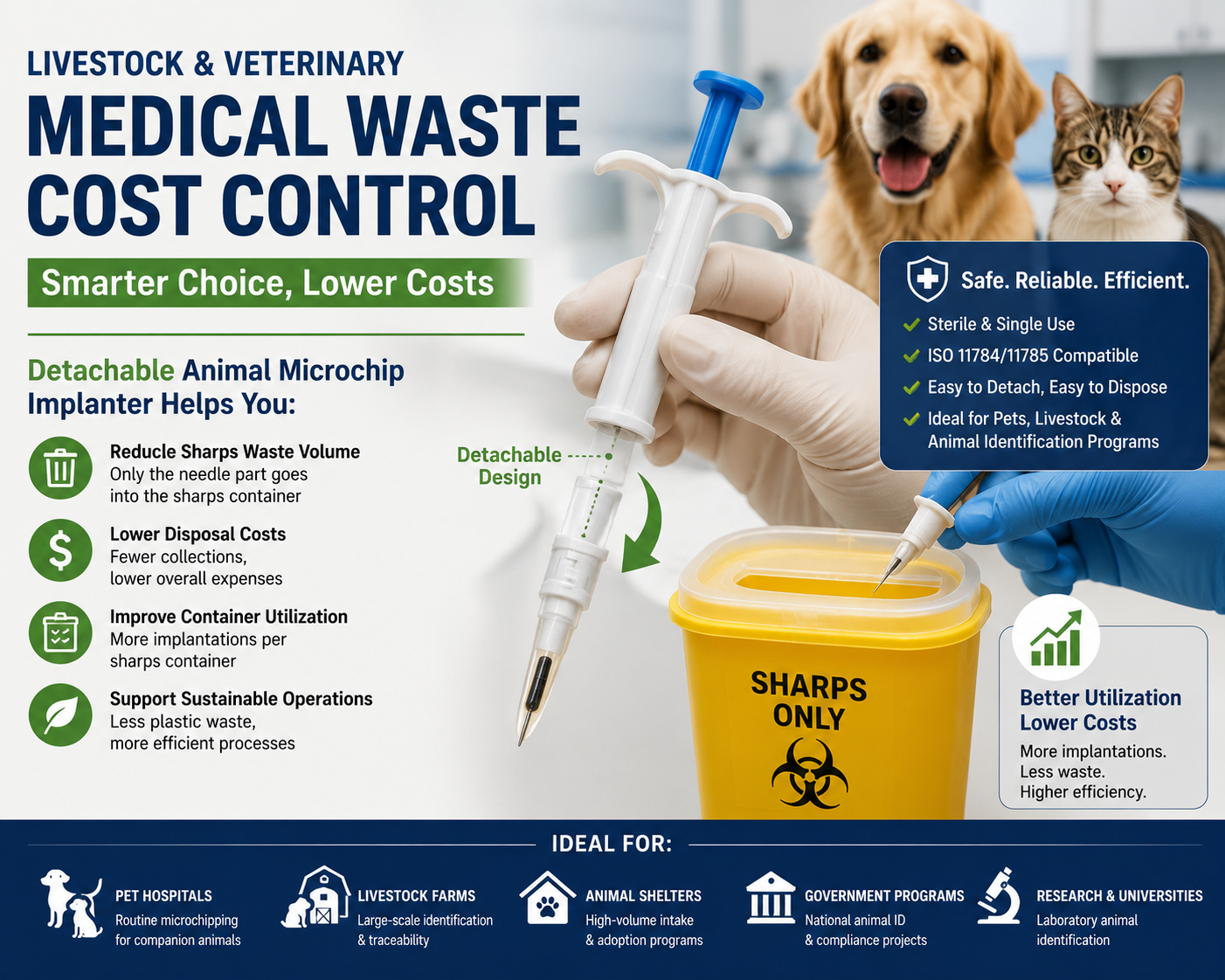
Microchipping has become a standard practice in modern animal identification. Whether used for companion animals, livestock, laboratory animals, or breeding programs, RFID microchips provide permanent identification that supports traceability, disease control, ownership verification, and regulatory compliance.
While most discussions focus on chip performance, ISO compatibility, or implantation procedures, one operational cost often goes unnoticed: medical waste disposal.
Veterinary hospitals, livestock service providers, and animal shelters perform hundreds or even thousands of implantations each year. Every disposable injector occupies valuable space inside sharps containers, directly influencing disposal frequency and medical waste costs.
An increasing number of organizations are addressing this challenge by adopting detachable animal microchip implanters. Unlike traditional one-piece disposable injectors, these systems allow the needle assembly to be separated after implantation, significantly improving sharps container utilization and reducing waste management expenses.
The Hidden Cost of Veterinary Sharps Waste
Every injection performed in a veterinary setting generates regulated medical waste.
Although an individual microchip injector is relatively inexpensive, disposal costs accumulate over time because veterinary sharps must be collected, transported, and treated according to local medical waste regulations.
For busy facilities, expenses include:
- Sharps container purchases
- Medical waste collection fees
- Incineration or treatment costs
- Storage and transportation
- Staff handling time
- Compliance documentation
Many clinics monitor pharmaceutical expenses carefully while overlooking waste disposal as an operational cost center.

Why Traditional Microchip Injectors Waste Valuable Sharps Container Space
Most conventional animal microchip injectors are manufactured as a single integrated unit.
After implantation, the entire plastic handle and needle assembly are discarded together.
Although only the needle is considered a sharps hazard, the large plastic body occupies far more space than the needle itself.
As sharps containers reach their fill limits based on volume rather than weight, large injectors reduce the number of procedures that each container can accommodate.
The result is:
- More frequent container replacement
- Higher disposal costs
- Increased storage requirements
- Additional transportation volume
For organizations performing thousands of implantations annually, these inefficiencies become significant.
What Is a Detachable Animal Microchip Implanter?
A detachable animal microchip implanter separates into two components after implantation:
- A disposable needle assembly containing the implanted microchip
- A detachable plastic handle or reusable holder, depending on product design
Once the procedure is complete, only the sharps component enters the sharps container.
The remaining non-sharp component is managed according to the manufacturer’s intended disposal or reuse process and applicable local regulations.
Because the bulky handle is no longer occupying sharps container space, facilities can improve container utilization considerably.
How Detachable Designs Improve Sharps Container Efficiency
The primary advantage is volumetric efficiency.
Instead of filling a sharps container with complete injector assemblies, only the components that present a sharps risk require disposal as regulated sharps waste.
This creates several operational benefits:
- More implantations per sharps container
- Reduced frequency of waste collection
- Better utilization of disposal capacity
- Lower transportation volume
- Improved storage efficiency before collection
The exact savings depend on injector design, sharps container size, local regulations, and implantation volume.
Cost Savings Become More Significant at Scale
Small veterinary clinics may perform only a few implantations each week.
By contrast, large organizations often process thousands of animals each year, including:
- Livestock breeding operations
- Government identification programs
- Tierheime
- Veterinary hospital networks
- Pet microchipping campaigns
- Research institutions
At these volumes, even modest improvements in sharps container utilization can contribute to lower annual waste management costs.
Facilities should evaluate total lifecycle costs rather than comparing only injector purchase prices.
Operational Benefits Beyond Disposal Costs
Detachable implant systems can also improve workflow efficiency.
Potential advantages include:
- Fewer sharps container replacements during busy periods
- Reduced storage requirements for full containers
- Lower handling frequency by staff
- Cleaner waste segregation
- Better organization of disposal processes
These operational improvements become increasingly valuable as implantation volume grows.
Supporting Sustainable Veterinary Operations
Many veterinary organizations are working to reduce environmental impact without compromising clinical safety.
Waste reduction initiatives may include:
- More efficient packaging
- Improved recycling programs
- Reduced plastic consumption
- Better segregation of regulated waste
- Optimized procurement practices
Detachable implant systems align with these objectives by minimizing the volume of regulated sharps waste requiring specialized treatment.
It is important to distinguish between reducing waste volume and reducing clinical safety requirements. All sharps must continue to be handled and disposed of in accordance with applicable regulations.
Applications Across Animal Identification Programs
Detachable microchip implanters are suitable for a wide range of identification projects.
Companion Animal Clinics
Routine pet identification programs can reduce sharps waste while maintaining efficient implantation workflows.
Tierheime
Shelters often implant microchips during intake or adoption preparation.
Large-scale processing makes waste optimization particularly valuable.
Livestock Operations
Breeding farms and livestock identification programs may implant thousands of animals during seasonal operations.
Reducing disposal logistics can improve operational efficiency.
Government Identification Programs
National animal identification initiatives frequently involve high-volume implantation campaigns where waste management becomes a significant operational consideration.
Veterinary Universities and Research Facilities
Teaching hospitals and research institutions performing regular implantation procedures may also benefit from improved sharps container utilization.
Choosing the Right Animal Microchip Implanter
When evaluating implantation systems, purchasing decisions should consider more than chip performance.
Wichtige Faktoren sind:
RFID Chip Compatibility
Ensure the implanted microchip complies with applicable standards such as ISO 11784 and ISO 11785 if required by the target market.
Needle Quality
Needle sharpness, coating, and manufacturing quality directly influence implantation performance.
Ergonomic Design
Comfortable handling helps improve consistency during repeated implantation procedures.
Detachable Mechanism
The separation process should be simple, reliable, and easy to perform while maintaining safe sharps handling practices.
Packaging and Sterility
Each sterile package should provide clear labeling, lot traceability, and protection throughout transportation and storage.
Einhaltung gesetzlicher Vorschriften
Select products that comply with applicable veterinary medical device regulations and market requirements.
Best Practices for Veterinary Waste Management
Regardless of the implantation system used, veterinary facilities should maintain clear waste management procedures.
Recommended practices include:
- Never overfill sharps containers.
- Follow local regulations for medical waste segregation.
- Train staff in safe sharps handling procedures.
- Replace containers according to manufacturer recommendations.
- Maintain documentation for regulated waste disposal.
- Conduct periodic reviews of waste generation and disposal costs.
Combining good operational practices with efficient implant systems provides the greatest opportunity for cost optimization.
Häufig gestellte Fragen
Does a detachable microchip implanter reduce medical waste?
It reduces the volume of regulated sharps waste requiring disposal by allowing only the sharps component to enter the sharps container, depending on the specific product design and local waste management regulations.
Can detachable implant systems improve sharps container utilization?
Yes. Because the larger handle is separated from the needle assembly, more sharps can typically fit within the same container volume.
Are detachable animal microchip implanters suitable for both pets and livestock?
Many manufacturers offer detachable systems for companion animals, livestock, and other animal identification applications. Product specifications should always be verified before purchase.
Does using a detachable implanter affect RFID chip performance?
No. The implantation device does not change the RFID chip’s communication protocol or identification performance when manufactured to the appropriate specifications.
Should veterinary clinics switch solely for waste cost savings?
Waste management is one consideration among many. Clinics should evaluate clinical performance, regulatory compliance, staff workflow, product quality, and total cost of ownership before making purchasing decisions.
Abschluss
Medical waste disposal represents an often-overlooked operating expense in veterinary medicine and livestock identification programs.
Traditional one-piece microchip injectors consume unnecessary sharps container space, increasing disposal frequency and associated costs. Detachable animal microchip implanters provide a practical alternative by separating the sharps component from the larger handle, allowing clinics and livestock operators to improve sharps container utilization without changing their identification procedures.
For organizations performing high volumes of animal microchip implantation, evaluating the entire lifecycle cost—including procurement, handling, storage, and medical waste disposal—can support more efficient and sustainable operations.


