


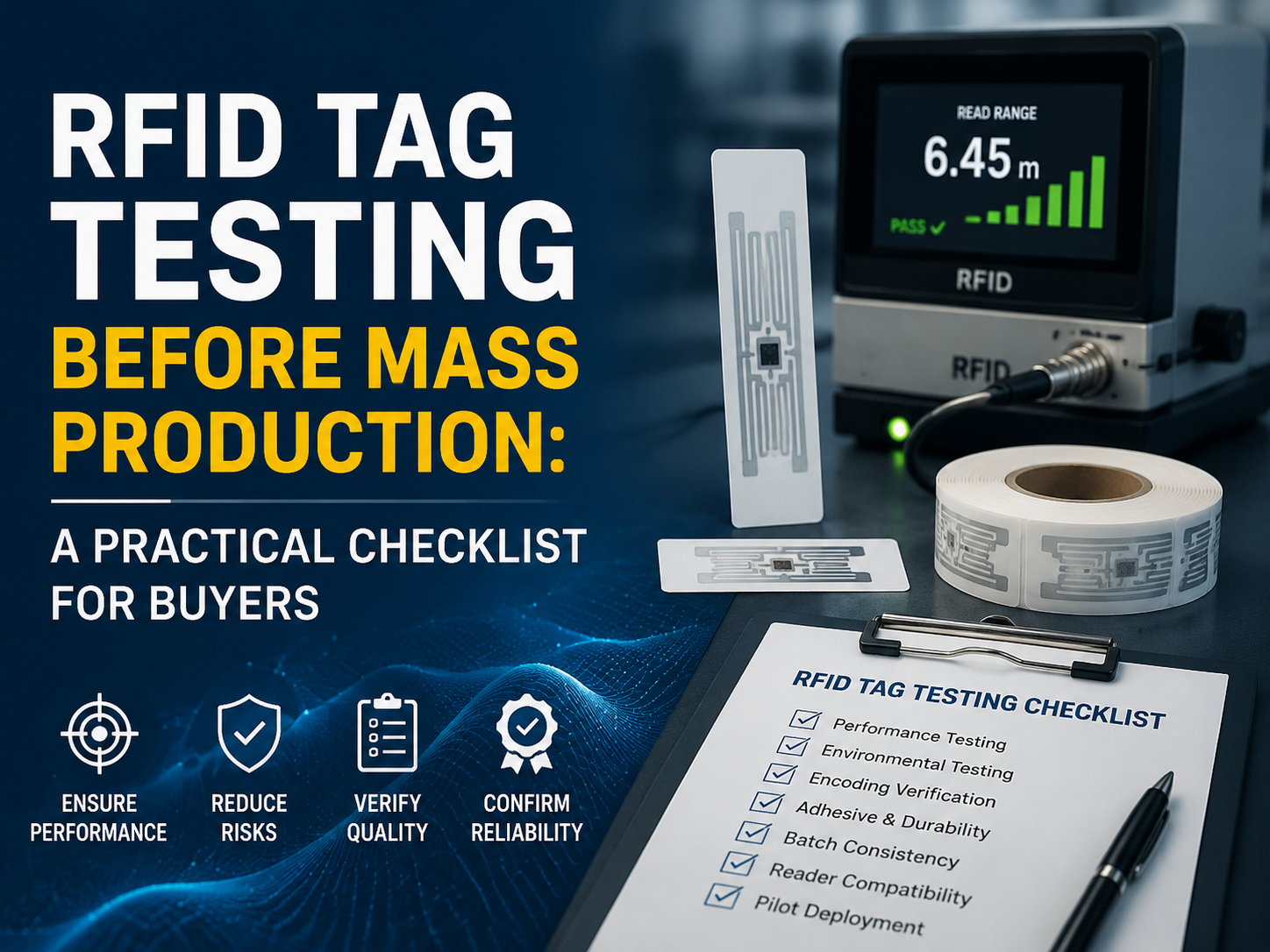
When companies begin an RFID deployment, most of the attention goes to software integration, reader installation, and process optimization. Surprisingly, one of the biggest causes of project failure happens much earlier—during the sourcing stage of RFID tags.
Many buyers assume that if a sample tag works during initial testing, the entire production batch will perform identically. In reality, large-volume manufacturing introduces variables that can significantly impact RFID performance, including antenna consistency, chip bonding quality, material selection, and production tolerances.
A tag that reads perfectly in the lab may fail when attached to metal containers, exposed to high temperatures, or processed through automated conveyor systems.
For manufacturers, retailers, logistics providers, hospitals, and industrial companies, a defective RFID batch can mean delayed projects, inventory inaccuracies, and thousands of dollars in replacement costs.
This guide provides a practical checklist that professional buyers can use before approving mass production.
Why RFID Tag Testing Is Critical
Unlike traditional printed labels, tag RFID are electronic devices. Every tag contains at least three critical components:
- Chip RFID
- Antenna
- Substrate or encapsulation material
Failure in any of these components can reduce read range or cause complete tag failure.
生产后发现的常见问题包括:
- Inconsistent read distance
- Dead tags
- Scarso incollaggio del chip
- EPC encoding errors
- Tags detuning on metal surfaces
- Environmental degradation
- Printing and RFID data mismatches
Finding these problems after receiving 100,000 tags is expensive. Finding them during sample validation costs almost nothing.
专业RFID采购人员将生产前测试视为一种保险措施。
Step 1: Confirm Technical Specifications
Before evaluating performance, verify that the proposed tag matches your application requirements.
Frequenza
Ensure the operating frequency is correct:
- LF (125 kHz / 134.2 kHz): Animal identification and access control
- HF (13.56 MHz): NFC, libraries, payment systems
- UHF (860-960 MHz): Supply chain, warehousing, retail
A mismatch here makes the tag unusable regardless of quality.
RFID Protocol
Check compatibility with your existing infrastructure.
Typical standards include:
- ISO 18000-6C / EPC Gen2
- ISO 14443
- ISO 15693
- ISO 11784/11785 for animal identification
Memory Configuration
Many new RFID buyers only focus on EPC memory, but additional memory banks can be important.
Review:
- Memoria EPC
- Memoria TID
- Memoria utente
- Memoria riservata
For example, apparel tracking may only require EPC, while industrial assets often benefit from additional user memory for maintenance records.
Step 2: Verify Physical Dimensions
Even a few millimeters difference can create installation problems.
Check:
- Overall tag dimensions
- Inlay size
- Spessore
- Hole diameter (for hard tags)
- Adhesive area
- Printing zone
Compare actual samples with engineering drawings.
If tags will be embedded into products, test physical fit before approving production.
Step 3: Test Read Range Under Real Conditions
Manufacturers often advertise maximum read distances measured in ideal laboratory environments.
Real-world performance can be dramatically different.
Create a testing environment that matches actual usage.
Questions to consider:
- Will tags be attached to cardboard?
- Plastic pallets?
- Liquid containers?
- Metal equipment?
- Fabric garments?
For each scenario, measure:
- Distanza massima di lettura
- Stable read distance
- Read angle sensitivity
- Multi-tag reading performance
A tag with a 12-meter laboratory range may only achieve 4 meters when mounted on metal.
Testing in the intended environment is far more valuable than relying on datasheet specifications.
Step 4: Evaluate Metal and Liquid Interference
RF signals behave differently around conductive materials and water.
Metal reflects radio waves, while liquids absorb RF energy.
Applications requiring special attention include:
- Beverage logistics
- Pharmaceutical products
- Chemical containers
- Apparecchiature mediche
- Steel asset tracking
- IT server management
If your products contain significant amounts of liquid or metal, request specialized anti-metal RFID tags or on-metal labels.
Never assume that a standard paper UHF label will work properly on steel surfaces.
Step 5: Check Encoding Accuracy
Encoding errors can cause major operational issues.
Verify that:
- EPC numbers are unique
- Data matches customer requirements
- TID remains unchanged
- User memory writes correctly
- Lock commands function properly
- Password protection operates as expected
Randomly sample encoded tags and compare them against your encoding database.
Many experienced buyers require suppliers to provide encoding verification reports before shipment.
Step 6: Conduct Batch Consistency Testing
A single sample proves almost nothing.
Instead, request a pilot batch of 500 to 2,000 pieces.
Randomly select tags from different positions within the batch and test:
- Read distance variation
- Encoding consistency
- Physical appearance
- Qualità di stampa
- Adhesive quality
Statistical sampling often reveals manufacturing problems that isolated samples cannot detect.
Professional buyers understand that consistency is just as important as peak performance.
Step 7: Test Adhesive Performance
For self-adhesive RFID labels, adhesive failure can completely undermine the project.
Test adhesion on actual application surfaces:
- Corrugated cartons
- Plastic containers
- Glass bottles
- Metal cabinets
- Textile products
Observe performance after:
- 24 hours
- One week
- Temperature cycling
- Humidity exposure
A high-performance RFID inlay attached with poor adhesive is still a failed solution.
Step 8: Environmental Durability Testing
RFID tags often operate in harsh conditions.
Environmental testing should simulate the product lifecycle.
Resistenza alla temperatura
Typical testing ranges:
- -40°C storage
- 85°C operation
- Thermal shock cycling
Humidity Testing
Expose samples to high-humidity conditions for extended periods.
Observe:
- Delaminazione
- Corrosion
- Read performance degradation
Water Resistance
For outdoor and laundry applications, test:
- Water immersion
- Pressure washing
- Steam exposure
Resistenza chimica
Industrial tags should withstand:
- Cleaning agents
- Alcohol
- Petrolio
- Solvents
- Disinfettanti
Laundry RFID tags should also survive repeated detergent and bleaching cycles.
Step 9: Mechanical Reliability Testing
Daily operations expose RFID tags to physical stress.
Depending on the application, perform:
- Bending tests
- Compression tests
- Drop tests
- Vibration tests
- Abrasion tests
Hard tags used in manufacturing and logistics should maintain functionality after repeated impacts.
Flexible labels should continue working after bending around curved surfaces.
Step 10: Multi-Reader Compatibility Testing
Not all readers perform identically.
A tag optimized for one reader may perform differently with another.
If your organization uses multiple brands of readers, test compatibility across all devices.
Include:
- Lettori fissi
- Lettori portatili
- Tunnel readers
- Portal readers
- Printer-encoders
This is especially important for multinational companies operating across different facilities.
Step 11: Validate Printing Quality
Many RFID projects combine visual information with RFID functionality.
Check:
- Barcode readability
- QR code quality
- Human-readable text
- Logo positioning
- Resistenza alla stampa
Use barcode verification equipment where possible.
A perfectly functioning RFID chip cannot compensate for unreadable printed information.
Step 12: Review Manufacturing Quality Controls
A reliable RFID supplier should be transparent about quality management.
Ask questions such as:
- Is every tag electrically tested?
- What is the acceptable defect rate?
- What inspection equipment is used?
- Is production fully automated?
- Can traceability reports be provided?
Suppliers with mature quality systems often perform 100% electrical testing before shipment.
This significantly reduces the likelihood of dead tags entering your inventory.
Step 13: Request Certifications
Depending on your industry, verify compliance with applicable standards.
Common certifications include:
- ISO 9001
- RoHS
- RAGGIUNGERE
- CE
- FCC
- EPCglobal compliance
These certifications do not guarantee perfect performance, but they demonstrate manufacturing discipline and regulatory compliance.
Step 14: Perform a Pilot Deployment
Before ordering hundreds of thousands of tags, conduct a limited field trial.
Deploy several hundred tags in actual operations.
Monitor:
- Read rates
- Missing reads
- Installation efficiency
- User feedback
- Impatto ambientale
Many hidden problems only emerge during real workflows.
A successful pilot greatly reduces implementation risk.
Questions Every Buyer Should Ask Before Approving Mass Production
Before signing the purchase order, ask your supplier:
- Has every tag been electrically tested?
- Can you provide encoding verification reports?
- What is your production defect rate?
- Can you guarantee batch consistency?
- Have these tags been tested in applications similar to ours?
- What environmental tests have been performed?
- Can you supply additional pilot quantities if adjustments are needed?
The quality of the answers often reveals more about the supplier than the technical datasheet itself.

Informazioni su XIUCHENG RFID
XIUCHENG RFID è specializzata nella produzione di un'ampia gamma di prodotti RFID, tra cui braccialetti in silicone RFID, braccialetti in Tyvek, braccialetti in tessuto, braccialetti elastici, braccialetti in vinile, etichette RFID per lavanderia, etichette per animali e tessere RFID. Tutti i prodotti sono realizzati con un rigoroso controllo di qualità e una tecnologia di produzione avanzata.
Con 12 anni di esperienza nella progettazione di braccialetti, tag, gestione della qualità e gestione delle relazioni con i clienti, abbiamo costruito una solida base per fornire soluzioni RFID affidabili e ad alte prestazioni.
Considerazioni finali
RFID projects rarely fail because the technology itself is flawed. Most failures stem from inadequate planning and insufficient validation before mass production.
Smart buyers understand that RFID tags are not commodity stickers—they are precision electronic components that must perform consistently under real operating conditions.
A structured testing process helps eliminate costly surprises, protects project timelines, and ensures long-term system reliability.
Whether you are sourcing RFID labels for retail, warehouse management, industrial asset tracking, healthcare, or livestock identification, investing time in pre-production testing will almost always deliver a positive return.
The cheapest RFID tag is not necessarily the lowest-cost solution.
The best RFID tag is the one that performs reliably, consistently, and exactly as your application demands.


