Choosing the right RFID tag is only part of a successful deployment. The adhesive that holds the tag to an asset is just as important. Even the highest-performing RFID inlay can fail if the adhesive cannot maintain a secure bond throughout the asset’s service life.
Different materials have different surface energies, textures, coatings, and environmental exposures. An adhesive that performs well on corrugated cartons may fail quickly on powder-coated metal. Likewise, an adhesive designed for smooth glass may not bond reliably to woven textiles.
Understanding how RFID tag adhesives interact with various surfaces helps manufacturers, system integrators, and end users improve read reliability, reduce tag replacement, and lower maintenance costs.
Why Adhesive Selection Matters
RFID systems depend on consistent tag positioning. If a label lifts, shifts, curls, or detaches, read performance may decrease or fail entirely.
Poor adhesive selection can lead to:
- Detached RFID tags
- Reduced read consistency
- Higher maintenance costs
- Rework during production
- Asset identification errors
- Shorter tag service life
- Customer complaints
In many industrial applications, replacing failed labels costs far more than the price difference between adhesive options.
How RFID Tag Adhesives Work
Pressure-sensitive adhesives (PSAs) are the most common bonding method for RFID labels.
Unlike liquid glues, PSAs form a bond when pressure is applied during installation. Their performance depends on:
- Surface energy
- Surface cleanliness
- 온도
- Contact pressure
- Dwell time
- 환경 노출
After application, many adhesives continue developing bond strength for several hours or even days.
For this reason, installers should avoid testing peel strength immediately after installation.
Permanent vs Removable Adhesives
RFID labels are typically available with either permanent or removable adhesive systems.
Permanent Adhesives
Permanent adhesives are intended to remain attached throughout the label’s service life.
다음과 같은 이점이 있습니다:
- Strong bonding
- Better vibration resistance
- Improved outdoor durability
- Lower risk of accidental removal
일반적인 애플리케이션은 다음과 같습니다:
- Fixed assets
- Industrial equipment
- 물류 컨테이너
- Warehouse labels
Removable Adhesives
Removable adhesives allow labels to be peeled away with minimal residue.
일반적인 애플리케이션은 다음과 같습니다:
- Temporary inventory
- 대여 장비
- Short-term identification
- Event logistics
They are generally not recommended for long-term industrial asset tracking.
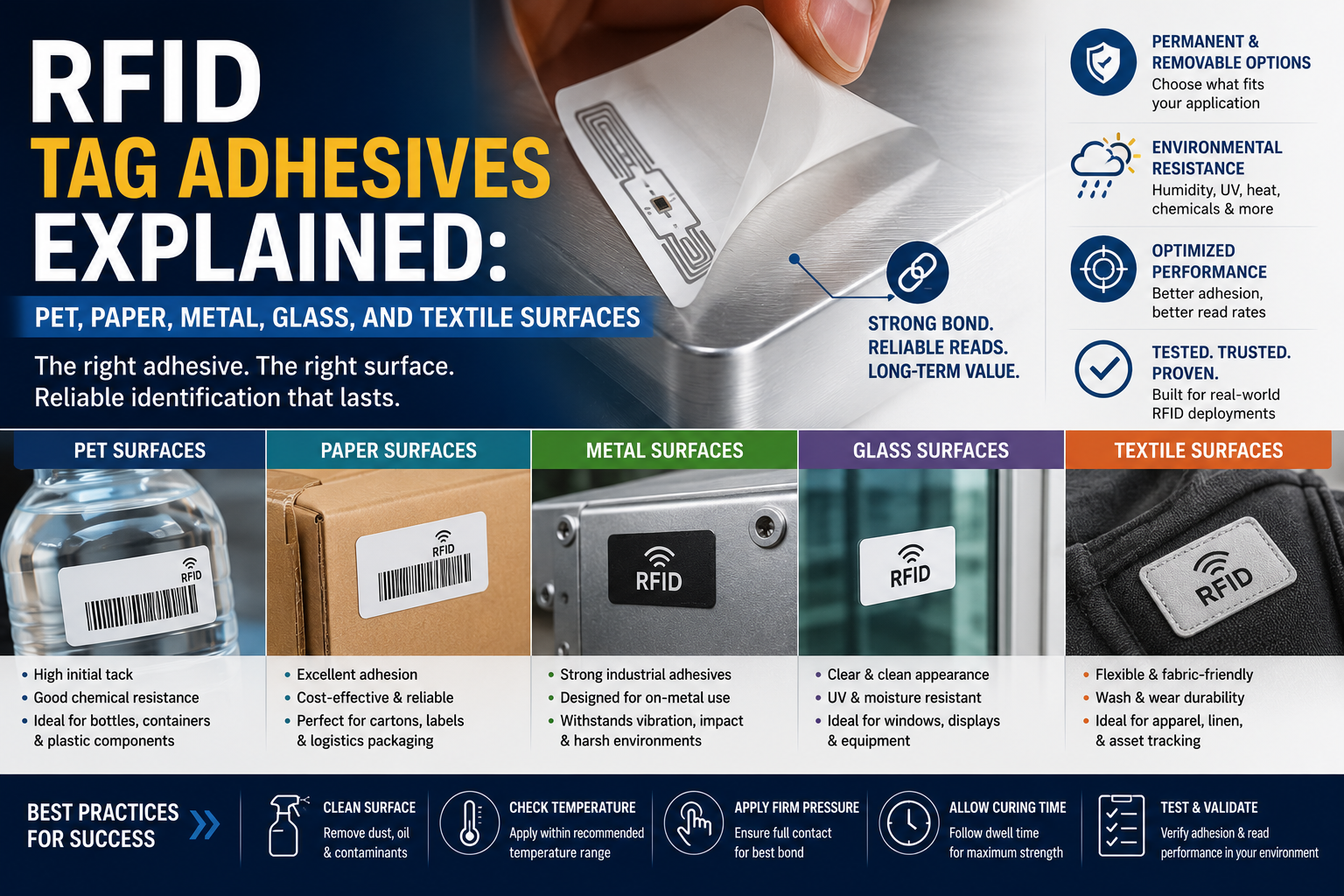
RFID Labels for PET Surfaces
PET (polyethylene terephthalate) is widely used in:
- 플라스틱 병
- Consumer packaging
- Medical containers
- Electronic housings
- Industrial components
PET provides a relatively smooth surface, but bonding performance depends on whether the material has coatings or release treatments.
Recommended characteristics include:
- Acrylic pressure-sensitive adhesive
- Good aging resistance
- High clarity when appearance matters
애플리케이션에는 다음이 포함됩니다:
- Beverage logistics
- 제약 포장
- Electronics manufacturing
- Retail labeling
Surface cleaning before installation improves long-term adhesion.
RFID Labels for Paper and Cardboard
Paper and corrugated cardboard generally provide excellent adhesion because they are porous and have relatively high surface energy.
일반적인 애플리케이션은 다음과 같습니다:
- 배송용 상자
- Logistics labels
- Retail packaging
- Archive boxes
Paper surfaces usually require:
- General-purpose permanent acrylic adhesive
- Fast tack
- Good initial bonding
However, rough recycled cardboard may require stronger adhesive formulations to compensate for uneven surfaces.
RFID Labels for Metal Surfaces
Metal presents two separate challenges:
First, the adhesive must maintain a reliable bond.
Second, the RFID antenna must function properly despite metal interference.
These are independent issues.
An excellent adhesive cannot compensate for an RFID inlay that is not designed for metal.
For metal assets, organizations typically use:
- 금속 부착용 RFID 라벨
- Foam-isolated labels
- 안티 메탈 RFID 태그
The adhesive should provide:
- High shear strength
- Long-term aging resistance
- Good vibration performance
애플리케이션에는 다음이 포함됩니다:
- Industrial machinery
- 도구 추적
- Metal cabinets
- Gas cylinders
- 반환 가능한 컨테이너
Surface preparation is especially important because oil, grease, rust, or oxidation reduce adhesive performance significantly.
RFID Labels for Glass
Glass offers one of the smoothest available mounting surfaces.
Its high surface energy generally allows excellent adhesive bonding.
일반적인 애플리케이션은 다음과 같습니다:
- Laboratory equipment
- 의료 기기
- Pharmaceutical containers
- Automotive windshields
- Smart building systems
Recommended adhesive characteristics include:
- Optical clarity where appearance matters
- 자외선 저항
- Long-term transparency
- Moisture resistance
For outdoor glass installations, UV stability becomes particularly important.
RFID Labels for Textile Surfaces
Textiles are among the most challenging materials for adhesive RFID labels.
Fabric characteristics vary widely depending on:
- Fiber type
- Surface texture
- Weave density
- Coatings
- 세탁 빈도
Standard pressure-sensitive adhesives generally perform poorly on clothing or reusable fabrics.
Instead, textile RFID applications often use:
- Heat-transfer labels
- Sew-in RFID tags
- Woven RFID labels
- Encapsulated laundry tags
When adhesive-backed textile labels are used, specialized fabric adhesives are required.
일반적인 애플리케이션은 다음과 같습니다:
- Apparel inventory
- 일관된 관리
- 리넨 추적
- Healthcare laundry
- Hospitality textiles
Environmental Factors That Affect Adhesive Performance
Even a well-matched adhesive may fail if environmental conditions exceed its design limits.
중요한 요소는 다음과 같습니다:
온도
Both installation temperature and operating temperature influence bonding.
Very low temperatures reduce adhesive flow, while excessive heat may soften certain adhesive formulations.
수분
Water exposure affects some adhesive systems more than others.
Applications involving:
- Outdoor storage
- Refrigeration
- Wash-down environments
- 높은 습도
require moisture-resistant adhesives.
UV Exposure
Outdoor sunlight gradually degrades some face materials and adhesives.
UV-stable constructions should be selected for long-term exterior applications.
화학 물질
Industrial assets may encounter:
- Oils
- Solvents
- Cleaning agents
- Fuels
- Acids
- Alkalis
Chemical resistance depends on both the adhesive and the label construction.
Mechanical Stress
Repeated flexing, vibration, abrasion, or impact may shorten adhesive life.
Assets that experience frequent handling should use more durable constructions.
Surface Preparation Best Practices
Adhesive performance depends as much on installation as on adhesive selection.
Before applying RFID labels:
- Remove dust and loose particles.
- Clean oil and grease using appropriate solvents.
- Dry the surface completely.
- Apply labels within the recommended temperature range.
- Press firmly across the entire label.
- Allow adequate curing time before heavy use.
Skipping these steps often results in premature label failure.
Should You Use Rubber or Acrylic Adhesives?
Most RFID labels use either acrylic-based or rubber-based pressure-sensitive adhesives.
Acrylic Adhesives
다음과 같은 이점이 있습니다:
- Better UV resistance
- Longer service life
- Higher temperature stability
- 우수한 내화학성
- Excellent aging characteristics
They are commonly used in industrial RFID applications.
Rubber Adhesives
다음과 같은 이점이 있습니다:
- High initial tack
- Good bonding to rough surfaces
- Strong adhesion to low-energy plastics
Limitations include:
- Lower UV resistance
- Reduced long-term durability
- Less temperature stability
Selection depends on the application rather than a universally superior adhesive chemistry.
Adhesive Selection by Surface
| Surface | Typical Adhesive Recommendation |
|---|---|
| PET | Permanent acrylic PSA |
| 종이 | General-purpose acrylic PSA |
| Corrugated cardboard | High-tack acrylic PSA |
| 금속 | Industrial acrylic PSA with on-metal RFID construction |
| 유리 | Clear UV-resistant acrylic PSA |
| 섬유 | Specialized textile adhesive or non-adhesive RFID tag |
| Powder-coated metal | High-performance industrial acrylic PSA |
| Plastic containers | Adhesive matched to specific plastic type |
These recommendations should always be validated through application testing.
Common Mistakes
Organizations frequently encounter adhesive problems because of assumptions made during product selection.
Typical mistakes include:
- Selecting adhesive based only on price
- Ignoring installation temperature
- Applying labels to dirty surfaces
- Using standard RFID labels on metal
- Choosing removable adhesive for permanent assets
- Testing bond strength immediately after application
- Assuming one adhesive works on every material
These mistakes often result in higher replacement rates and reduced RFID system reliability.
Questions to Ask Before Choosing an RFID Adhesive
Before ordering RFID labels, consider the following:
- What material will the label be attached to?
- Is the surface smooth, rough, coated, or painted?
- Will the asset be used indoors or outdoors?
- What temperature range will it experience?
- Will the label contact chemicals or moisture?
- How long must the label remain attached?
- Is removal expected during the asset’s lifecycle?
- Does the RFID antenna require an on-metal construction?
The answers help determine the appropriate adhesive and label construction.
결론
The performance of an RFID label depends on more than the chip and antenna. Adhesive selection plays a critical role in ensuring that tags remain securely attached and readable throughout their intended service life.
PET, paper, metal, glass, and textile surfaces each present unique bonding requirements. By matching adhesive chemistry, label construction, and installation practices to the application environment, organizations can improve RFID reliability, reduce maintenance, and maximize the value of their asset tracking systems.
Rather than treating adhesive selection as a secondary consideration, it should be viewed as an integral part of every RFID deployment strategy.