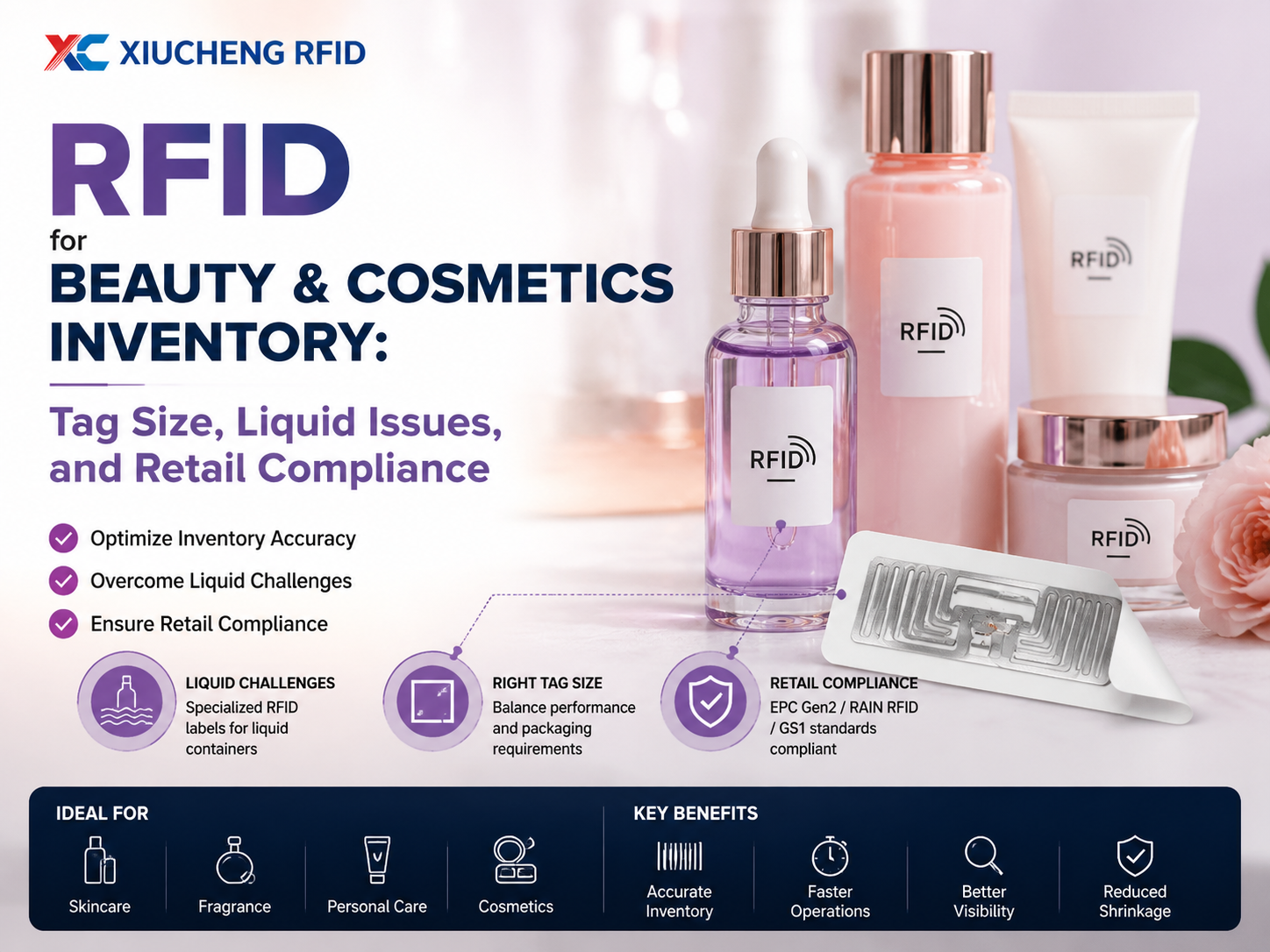
RFID technology is revolutionizing inventory management in the beauty and cosmetics industry. From skincare and makeup to hair care products, retailers and manufacturers are increasingly adopting UHF RFID labels to improve stock accuracy, streamline operations, and enhance omnichannel fulfillment.
However, beauty products present unique challenges for RFID deployments. Liquids, small packaging, and high-value goods require careful tag selection and placement. Choosing the wrong label can lead to poor read rates, inventory discrepancies, and compliance issues with retail standards.
This guide explores how to select the right RFID labels for beauty and cosmetics products, focusing on tag size, liquid interference, and retail compliance requirements.
Why RFID Is Valuable for Beauty and Cosmetics
The beauty industry faces several inventory management challenges:
- High SKU variety with multiple shades, sizes, and packaging
- Small product sizes that make manual scanning time-consuming
- Liquids that interfere with RFID signal performance
- Luxury products that require anti-counterfeit measures
RFID improves operations by providing:
- Faster inventory counts
- Real-time stock visibility
- Automated replenishment alerts
- Enhanced security for high-value products
- Streamlined self-checkout for retail customers
Tag Size Considerations
Selecting the correct RFID label size is critical for performance in beauty products.
Small Packaging
Many cosmetics items, such as lipstick tubes, small bottles, or compact cases, have limited space for RFID labels.
Najlepsze praktyki:
- Choose compact inlays that fit small surfaces without affecting packaging aesthetics.
- Use hang tags or carton labels for very small items where direct labeling is impractical.
- Ensure the antenna is optimized for short read distances if product size restricts tag dimensions.
Medium and Large Packaging
Products like shampoo bottles, lotion bottles, and perfume containers offer more labeling space.
Najlepsze praktyki:
- Larger antennas improve read range and reliability.
- Consider placing the tag on the flat side of the container or the packaging carton.
- Test tag placement with the actual product to maximize read rates.
Liquid Interference Challenges
Liquids absorb UHF signals, reducing read range and causing inconsistent performance.
Strategies to Minimize Liquid Interference
- Foam or Spacers: Insert a thin foam backing between the label and the liquid container to improve antenna performance.
- On-Pack Carton Tagging: Instead of placing RFID directly on the bottle, tag the outer packaging.
- Liquid-Optimized Labels: Select RFID inlays specifically designed for liquid containers, often with a tuned antenna shape.
Testing Is Critical
Always test labels with:
- Actual liquid-filled products
- Intended retail packaging
- Bulk reading conditions
Lab specifications alone cannot predict real-world performance.
Retail Compliance and Standards
Retailers increasingly require compliance with:
- EPC Gen2 UHF: Ensures global interoperability.
- RAIN RFID standards: For supply chain and inventory applications.
- GS1 EPC guidelines: For barcode and RFID harmonization.
Non-compliant labels may be rejected by retail partners, causing costly rework or delayed shipments.
Other Considerations
- Serialized tags for authentication and anti-counterfeit measures.
- Integration with point-of-sale systems for automated checkout.
- Support for omnichannel retail, including e-commerce fulfillment.
Recommended Label Types for Beauty Products
| Typ produktu | Recommended Label | Notes |
|---|---|---|
| Perfume bottles | Liquid-resistant UHF label | Optimize placement for maximum read range |
| Lotion and skincare | Foam-backed or on-carton RFID labels | Protect against liquid absorption |
| Makeup and compacts | Small inlays or hang tags | Ensure aesthetics are maintained |
| Haircare bottles | Medium-sized UHF labels | Flat surfaces preferred for better antenna performance |
Typowe błędy, których należy unikać
- Ignoring product testing: Always validate labels with actual liquid products and packaging.
- Using generic labels: Standard RFID labels may underperform on liquid products.
- Incorrect antenna placement: Placement impacts read reliability more than chip selection.
- Neglecting retail standards: Non-compliant labels may be rejected or require re-labeling.
Working with an Experienced RFID Supplier
An experienced RFID manufacturer can:
- Recommend the best inlay and antenna type for each product
- Provide custom label sizes for small or irregular packaging
- Test label performance in real-world conditions
- Ensure compliance with EPC, RAIN, and GS1 standards
- Offer encoding and serialized tracking options for anti-counterfeit purposes
Przy XIUCHENG RFID, we specialize in RFID labels for beauty and cosmetics. Our team helps brands select the right tag, test placement, and implement solutions that maximize read accuracy and operational efficiency.

O XIUCHENG RFID
XIUCHENG RFID specjalizuje się w produkcji szerokiej gamy produktów RFID, w tym opasek silikonowych RFID, opasek Tyvek, opasek materiałowych, opasek elastycznych, opasek winylowych, przywieszek RFID do prania, przywieszek dla zwierząt i kart RFID. Wszystkie produkty są wytwarzane pod ścisłą kontrolą jakości i przy użyciu zaawansowanej technologii produkcji.
Dzięki 12-letniemu doświadczeniu w projektowaniu opasek na rękę, projektowaniu tagów, zarządzaniu jakością i zarządzaniu relacjami z klientami, zbudowaliśmy solidne podstawy do dostarczania niezawodnych i wydajnych rozwiązań RFID.
Przemyślenia końcowe
RFID is a powerful tool for managing beauty and cosmetics inventory, but successful implementation requires attention to detail:
- Select label sizes appropriate for product dimensions
- Mitigate liquid interference through tag design and placement
- Ensure retail compliance with global standards
By partnering with an experienced RFID supplier and testing real-world scenarios, brands can achieve reliable inventory tracking, improve operational efficiency, and enhance the customer experience.