Sustainability is becoming a core requirement rather than a marketing differentiator. Governments, manufacturers, retailers, and consumers increasingly expect products to provide transparent information about their origin, materials, environmental impact, and end-of-life handling.
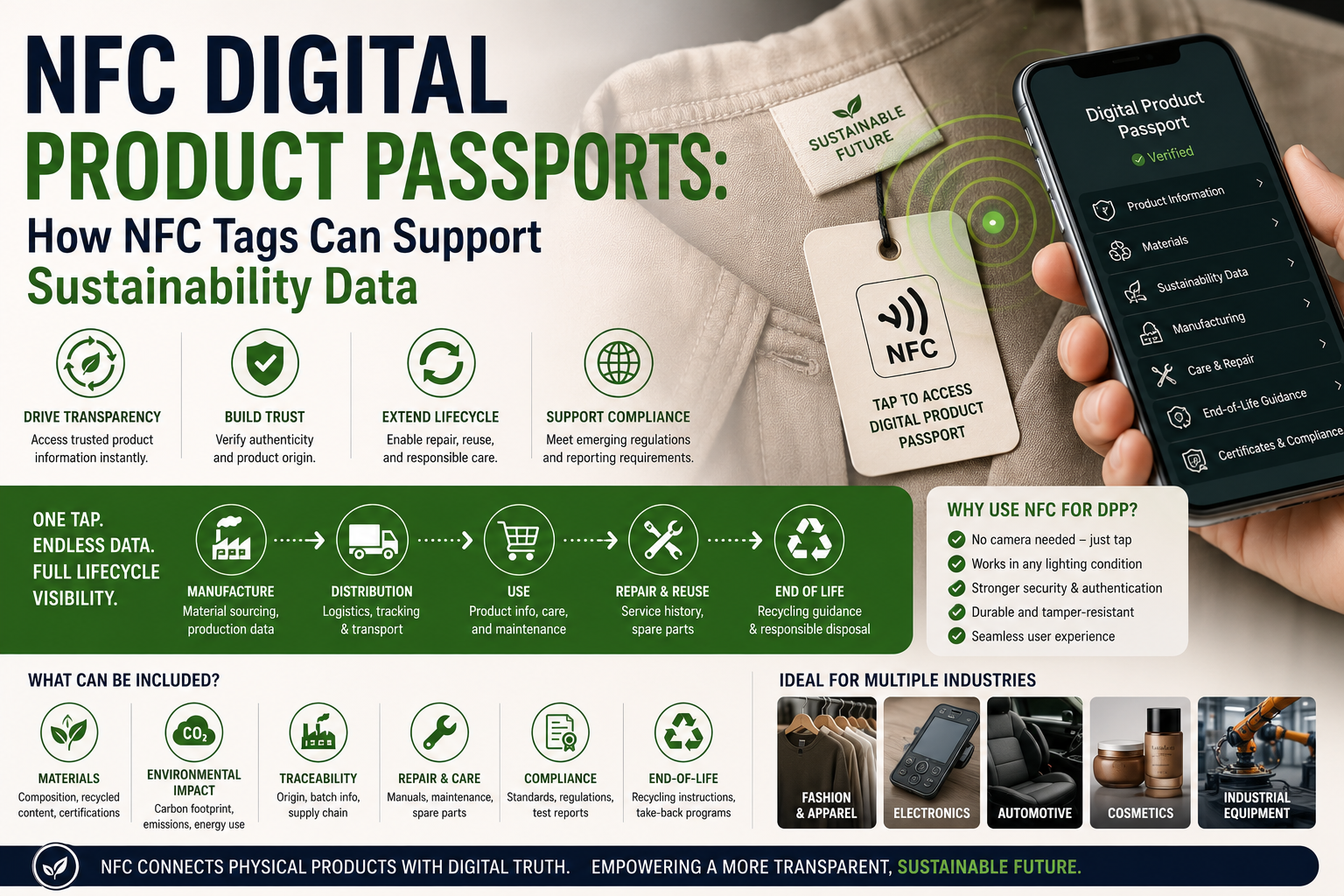
One of the most significant developments supporting this transition is the Digital Product Passport (DPP). Designed to create a digital identity for physical products, a Digital Product Passport enables information to follow a product throughout its entire lifecycle—from raw material sourcing and manufacturing to repair, resale, and recycling.
While QR codes are widely recognized as a practical way to access Digital Product Passports, NFC technology is gaining attention as a complementary solution that offers a more seamless user experience. With a simple tap, consumers, service technicians, and supply chain partners can securely access product information without opening a camera application or aligning a barcode.
This article explains how NFC tags support Digital Product Passports, the advantages they offer over traditional identification methods, and how manufacturers can prepare for the next generation of connected products.
O que é um passaporte digital do produto?
A Digital Product Passport is a structured digital record that stores and provides access to information about a product throughout its lifecycle.
Rather than existing as a single document, a Digital Product Passport connects multiple data sources, allowing authorized users to retrieve relevant information at different stages of a product’s life.
Depending on the industry, a Digital Product Passport may include:
- Identificação do produto
- Manufacturer information
- Composição do material
- País de origem
- Pegada de carbono
- Recycled content
- Compliance documentation
- Instruções de reparação
- Histórico de manutenção
- Warranty status
- Spare parts information
- Recycling guidance
The objective is to improve transparency, support circular economy initiatives, and make products easier to repair, reuse, and recycle.
Why NFC Is Well Suited for Digital Product Passports
Several technologies can provide access to a Digital Product Passport, including QR codes, NFC, and RAIN RFID.
Each serves different purposes.
NFC is particularly attractive because it combines convenience with secure data exchange.
Users simply tap an NFC-enabled smartphone against the product.
Não é necessário o alinhamento da câmara.
This provides several advantages:
- Faster interaction
- Better user experience
- Reliable operation in low-light environments
- Redução dos erros de digitalização
- Support for secure authentication
- Easy integration into premium products
For high-value products, NFC creates a more intuitive and engaging experience than traditional printed codes.
How NFC Connects Physical Products to Digital Information
An NFC tag typically contains only a small amount of stored data.
Instead of storing an entire Digital Product Passport inside the chip, the NFC tag usually acts as a secure digital identifier.
When tapped, the tag directs the user’s device to cloud-based information associated with that individual product.
This approach offers several advantages:
- Information can be updated without replacing the tag.
- Different users can access different data.
- Product history can grow throughout the lifecycle.
- Access permissions can be managed centrally.
The NFC tag therefore becomes the bridge between the physical product and its continuously evolving digital record.
What Sustainability Data Can Be Included?
A Digital Product Passport is designed to support transparency across the product lifecycle.
Typical sustainability information includes the following.
Material Composition
Manufacturers can identify:
- Primary materials
- Recycled material content
- Bio-based materials
- Hazardous substances where applicable
This information helps recyclers process products correctly at end of life.
Manufacturing Information
The passport may record:
- Manufacturing facility
- Data de produção
- Número de lote
- Quality inspection records
- Compliance certifications
This improves product traceability across global supply chains.
Carbon Footprint
Many organizations are beginning to calculate environmental impact throughout manufacturing and transportation.
The Digital Product Passport may reference:
- Product carbon footprint
- Manufacturing emissions
- Transportation emissions
- Energy sources
Providing this information helps businesses meet sustainability reporting requirements.
Repair and Maintenance
Rather than replacing products prematurely, consumers can access:
- Service manuals
- Maintenance schedules
- Peças sobressalentes
- Repair videos
- Authorized service centers
This supports longer product lifecycles and reduces waste.
Recycling Guidance
When products reach the end of their useful life, users can access information explaining:
- Material separation
- Procedimentos de reciclagem
- Collection locations
- Hazardous component handling
Improved recycling begins with better product information.
Industries Adopting NFC Digital Product Passports
Although Digital Product Passports are often associated with future European sustainability initiatives, many industries are already developing connected products.
Moda e Vestuário
Brands are using NFC to provide:
- Material transparency
- Autenticação do produto
- Instruções de cuidados
- Verificação de revenda
- Informações sobre reciclagem
Digital Product Passports can help extend garment lifecycles while supporting circular fashion.
Consumer Electronics
Electronic products contain valuable materials that should be recovered efficiently.
NFC can provide access to:
- Component information
- Instruções de reparação
- Firmware updates
- Registos de garantia
- Recycling guidance
Bens de luxo
Luxury brands increasingly combine NFC authentication with lifecycle records.
This supports:
- Luta contra a contrafação
- Ownership transfer
- Repair history
- Verificação da autenticidade do produto
Furniture
Manufacturers can use NFC-enabled Digital Product Passports to document:
- Wood origin
- Material certifications
- Assembly instructions
- Replacement parts
- Recycling recommendations
Equipamento industrial
Enterprise assets benefit from:
- Histórico de manutenção
- Registos de inspeção
- Calibration certificates
- Spare parts information
- Service documentation
Technicians can retrieve information instantly using NFC-enabled mobile devices.
NFC Compared with QR Codes
Both NFC and QR codes can provide access to a Digital Product Passport.
However, their strengths differ.
| Recurso | NFC | Código QR |
|---|---|---|
| User interaction | Torneira | Varrimento da câmara |
| Lighting required | Não | Sim |
| Compatibilidade com smartphones | Most modern smartphones | Nearly universal |
| Authentication capability | Forte | Limited without backend security |
| Experiência do utilizador | Sem costuras | Very good |
| Printing cost | Mais alto | Muito baixo |
| Durabilidade | Protected inside product | Printed surface may wear |
Many manufacturers combine both technologies on a single product.
The QR code provides universal accessibility, while NFC delivers a premium user experience and stronger authentication capabilities.
Security Advantages of NFC
NFC chips can support security features that are difficult to achieve using printed labels alone.
Depending on the chip selected, manufacturers may implement:
- Unique chip identifiers
- Proteção por palavra-passe
- Autenticação criptográfica
- Secure memory
- Digital signatures
These capabilities help reduce counterfeiting and strengthen trust in Digital Product Passport information.
Supporting the Circular Economy
One of the primary objectives of Digital Product Passports is to encourage products to remain in use for longer.
NFC contributes by making information readily available throughout each stage of the product lifecycle.
Os exemplos incluem:
- Fabrico
- Distribuição
- Retalho
- Propriedade do cliente
- Reparação
- Remodelação
- Revenda
- Reciclagem
Instead of information disappearing after purchase, the product continues to communicate valuable data throughout its useful life.
Design Considerations
Manufacturers planning NFC-enabled Digital Product Passports should evaluate several factors.
Tag Placement
The NFC tag should be positioned where users naturally expect to tap.
Compatibilidade de materiais
Metal surfaces may require anti-metal NFC constructions.
Data Architecture
The NFC chip should reference a centralized product database rather than storing extensive information directly on the tag.
Product Durability
The tag construction should match the product’s expected service life.
Outdoor products require UV-resistant and weather-resistant label materials.
Privacy
Only appropriate information should be publicly accessible.
Sensitive manufacturing or customer data should remain protected through backend access controls.
Perguntas mais frequentes
Does an NFC tag store the entire Digital Product Passport?
Usually not. Most NFC tags contain a unique identifier or secure web link that retrieves information from cloud-based databases.
Is NFC required for Digital Product Passports?
No. QR codes, NFC, RAIN RFID, and other technologies can all support Digital Product Passports. The most appropriate solution depends on the product, user experience, and business objectives.
Can NFC improve product authentication?
Yes. Many NFC chips include security features that help brands verify genuine products and reduce counterfeiting.
Can consumers access Digital Product Passports with smartphones?
Yes. Most modern smartphones support NFC, allowing users to retrieve Digital Product Passport information with a simple tap when compatible tags are used.
Should manufacturers use both NFC and QR codes?
For many products, combining NFC and QR codes provides the greatest flexibility by supporting both premium user experiences and universal accessibility.
Best Practices for Implementing NFC Digital Product Passports
Organizations planning connected products should consider the following recommendations:
- Establish a unique digital identity for every product.
- Store lifecycle data in secure cloud systems.
- Design the NFC experience around simple user interactions.
- Keep sustainability information current.
- Combine NFC with QR codes where appropriate.
- Ensure long-term support for digital records throughout the product lifecycle.
A successful Digital Product Passport depends as much on data quality and governance as on the NFC technology itself.
Conclusão
Digital Product Passports are reshaping how products communicate information throughout their lifecycle. Rather than limiting transparency to printed labels or instruction manuals, manufacturers can provide continuously updated digital records covering sustainability, traceability, repair, compliance, and recycling.
NFC technology plays an important role in this transformation by offering an intuitive, secure, and durable way to connect physical products with cloud-based information. Combined with QR codes and other identification technologies, NFC enables manufacturers to create smarter products that support both business objectives and the growing demand for environmental transparency.
As sustainability regulations evolve and circular economy initiatives expand, NFC-enabled Digital Product Passports are likely to become an increasingly valuable component of modern product design and lifecycle management.