


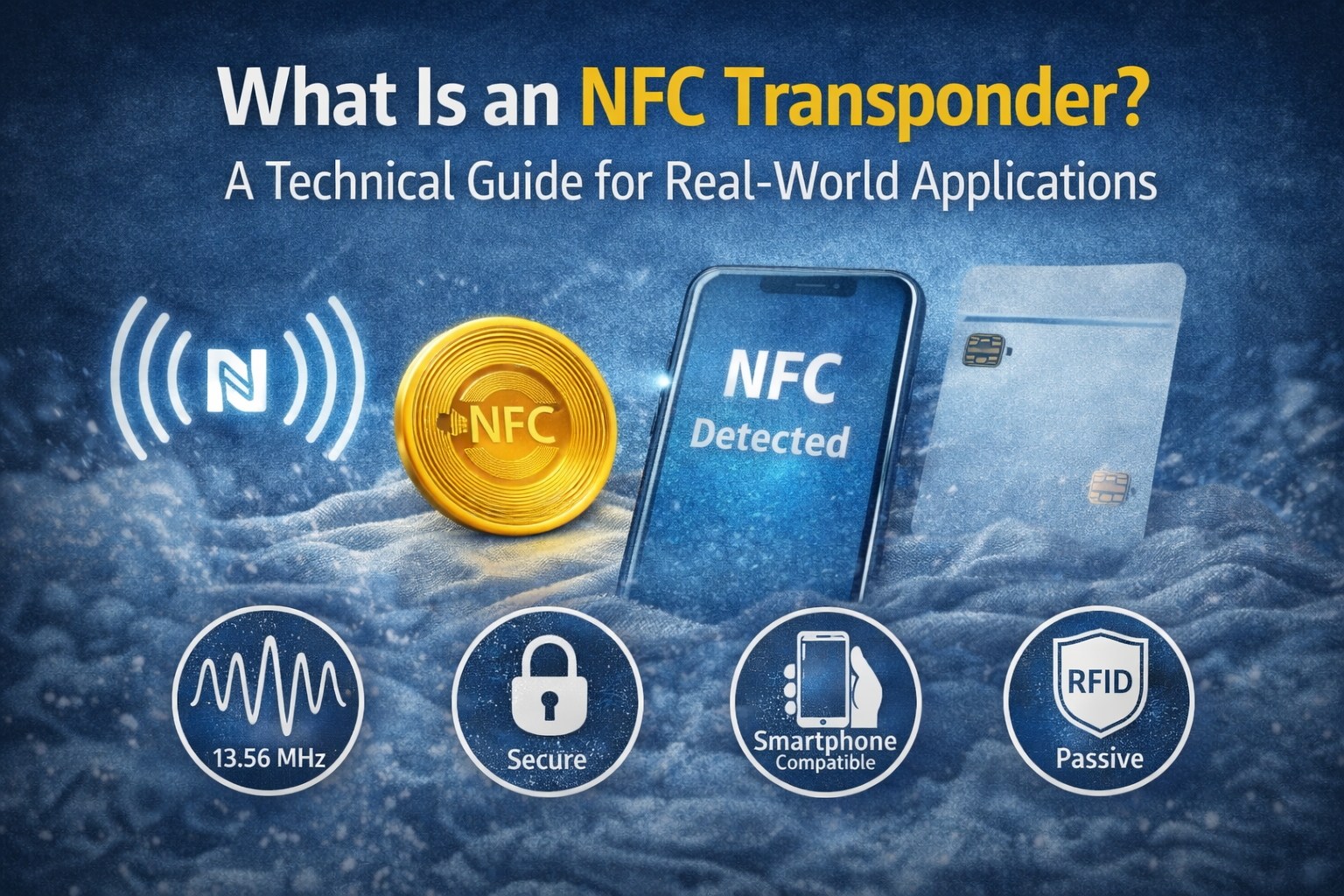
Near Field Communication (NFC) technology is widely used in contactless payments, access control, smart packaging, and consumer electronics. At the core of every NFC system lies a fundamental component: the NFC transponder.
Despite the frequent use of the term, many engineers and buyers misunderstand what an NFC transponder actually is, how it works, and how it differs from other RFID devices.
This article explains NFC transponders from a technical and practical perspective, focusing on structure, operating principles, standards, and real-world use cases.
What Is an NFC Transponder?
An NFC transponder is a passive RFID device that operates at 13.56 MHz and responds to an NFC reader by transmitting stored data via electromagnetic coupling.
In simple terms:
- The reader generates an RF field
- The transponder harvests energy from that field
- The transponder modulates the field to send data back
Unlike active devices, NFC transponders do not contain a battery. They only function when placed within a short range—typically 0 to 4 cm—of an NFC-enabled reader or smartphone.
Core Components of an NFC Transponder
An NFC transponder consists of three essential elements:
1. Antenna (Inductive Coil)
The antenna is usually a copper or aluminum coil tuned to 13.56 MHz. It enables:
- Energy harvesting from the reader’s RF field
- Load modulation for data transmission
Antenna design directly impacts read range, reliability, and device size.
2. NFC IC (Integrated Circuit)
The chip manages:
- Communication protocol (ISO/IEC 14443 or 15693)
- Memory access
- Security features (UID, authentication, encryption)
Common NFC chips include NXP NTAG, MIFARE Ultralight, DESFire, and ICODE families.
3. Substrate or Encapsulation
Depending on application, the transponder may be:
- Embedded in plastic cards
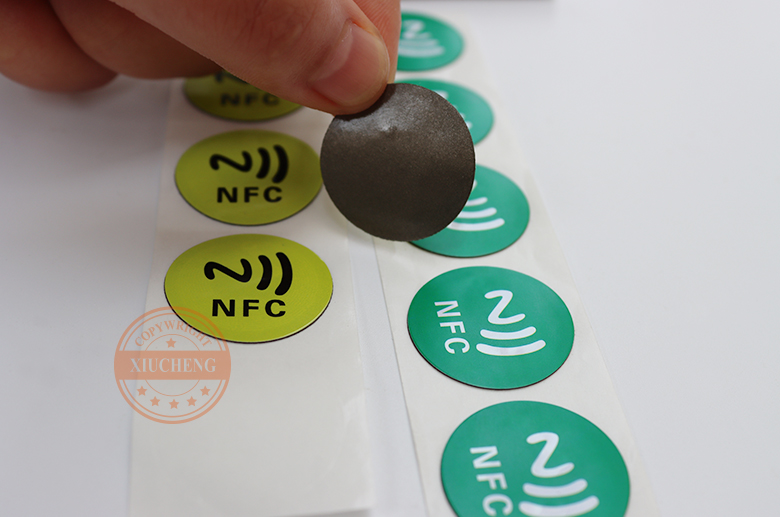
- Inlaid into labels
- Encapsulated in PPS, epoxy, or silicone for harsh environments
How an NFC Transponder Works
The operating principle is based on inductive coupling, not radio propagation.
- The NFC reader generates an alternating magnetic field at 13.56 MHz
- The transponder’s antenna induces a current
- The chip powers up and executes a command
- Data is returned using load modulation
This design ensures:
- Very short read distance
- High resistance to eavesdropping
- Precise user interaction
NFC Transponder vs RFID Tag: What’s the Difference?
While NFC transponders are technically RFID devices, not all RFID tags qualify as NFC transponders.
| Feature | NFC Transponder | Typical RFID Tag |
|---|---|---|
| Frequency | 13.56 MHz | LF, HF, or UHF |
| Read Range | < 4 cm | Up to 15 m (UHF) |
| Smartphone Compatible | Yes | Usually no |
| Data Rate | Moderate | High (UHF) |
| User Interaction | Intentional tap | Often automated |
NFC transponders are designed for human-initiated interactions, while UHF RFID tags are optimized for bulk, long-range identification.
NFC Transponder Operating Modes
According to NFC standards, a transponder typically operates in card emulation mode, but NFC devices can support multiple modes:
- Reader/Writer Mode – reading and writing NFC tags
- Card Emulation Mode – acting like a contactless card
- Peer-to-Peer Mode – two active devices exchanging data
Passive NFC transponders always function in card emulation mode.
Memory Types in NFC Transponders
NFC transponders can store different data types depending on memory architecture:
- UID (Unique Identifier)
- NDEF records (URLs, text, vCards)
- Secure files with access keys
- Counters and status flags
Memory sizes typically range from 48 bytes to 8 KB, depending on chip type.
Common Applications of NFC Transponders
NFC transponders are widely used in applications where security, simplicity, and proximity are critical:
- Mobile payments and ticketing
- Access control and visitor management
- Product authentication and anti-counterfeiting
- Smart posters and marketing campaigns
- Medical device identification
- Asset tracking at item level
Their compatibility with smartphones makes them especially valuable in consumer-facing solutions.
Security Capabilities
Modern NFC transponders may include:
- 7-byte or 10-byte UID
- Password protection
- AES or DES encryption
- Secure key storage
- Transaction counters
High-security chips such as MIFARE DESFire EV2/EV3 are widely used in transport and financial systems.
Key Advantages of NFC Transponders
- No battery required
- High reliability and long service life
- Strong ecosystem and global standards
- Native smartphone support
- Precise, user-controlled interaction
These advantages make NFC transponders ideal for both industrial and consumer deployments.
Final Thoughts
An NFC transponder is not just a “contactless tag.” It is a carefully engineered device that combines antenna design, secure IC architecture, and standardized protocols to enable safe, short-range data exchange.
Understanding how NFC transponders work—and how they differ from other RFID technologies—is essential when designing access systems, authentication solutions, or smart connected products.
If you are selecting NFC transponders for a commercial or industrial project, factors such as chip type, memory size, security level, and encapsulation should always be evaluated together.


