


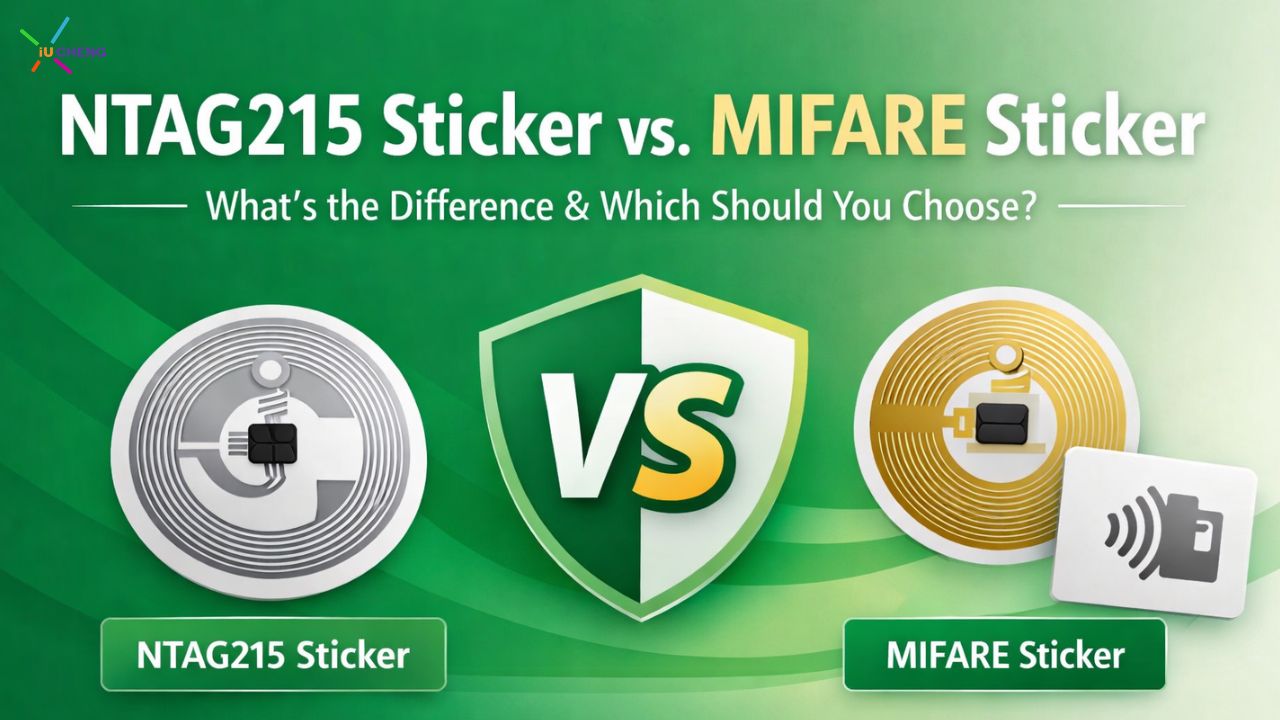
RFID and NFC stickers are widely used for contactless identification, marketing, access control, and product authentication. Two common options are NTAG215 stickers and MIFARE stickers. While both belong to the NFC family and operate at 13.56 MHz, they serve very different purposes.
Understanding their differences helps businesses select the right NFC tag for their applications.
This guide compares NTAG215 vs MIFARE stickers, including technology, memory, compatibility, and real-world use cases.
What Is an NTAG215 Sticker?
An NTAG215 sticker is an NFC tag based on the NXP NTAG21x series. It is designed primarily for consumer interaction, marketing, and mobile applications.
Key characteristics:
- Frequency: 13.56 MHz NFC
- Memory: 504 bytes usable memory
- Protocol: ISO/IEC 14443A
- Read range: 2–5 cm
- Smartphone compatibility: Excellent
NTAG215 tags are widely supported by Android and iPhone devices, making them ideal for applications where users interact with tags using their smartphones.
Typical applications include:
- NFC marketing campaigns
- Smart posters
- Product authentication
- NFC business cards
- Social media sharing
- Amiibo game figures (Nintendo)
Because they are inexpensive and easy to encode, NTAG215 stickers are commonly used in large-scale marketing deployments.
What Is a MIFARE Sticker?
A MIFARE sticker refers to NFC stickers using chips from the MIFARE family, such as:
- MIFARE Ultralight
- MIFARE Classic 1K / 4K
- MIFARE DESFire EV1 / EV2
These chips are widely used in secure identification systems.
Key characteristics vary depending on the chip type, but typical features include:
- Frequency: 13.56 MHz
- Protocol: ISO/IEC 14443A
- Security: Authentication and encryption
- Memory: From 64 bytes to several kilobytes
Unlike NTAG tags, many MIFARE chips are designed for access control and ticketing systems, where security and authentication are critical.
Common applications:
- Access control cards and stickers
- Hotel key systems
- Public transportation tickets
- Campus ID cards
- Event ticketing
- Cashless payment systems
NTAG215 vs MIFARE Sticker: Key Differences
| Feature | NTAG215 Sticker | MIFARE Sticker |
|---|---|---|
| Frequency | 13.56 MHz | 13.56 MHz |
| Standard | ISO14443A | ISO14443A |
| Memory | 504 bytes | 64B – 8KB depending on chip |
| Security | Basic password protection | Strong authentication & encryption |
| Smartphone compatibility | Excellent | Depends on chip type |
| Cost | Low | Medium to high |
| Main use | NFC marketing & consumer interaction | Access control & ticketing |
Compatibility with Smartphones
One of the biggest practical differences is smartphone compatibility.
NTAG215 stickers
- Fully compatible with most Android and iPhone NFC devices
- Easy to read/write with NFC apps
- Ideal for consumer-facing applications
MIFARE stickers
Compatibility depends on the chip:
- MIFARE Ultralight – good smartphone compatibility
- MIFARE Classic – limited support on many phones
- MIFARE DESFire – supported but requires specialized apps
Because of this, NTAG215 is usually preferred for marketing campaigns and smart product experiences.
Memory Comparison
NTAG215 offers 504 bytes usable memory, which is enough for:
- URLs
- contact cards (vCard)
- small data payloads
MIFARE chips vary greatly:
| Chip | Memory |
|---|---|
| MIFARE Ultralight | 64–192 bytes |
| MIFARE Classic 1K | 1 KB |
| MIFARE Classic 4K | 4 KB |
| MIFARE DESFire EV1 | up to 8 KB |
For applications requiring structured data storage and secure transactions, MIFARE chips are usually the better choice.
Security Differences
Security is another major distinction.
NTAG215
Security features include:
- 32-bit password protection
- read/write lock
- UID-based identification
These features are sufficient for marketing and product identification, but not for high-security environments.
MIFARE chips
Depending on the chip type, security can include:
- mutual authentication
- encrypted communication
- secure memory sectors
- anti-cloning protection
This makes MIFARE suitable for payment systems, transportation cards, and corporate access control.
When Should You Choose NTAG215 Stickers?
NTAG215 stickers are ideal when:
- Users interact using smartphones
- You need NFC marketing
- You want tap-to-open links
- You need low-cost NFC tags
- The data stored is relatively small
Typical industries:
- marketing and advertising
- retail
- social media creators
- smart packaging
- interactive displays
When Should You Choose MIFARE Stickers?
MIFARE stickers are better when:
- Security is important
- You need authentication
- Tags must work with existing RFID access systems
- The application involves ticketing or payments
Typical industries:
- public transportation
- hotels
- office access control
- events
- universities
Can NTAG215 Replace MIFARE Tags?
In most cases, no.
Even though both operate at 13.56 MHz NFC, their intended use cases are different.
- NTAG215 → consumer interaction
- MIFARE → secure identification systems
Trying to replace a MIFARE access card with an NTAG215 sticker usually won’t work with existing readers.
Choosing the Right NFC Sticker for Your Project
When selecting between NTAG215 and MIFARE stickers, consider these factors:
- Device compatibility
- Security requirements
- Memory needs
- System integration
- Budget
For most smartphone-based NFC applications, NTAG215 is the simplest choice.
For secure RFID infrastructure, MIFARE chips remain the industry standard.
Custom NTAG215 & MIFARE Stickers
Manufactured by XIUCHENG RFID
XIUCHENG RFID is a professional RFID and NFC tag manufacturer in China, specializing in large-scale customization for global businesses.
- NTAG213 / NTAG215 / NTAG216 NFC Stickers
- MIFARE Ultralight / Classic / DESFire Stickers
- Custom Printing & Data Encoding
- Waterproof & On-Metal NFC Labels
- Low-Cost Bulk Manufacturing
Planning an NFC marketing campaign or RFID access system? Our engineering team can help you select the right chip and antenna design.


