


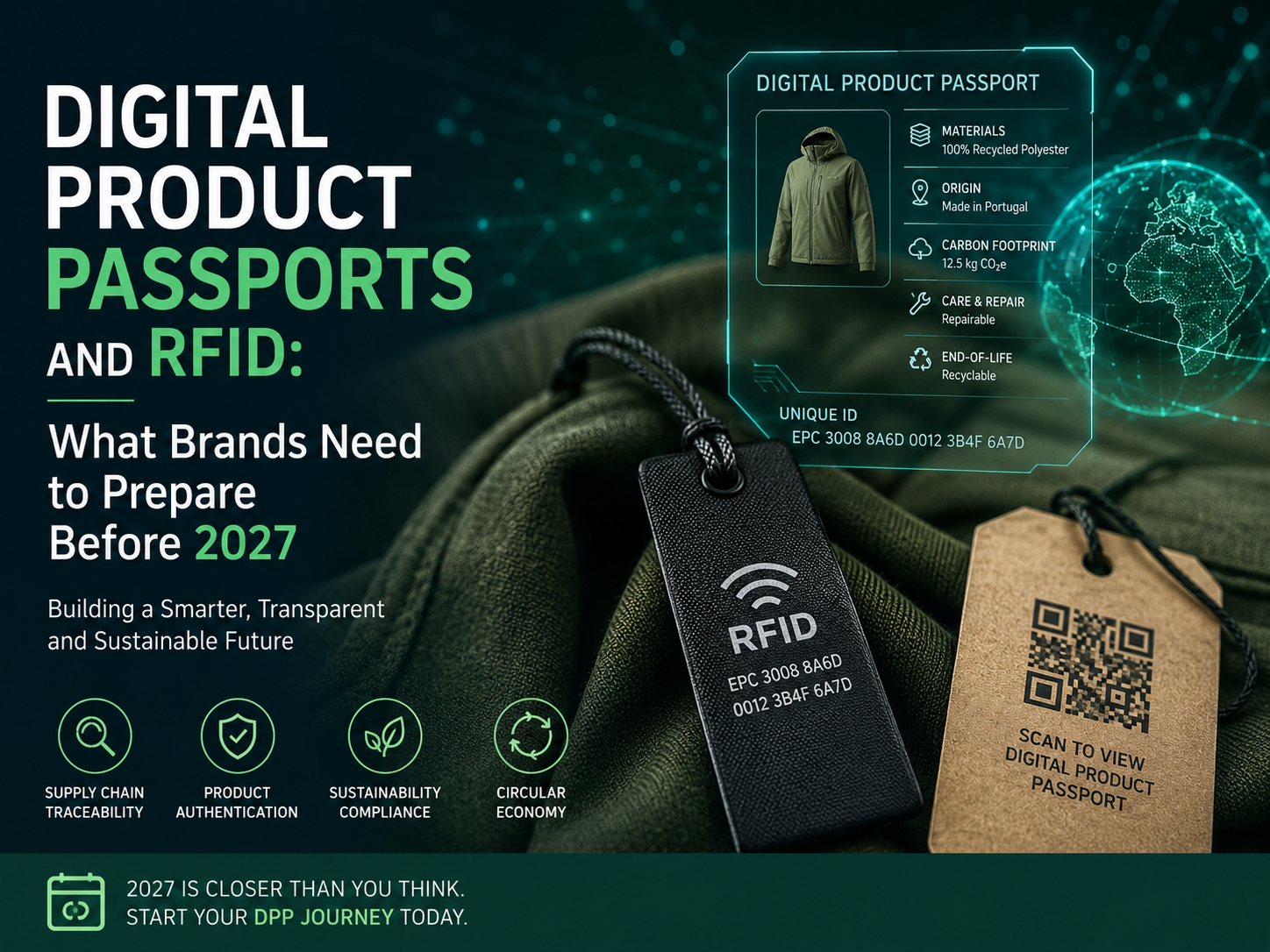
Across Europe and increasingly around the world, brands are facing a new reality: products will soon need to carry a digital identity that follows them throughout their entire lifecycle.
This initiative is known as the Digital Product Passport (DPP).
Driven by the European Union’s sustainability strategy and Circular Economy Action Plan, Digital Product Passports are expected to become mandatory for many product categories over the coming years. By 2027, companies operating in industries such as apparel, electronics, batteries, industrial equipment, and consumer goods will need to provide transparent product data accessible to regulators, customers, recyclers, and supply chain partners.
For brands, the challenge is clear:
How do you connect a physical product to its digital record in a reliable, scalable, and cost-effective way?
The answer increasingly points toward RFID technology.
What Is a Digital Product Passport?
A Digital Product Passport is a digital record containing key information about a product throughout its lifecycle.
The passport may include:
- Product origin
- Manufacturing location
- Raw material sources
- Carbon footprint data
- Compliance certificates
- Repair instructions
- Recycling information
- Ownership history
- Product authenticity verification
The goal is to create greater transparency across supply chains while supporting sustainability and circular economy initiatives.
Instead of products becoming anonymous once they leave the factory, every item can maintain a permanent digital identity.
For consumers, this means better transparency.
For regulators, it means easier compliance monitoring.
For brands, it means unprecedented product visibility.
Why RFID Is Becoming Critical for DPP Implementation
A Digital Product Passport is only useful if the physical product can always be linked to its digital data.
Traditional identification methods face limitations:
| Technology | Limitations |
|---|---|
| Printed Labels | Easily damaged or removed |
| Barcodes | Require line-of-sight scanning |
| QR Codes | Can fade or become unreadable |
| Manual Serial Numbers | Labor-intensive and error-prone |
RFID provides a more robust solution.
An RFID tag contains a unique electronic identifier that can be read wirelessly without direct visibility.
This creates a permanent bridge between:
Physical Product ↔ Digital Passport
Benefits include:
- Automated identification
- Bulk reading capability
- Long service life
- Resistance to harsh environments
- Faster inventory management
- Enhanced product authentication
As DPP regulations expand, RFID is becoming one of the most practical technologies for maintaining product identity throughout the supply chain.
Industries Most Likely to Adopt RFID-Based Digital Product Passports
Fashion and Apparel
The fashion industry is among the first sectors targeted by EU sustainability regulations.
Brands will likely need to provide information such as:
- Fabric composition
- Country of origin
- Environmental impact
- Repair guidance
- Recycling instructions
RFID garment tags can connect each item to a cloud-based passport that remains accessible throughout the product’s lifecycle.
Luxury brands are particularly interested because RFID also supports anti-counterfeiting efforts.
Electronics
Electronic products contain valuable materials and often create significant waste streams.
Future DPP requirements may include:
- Component traceability
- Battery information
- Repairability scores
- Recycling procedures
- Hazardous material disclosures
RFID tags can remain embedded inside devices, enabling efficient asset management and compliance verification.
Industrial Equipment
Manufacturers of industrial machinery increasingly need lifecycle tracking.
RFID-enabled Digital Product Passports can store information related to:
- Maintenance history
- Warranty records
- Service schedules
- Spare parts compatibility
- Safety certifications
This improves asset management while reducing downtime.
Automotive Components
Vehicle manufacturers already use RFID extensively in production and logistics.
Digital Product Passports may expand visibility into:
- Parts origin
- Manufacturing batches
- Carbon emissions
- End-of-life recycling
RFID can provide continuous traceability from component manufacturing through vehicle disposal.
What Information Should Brands Start Collecting Now?
Many organizations underestimate the amount of data required for future DPP compliance.
Brands should begin building systems capable of capturing:
Product-Level Data
- Unique product ID
- SKU information
- Manufacturing date
- Production batch
Material Data
- Material composition
- Recycled content percentage
- Supplier information
Sustainability Metrics
- Carbon footprint
- Energy consumption
- Water usage
- Environmental certifications
Supply Chain Data
- Factory locations
- Logistics records
- Transportation routes
End-of-Life Information
- Repair instructions
- Reuse recommendations
- Recycling procedures
Companies that begin collecting this information today will face fewer challenges when DPP regulations become mandatory.
Why RFID Manufacturers Will Play a Strategic Role
Many brands assume Digital Product Passports are purely software projects.
In reality, hardware identification technologies are equally important.
Without a reliable carrier for the product’s identity, digital records lose their value.
RFID manufacturers will become key partners by providing:
Durable Product Identification
RFID tags can survive conditions that would damage printed labels.
Unique Serialization
Every RFID chip can contain a globally unique identifier.
Automated Data Capture
Products can be scanned automatically during manufacturing, warehousing, shipping, retail operations, and recycling.
Scalable Deployment
Millions of products can be tracked with minimal labor costs.
For this reason, RFID is expected to become a foundational technology for DPP ecosystems.
How RFID Supports Sustainability Goals
Digital Product Passports are ultimately designed to support sustainability.
RFID contributes by enabling:
Better Recycling
Recyclers can instantly identify material compositions and processing instructions.
Product Reuse
Second-hand markets gain access to verified product histories.
Reduced Waste
Improved inventory accuracy reduces overproduction.
Extended Product Lifecycles
Maintenance and repair records become easier to access.
Together, RFID and DPP help transform products from disposable items into traceable assets.
Challenges Brands Should Address Before 2027
While the opportunities are significant, preparation is essential.
Key challenges include:
Data Standardization
Information must be collected consistently across suppliers and regions.
Technology Selection
Brands must choose between:
- RFID
- NFC
- QR codes
- Hybrid identification solutions
System Integration
ERP, PLM, WMS, and sustainability platforms must exchange data seamlessly.
Supplier Collaboration
Supply chain partners need to adopt common data-sharing standards.
The earlier brands begin these discussions, the smoother their transition will be.
How RFID Supports Hybrid DPP Solutions
While RFID is a powerful technology for Digital Product Passports, many future implementations are expected to combine multiple identification technologies.
A typical DPP deployment may include:
| Technology | Primary Purpose |
|---|---|
| RFID | Supply chain automation and inventory tracking |
| NFC | Consumer engagement and authentication |
| QR Code | Easy public access to product information |
| Cloud Database | Storage of DPP records |
| Mobile Apps | Product passport access and updates |
For example, a garment may contain an RFID tag for warehouse operations and a QR code for consumers to access sustainability information.
Brands should evaluate how these technologies can work together rather than viewing them as competing solutions.
How XIUCHENG RFID Helps Brands Prepare
As a professional RFID manufacturer, XIUCHENG RFID works with companies worldwide to build traceability solutions for modern supply chains.
Our RFID products support:
- Product serialization
- Inventory management
- Asset tracking
- Anti-counterfeiting systems
- Sustainability initiatives
- Digital Product Passport deployments
We offer:
- UHF RFID tags
- NFC tags
- RFID labels
- Anti-metal RFID tags
- Industrial RFID solutions
- Custom RFID encoding services
Whether you are preparing for future DPP regulations or upgrading your supply chain visibility, RFID technology can provide the physical foundation for your digital transformation.
Final Thoughts
Digital Product Passports are no longer a distant concept.
By 2027, many brands will be expected to provide transparent, verifiable product information throughout the entire lifecycle of their products.
The companies that begin preparing today will gain a competitive advantage tomorrow.
RFID technology offers one of the most effective ways to connect physical products with digital identities, making it a critical component of future Digital Product Passport strategies.
As regulations evolve and customer expectations increase, RFID-enabled traceability will move from a competitive advantage to a business necessity.


