


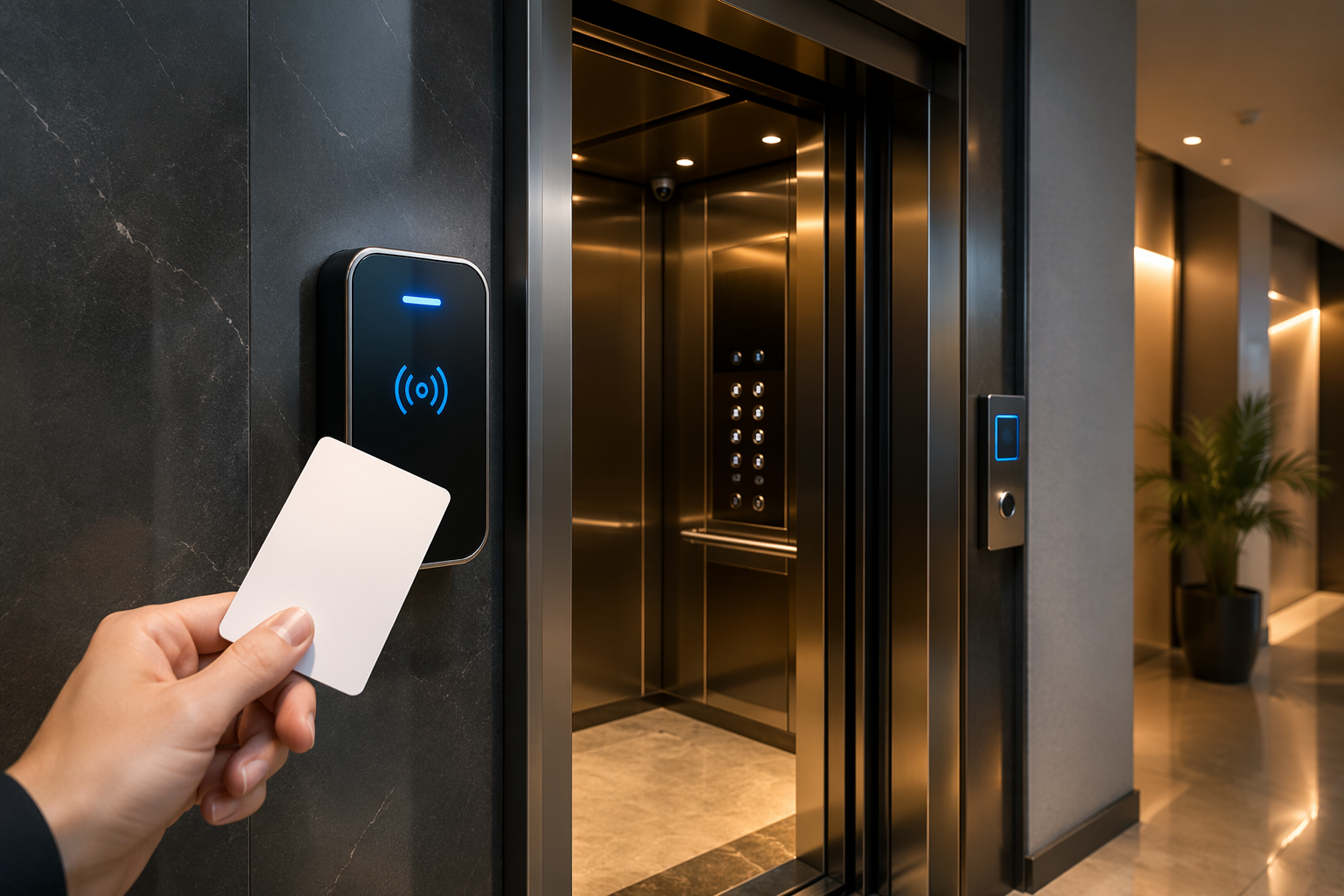
In modern hospitality and commercial buildings, security is no longer limited to the room door. Elevators have become a critical control point—and this is where RFID key cards show their real value.
For procurement managers and system integrators, understanding how RFID-enabled room cards work with elevator access control systems is essential for making the right infrastructure decisions.
Why Elevators Are Now Part of Access Control
Traditionally, elevators allowed unrestricted movement between floors. That model no longer meets today’s security expectations.
Hotels, serviced apartments, and office buildings are increasingly implementing floor-level authorization, where guests or staff can only access specific floors using their RFID credentials.
This shift is driven by:
- Guest safety expectations
- Regulatory compliance in some regions
- The need to reduce unauthorized access
- Operational efficiency in large properties
How RFID Key Cards Work with Elevator Systems
An RFID hotel key card is more than just a room unlock tool—it acts as a secure identity token.
Here’s how the integration typically works:
1. Card Issuance
At check-in, the hotel management system encodes the RFID card with:
- Room number
- Stay duration
- Access permissions (specific floors, amenities, time windows)
2. Elevator Reader Interaction
Inside the elevator cabin or near the call panel, an RFID reader is installed.
When the guest taps the card:
- The reader scans the RFID chip (typically HF 13.56 MHz such as MIFARE)
- The system verifies credentials in real time or via a local controller
- Authorized floor buttons are activated
3. Access Control Logic
The system enforces rules such as:
- Floor restriction (e.g., Room 1208 → Floor 12 only)
- Time-based access (valid only during stay period)
- Multi-zone permissions (gym, spa, executive lounge)
Key Technical Components
A reliable RFID elevator access solution includes:
RFID Key Cards
- PVC, PET, or eco-friendly materials
- Compatible chips (e.g., MIFARE Classic, Ultralight, DESFire EV1/EV2)
- Secure data encoding
RFID Readers (Elevator Panels)
- Embedded or external readers
- Anti-collision and fast read performance
- Integration via Wiegand, RS485, or TCP/IP
Access Control Controller
- Central logic unit
- Handles permission verification
- Interfaces with elevator control system (e.g., via relay or API)
Hotel Management System (HMS/PMS Integration)
- Syncs guest data with access permissions
- Automates card activation and expiration
Real-World Applications
Hotels
Guests can only access:
- Their assigned floor
- Public floors (lobby, restaurant, gym)
Office Buildings
Employees are restricted to:
- Authorized departments
- Specific time schedules
High-Security Facilities
Multi-factor setups combine:
- RFID card
- PIN or biometric authentication
Benefits That Matter to Buyers
From a procurement perspective, RFID elevator integration delivers measurable value:
1. Enhanced Security
Prevents unauthorized floor access and reduces risks like tailgating.
2. Better Guest Experience
Seamless, contactless interaction—no need for manual checks.
3. Operational Efficiency
Reduces reliance on security personnel and manual monitoring.
4. Scalable Infrastructure
Easily expandable across multiple buildings or properties.
5. Data Traceability
Access logs provide insights for audits and incident tracking.
Common Mistakes to Avoid
Many projects fail not due to hardware—but poor planning.
- Choosing low-security chips (e.g., outdated MIFARE Classic for high-end hotels)
- Ignoring system compatibility between elevator brand and access controller
- Lack of encryption or weak key management
- No fallback mechanism during network failure
What to Consider Before Procurement
Before selecting a supplier, clarify:
- What RFID chip level is required? (Standard vs high-security)
- Does the system support your existing PMS?
- Is elevator integration native or requires middleware?
- What is the expected daily scan volume?
- Are custom branding and encoding services included?
Final Insight
RFID key cards are no longer just about opening doors—they are central to vertical access control strategy.
In high-density environments, the elevator is the most critical checkpoint. Integrating RFID at this level transforms a basic access system into a layered security architecture.
For buyers, the difference between a standard solution and a well-integrated system often comes down to one factor:
how early RFID is considered in the building’s overall access design.

About XIUCHENG RFID
XIUCHENG RFID specializes in manufacturing a wide range of RFID products, including RFID Silicone Wristbands, Tyvek Wristbands, Fabric Wristbands, Elastic Wristbands, Vinyl Wristbands, RFID Laundry Tags, Animal Tags, and RFID Cards. All products are produced under strict quality control and advanced production technology.
With 12 years of experience in wristband design, tag design, quality management, and customer relationship management, we have built a solid foundation for delivering reliable and high-performance RFID solutions.


