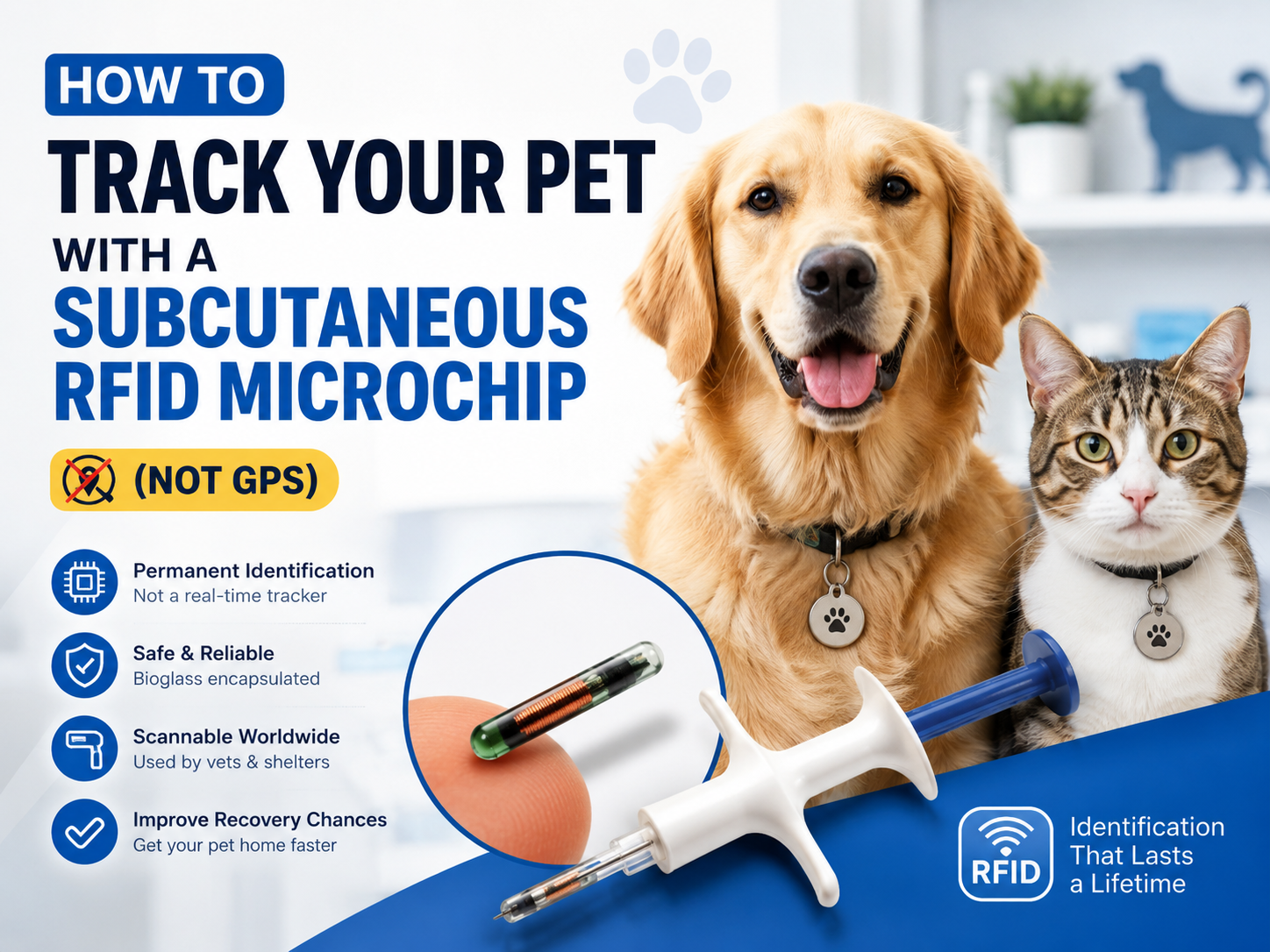
Losing a pet is every owner’s nightmare. Many people assume “pet tracking chips” work like GPS trackers, but that is not how pet RFID microchips operate.
A subcutaneous RFID microchip is an identification system, not a live location tracker. It helps veterinarians, shelters, and animal control identify your pet after it is found and scanned.
This guide explains how RFID pet microchips actually work, how they are implanted, how recovery works, and what you need to know before using one.
What Is a Pet RFID Microchip?
A pet RFID microchip is a tiny passive electronic identification device implanted under the animal’s skin.
Most pet chips:
- Are about the size of a grain of rice
- Operate at 134.2 kHz
- Follow ISO 11784/11785 standards
- Store a unique identification number
- Require no battery
- Can last for the lifetime of the pet
Unlike GPS collars, RFID chips do not transmit real-time location data.
The chip only responds when scanned by a compatible RFID reader.

RFID vs GPS Pet Tracking
Many pet owners confuse RFID microchips with GPS trackers.
Here is the difference:
| Feature | RFID Pet Microchip | GPS Pet Tracker |
|---|---|---|
| Real-time tracking | No | Yes |
| Battery required | No | Yes |
| Implantable | Yes | No |
| Works worldwide | Usually | Depends on cellular coverage |
| Requires scanner | Yes | No |
| Monthly subscription | No | Often yes |
| Main purpose | Identification | Live location tracking |
An RFID microchip is best for permanent identification.
A GPS tracker is best for live movement tracking.
Many owners use both together.
How RFID Pet Microchips Work
The system has three components:
- The implanted RFID microchip
- An RFID scanner
- A pet registration database
When the scanner emits radio frequency energy, the passive chip becomes temporarily activated and transmits its unique ID number.
The operating principle is based on electromagnetic induction.
f=134.2 kHz
The scanner then displays the chip ID.
Veterinarians or shelters use this ID to search the pet owner database.
Where the RFID Chip Is Implanted
For dogs and cats, the chip is usually implanted:
- Between the shoulder blades
- Under loose skin
- Using a sterile single-use injector
The process is similar to a vaccination injection and usually takes only a few seconds.
Most animals tolerate the procedure very well without anesthesia.
What Happens After Implantation
Implanting the chip alone is not enough.
The most important step is registration.
After implantation, you must:
- Record the chip number
- Register it in a pet recovery database
- Add accurate contact information
- Update your details whenever they change
An unregistered chip is almost useless during recovery.
How Lost Pet Recovery Actually Works
Here is the real recovery process:
- Your pet gets lost
- Someone finds the animal
- They bring it to:
- A veterinary clinic
- Animal shelter
- Rescue organization
- Municipal animal control
- Staff scan the pet
- The RFID number appears
- The database links the ID to your contact information
- You are contacted
The system depends on someone physically finding and scanning the animal.
RFID alone cannot show the pet’s live location.
Common RFID Frequencies for Pets
Most modern pet chips use:
| Frequency | Usage |
|---|---|
| 134.2 kHz | Global ISO pet standard |
| 125 kHz | Older systems |
| 128 kHz | Legacy systems |
ISO 134.2 kHz chips are the safest choice for international compatibility.
Can Smartphones Read Pet RFID Chips?
Usually no.
Most smartphones only support NFC at 13.56 MHz.
Pet microchips operate at low frequency 134.2 kHz, which requires specialized animal RFID scanners.
These are completely different RFID systems.
Are RFID Pet Microchips Safe?
Pet RFID microchips are widely used globally and are generally considered safe by veterinarians.
The chips are:
- Biocompatible
- Encased in bio-glass
- Passive (no radiation transmission)
- Battery-free
Potential issues are rare but can include:
- Chip migration
- Scanner incompatibility
- Registration errors
- Failed database updates
Proper implantation and ISO-standard chips reduce these risks significantly.
Can RFID Chips Track Pet Location?
No.
This is the biggest misconception.
Passive RFID pet chips cannot:
- Send GPS coordinates
- Use satellites
- Connect to Wi-Fi
- Use cellular networks
- Continuously broadcast signals
The scanning range is extremely short.
Typical reading distance:
| Reader Type | Approximate Distance |
|---|---|
| Handheld LF scanner | 2–10 cm |
| High-performance reader | Up to 20 cm |
RFID microchips are identification devices, not navigation devices.
Should You Use RFID Microchips for Pets?
Yes — for identification purposes.
An RFID microchip dramatically improves the chance of recovering a lost pet because shelters and veterinarians routinely scan animals.
However, it should not replace:
- GPS collars
- Name tags
- Airtag-style trackers
- Proper fencing and supervision
The best recovery strategy combines multiple identification methods.
Best Practices for Pet RFID Microchipping
Choose ISO-Compatible Chips
Use ISO 11784/11785 compliant 134.2 kHz microchips for maximum compatibility.
Register Immediately
Implantation without registration defeats the purpose.
Keep Contact Details Updated
Many failed recoveries happen because phone numbers are outdated.
Ask for a Scan Verification
After implantation, ask the veterinarian to scan the chip to confirm readability.
Combine RFID With Visible ID Tags
Visible tags help people contact you immediately without visiting a clinic.
Final Thoughts
Subcutaneous RFID microchips are one of the most effective permanent identification methods for pets.
But they are not GPS trackers.
Their strength lies in reliable identification after recovery, not real-time monitoring.
Understanding this distinction helps pet owners build a realistic and effective lost-pet protection strategy.

About XIUCHENG RFID
XIUCHENG RFID specializes in manufacturing a wide range of RFID products, including RFID Silicone Wristbands, Tyvek Wristbands, Fabric Wristbands, Elastic Wristbands, Vinyl Wristbands, RFID Laundry Tags, Animal Tags, and RFID Cards. All products are produced under strict quality control and advanced production technology.
With 12 years of experience in wristband design, tag design, quality management, and customer relationship management, we have built a solid foundation for delivering reliable and high-performance RFID solutions.