


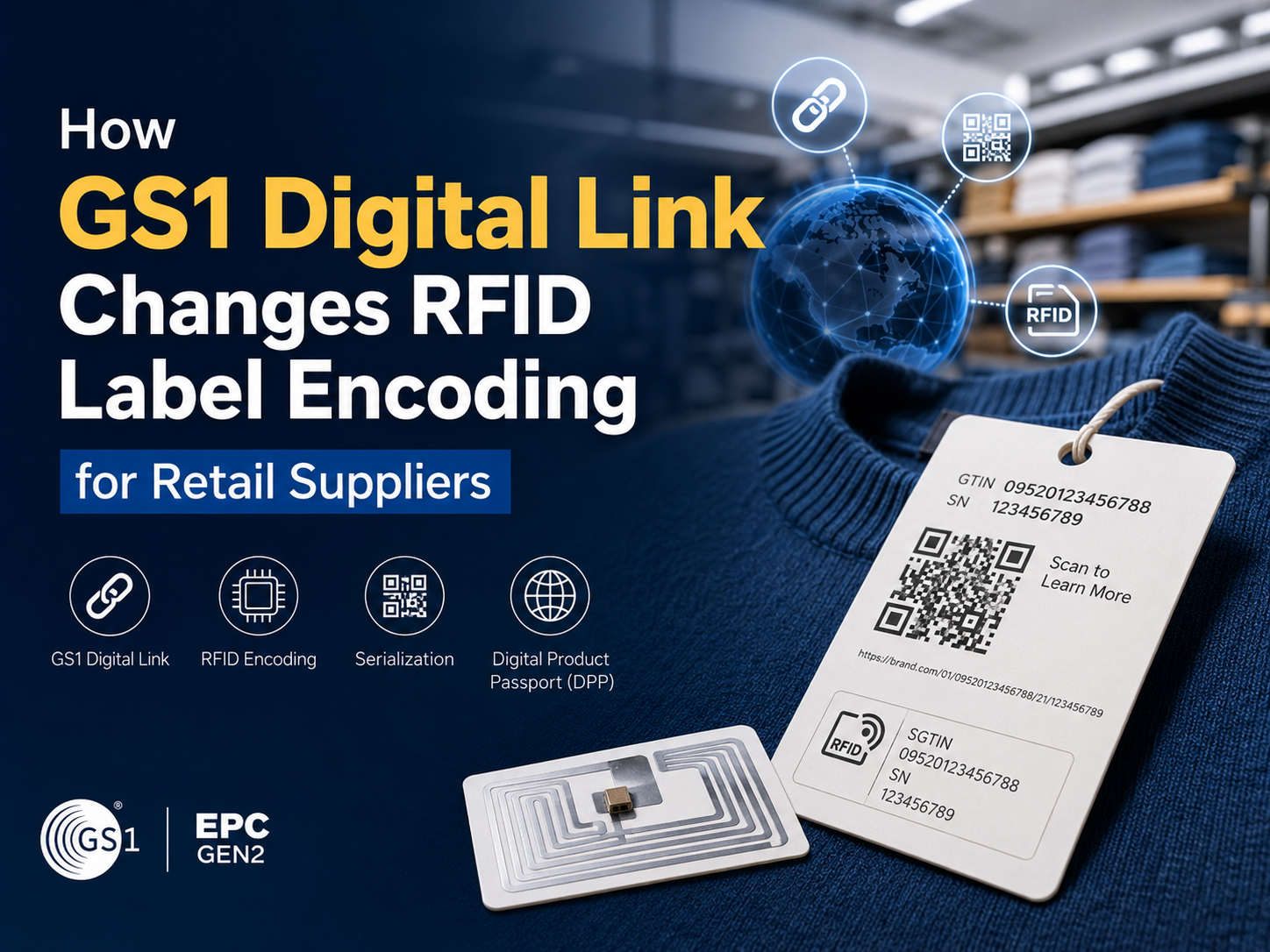
For years, RFID labels have primarily served one purpose: enabling automatic identification through EPC (Electronic Product Code) encoding. Retail suppliers would program a serial number into an RFID chip, attach the label to a product, and rely on inventory management systems to track it throughout the supply chain.
However, the retail industry is entering a new era of connected products.
With the rapid adoption of GS1 Digital Link, brands are beginning to transform ordinary RFID labels into digital gateways that connect physical products with online information, consumer experiences, regulatory compliance data, and Digital Product Passports (DPP).
For retail suppliers, this shift changes not only how labels are printed but also how RFID tags are encoded and managed.
In this article, we’ll explore what GS1 Digital Link is, why major retailers are adopting it, and how RFID manufacturers and suppliers should prepare for the next generation of smart product identification.
What Is GS1 Digital Link?
GS1 Digital Link is a global standard developed by GS1 that converts traditional product identifiers into web-based URLs.
Instead of storing only a static barcode number, products can be represented by a standardized web address, such as:
Where:
- 01 = GTIN (Global Trade Item Number)
- 21 = Serial Number
When scanned by a smartphone or industrial reader, this URL can direct users or systems to different digital resources.
Examples include:
- Product authenticity verification
- Warranty registration
- User manuals
- Sustainability information
- Recycling instructions
- Product recalls
- Digital Product Passports
- Supply chain traceability records
Rather than treating RFID and QR codes as separate technologies, GS1 Digital Link allows them to share the same product identity.
Traditional RFID Label Encoding
Most UHF RFID labels today follow the EPCglobal Gen2 standard.
A typical encoded memory structure includes:
| Memory Bank | Purpose |
|---|---|
| Reserved | Passwords |
| EPC | Product identifier |
| TID | Chip unique ID |
| User Memory | Optional custom data |
The EPC field often contains:
- Company Prefix
- Item Reference
- Serialized Number
For example:
Warehouse systems, POS terminals, and inventory software interpret this EPC value internally.
Consumers, however, cannot directly access or understand it.
The Problem with Traditional EPC Encoding
Modern retailers require much more than inventory visibility.
A single product may need to provide information to multiple stakeholders:
Consumers
- Product origin
- Care instructions
- Authentication
- Loyalty programs
Retailers
- Inventory tracking
- Omnichannel fulfillment
- Return management
Regulators
- Sustainability reporting
- Carbon footprint data
- Material composition
- Digital Product Passport compliance
Traditional EPC encoding was never designed to handle these expanding digital interactions.
How GS1 Digital Link Works with RFID
The key concept is identity unification.
An RFID tag and a QR code can reference exactly the same product identifier.
For example:
RFID Chip
EPC Memory:
QR Code
Both identifiers point to the same serialized product.
Backend software resolves the Digital Link URL and determines what information should be displayed based on:
- User location
- Device type
- Language
- Supply chain role
- Authentication status
This creates a single digital identity for every physical product.
Why Retail Suppliers Need to Care
1. Sunrise 2027 Initiative
GS1’s Sunrise 2027 initiative encourages retailers to adopt 2D barcodes capable of carrying Digital Link data.
Many global retailers are already upgrading their scanning infrastructure to support QR codes alongside traditional UPC barcodes.
For suppliers, RFID labels increasingly need to coexist with these next-generation identifiers.
2. Digital Product Passport (DPP) Requirements
The European Union is introducing Digital Product Passports across multiple industries, including:
- Apparel
- Footwear
- Electronics
- Batteries
- Textiles
Each product will require accessible digital information throughout its lifecycle.
RFID labels encoded with serialized GS1 identifiers provide an ideal foundation for DPP implementation.
3. Anti-Counterfeiting
Luxury brands and premium retailers are combining RFID and Digital Link to create secure authentication systems.
A customer can scan the QR code.
A warehouse can read the RFID chip.
Both access the same authenticated product record.
Counterfeiters must now replicate both the physical label and the backend digital identity.
How RFID Label Encoding Will Change
Retail suppliers should expect several workflow changes.
Serialization Becomes Mandatory
Instead of encoding only SKU-level information, every individual item receives a unique serial number.
Example:
| Product | Serial Number |
|---|---|
| Blue Shirt M | 100000001 |
| Blue Shirt M | 100000002 |
| Blue Shirt M | 100000003 |
This supports item-level traceability.
RFID and QR Production Must Be Synchronized
The printed QR code and RFID EPC must correspond to the same product identity.
Encoding software must ensure:
- Correct GTIN
- Correct serial number
- Proper EPC conversion
- Matching Digital Link URL
Any mismatch could break downstream tracking systems.
Backend Databases Become Critical
The RFID chip itself does not store the entire Digital Link URL.
Instead, it stores standardized identifiers that backend systems translate into digital experiences.
Manufacturers need robust serialization databases capable of handling millions of unique products.
Best Practices for RFID Manufacturers
Support GS1-Compliant EPC Encoding
Ensure your encoding software follows GS1 EPC Tag Data Standards.
Offer QR + RFID Combined Labels
Many retail customers now request labels that integrate:
- UHF RFID inlay
- Printed QR code
- Human-readable serial number
- Brand graphics
Hybrid labels reduce production complexity.
Build Flexible Encoding Platforms
Customers increasingly require:
- Batch serialization
- CSV imports
- ERP integration
- MES connectivity
- API-based encoding
Cloud-connected encoding systems offer significant competitive advantages.
Prepare for Digital Product Passports
RFID factories that understand DPP implementation today will be well positioned as regulations expand globally.
Providing consulting around serialization and GS1 standards can become an additional value-added service.
Example: Apparel Supply Chain
A fashion brand manufactures 500,000 jackets.
Each jacket receives:
RFID EPC
Printed QR Code
During manufacturing:
- RFID readers automate packing.
- Warehouse portals track shipments.
At retail:
- Inventory counts occur in seconds.
- Self-checkout systems identify products instantly.
After purchase:
The customer scans the QR code and accesses:
- Product authenticity
- Care instructions
- Sustainability certificate
- Recycling program
- Warranty registration
One serialized identity powers the entire product lifecycle.
The Future of RFID Is Digital Identity
RFID technology is evolving beyond simple inventory tracking.
GS1 Digital Link creates a bridge between physical products and digital information, enabling smarter supply chains, enhanced consumer engagement, and future regulatory compliance.
For retail suppliers, the question is no longer whether to adopt serialization and Digital Link standards—but how quickly they can integrate them into existing RFID labeling workflows.
Manufacturers that prepare now will be better positioned to support Sunrise 2027 initiatives, Digital Product Passports, and the next generation of connected retail.
Conclusion
GS1 Digital Link does not replace RFID. Instead, it makes RFID labels significantly more valuable by connecting them to a universal digital identity.
As retailers move toward fully traceable, serialized products, RFID label encoding will become increasingly integrated with QR codes, cloud databases, and Digital Product Passport ecosystems.
Suppliers that understand this transformation today can help customers build future-ready supply chains while gaining a competitive advantage in the rapidly evolving RFID market.

About XIUCHENG RFID
XIUCHENG RFID specializes in manufacturing a wide range of RFID products, including RFID Silicone Wristbands, Tyvek Wristbands, Fabric Wristbands, Elastic Wristbands, Vinyl Wristbands, RFID Laundry Tags, Animal Tags, and RFID Cards. All products are produced under strict quality control and advanced production technology.
With 12 years of experience in wristband design, tag design, quality management, and customer relationship management, we have built a solid foundation for delivering reliable and high-performance RFID solutions.


