Buyers of livestock RFID ear tags, injectable transponders and rumen boluses often ask suppliers to customize the electronic identification number.
Typical requests include:
- Can the RFID number begin with our company code?
- Can we choose a specific country code?
- Can the electronic number match our visual ear tag number?
- Can we reserve an exclusive serial-number range?
- Can the same numbering format be used in several countries?
- Can unused numbers be programmed again for another customer?
The technical answer is more restrictive than many buyers expect.
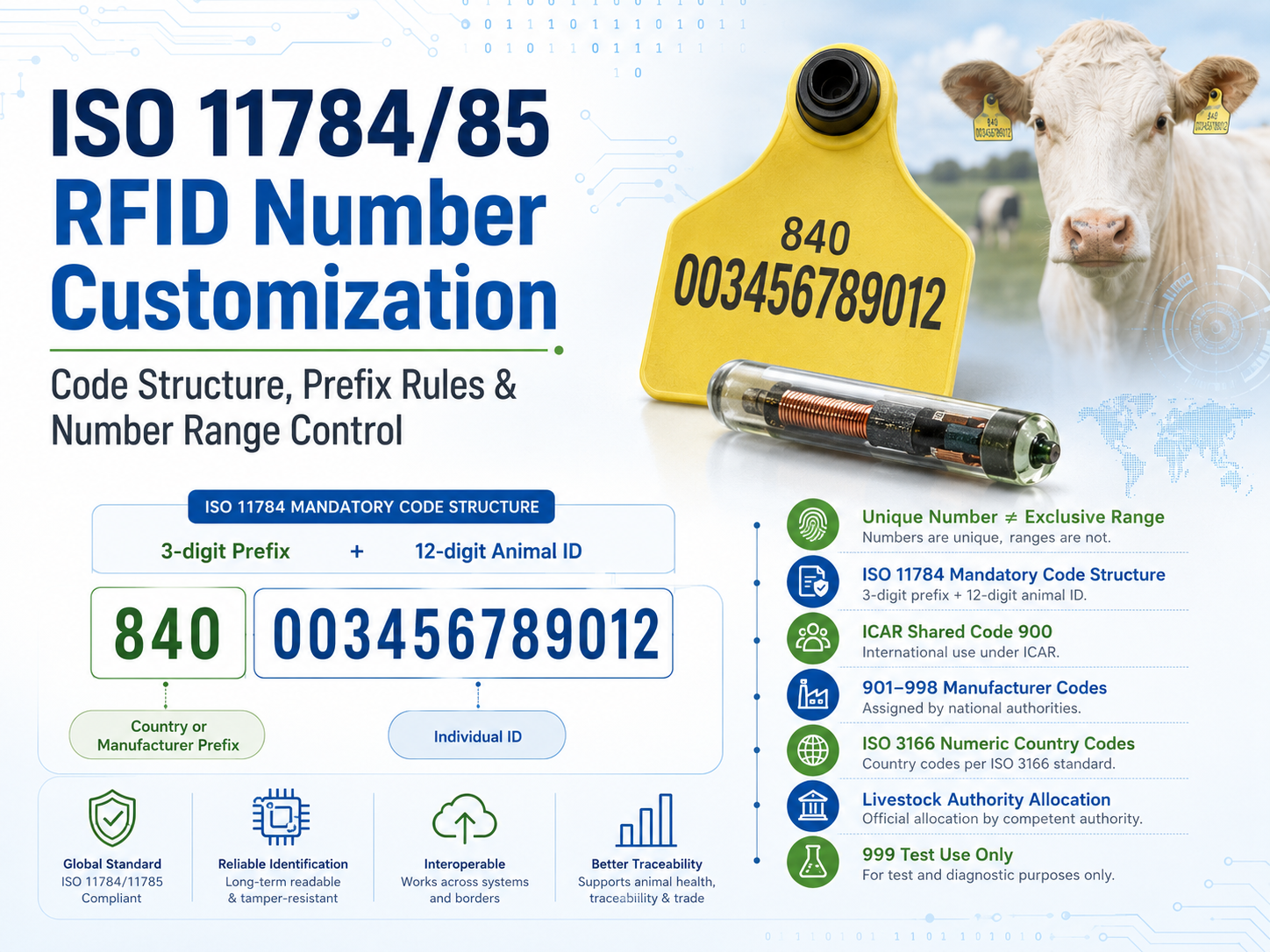
An ISO 11784/11785 transponder may be physically programmable during manufacturing, but its identification code cannot be treated as an unrestricted customer field. The number must follow the ISO code structure, use an authorized country or manufacturer prefix, remain within an allocated range and be globally unique.
In other words:
The number sequence may sometimes be customized, but the code structure, prefix authority and uniqueness controls cannot be freely changed.
Understanding this distinction is essential for livestock tag manufacturers, distributors, animal identification authorities and farms purchasing customized RFID devices.
ISO 11784 and ISO 11785 Perform Different Functions
ISO 11784 and ISO 11785 are frequently written together, but they address different parts of an animal RFID system.
ISO 11784 Defines the Identification Code
ISO 11784 specifies the structure of the radio-frequency identification code used for animals.
It determines how the electronic identity is divided into fields such as:
- Country or manufacturer prefix
- Individual animal identification number
- Animal-application indicator
- Additional-data indicator
- Reserved or controlled bits
The current published edition is ISO 11784:2024.
ISO 11785 Defines the Technical Communication Concept
ISO 11785 describes how compatible animal transponders and readers communicate.
It covers technologies such as:
- FDX-B
- HDX
- Low-frequency operation around 134.2 kHz
- Reader and transponder communication behavior
ISO 11785 does not allocate a customer’s serial-number range. It ensures that a compliant reader can interpret a compliant transponder’s transmission.
Therefore, a statement such as “ISO 11784/11785 chip” should not be interpreted as permission to program any requested number.
The Standard 15-Digit Animal RFID Number
The human-readable form of an ISO 11784 identification number is normally presented as 15 numeric digits:
3-digit prefix + 12-digit individual identification number
Par exemple :
840 003456789012
The spaces are only used to improve readability. The electronic and database value is normally treated as one continuous numeric code:
840003456789012
The two visible sections serve different purposes.
| Section | Decimal length | Binary allocation | Fonction |
|---|---|---|---|
| Country or manufacturer prefix | 3 digits | 10 bits | Identifies the authorized country scheme or RFID manufacturer |
| Individual identification number | 12 digits | 38 bits | Identifies the individual animal or device within that prefix |
| Complete displayed ID | 15 digits | 48 identification bits | Creates the externally displayed electronic identity |
The complete ISO identification block also contains control and reserved fields that are not normally visible in the 15-digit decimal number.
The Underlying 64-Bit Structure
The ISO 11784 animal identification code is based on a 64-bit structure.
At a functional level, it contains:
| Field | Longueur | General purpose |
|---|---|---|
| Individual identification code | 38 bits | Unique animal or transponder number |
| Country or manufacturer code | 10 bits | Authorized numeric prefix |
| Additional-data indicator | 1 bit | Indicates whether an additional data block is present |
| Reserved or controlled field | 14 bits | Reserved or used only according to defined rules |
| Animal-application indicator | 1 bit | Distinguishes animal identification use |
| Total | 64 bits | ISO identification code |
Technical diagrams may display these fields in different directions according to transmission order or bit numbering. That does not change the functional allocation.
The 14 reserved bits are not a general-purpose customer memory area. They should not be used to insert company numbers, farm codes or product information unless the applicable standard and national scheme specifically permit that use.
A 12-Digit Field Does Not Accept Every 12-Digit Number
This is one of the most commonly overlooked restrictions.
The individual identification section is displayed using 12 decimal digits, but it is stored in 38 binary bits.
A 38-bit field can represent values from:
0 to 274,877,906,943
It cannot represent every value from 000,000,000,000 to 999,999,999,999.
For example, a buyer cannot assume that any 12-digit number below one trillion is technically valid. Numbers above 274,877,906,943 exceed the capacity of the 38-bit identification field.
Leading zeros are permitted and are commonly used to maintain the fixed 12-digit display format.
What Can Actually Be Customized?
Customization is normally possible only inside an authorized and unused number allocation.
A supplier may be able to customize:
- The starting serial number
- The number of transponders in a production batch
- Sequential or controlled number progression
- A customer-specific subrange
- Visual printing associated with the electronic ID
- A database mapping between the RFID number and the customer’s internal animal number
- Barcode or QR code content
- Packaging labels and encoding reports
Customization remains subject to several conditions:
- The prefix must be authorized.
- The requested numbers must fall within the supplier’s allocated range.
- Every complete 15-digit code must be unique.
- The number must not have been used previously.
- The 12-digit value must fit within the 38-bit limit.
- The final ISO code must be locked.
- Production records must preserve traceability between the silicon chip and the programmed number.
- National livestock identification rules may impose additional subdivisions.
A supplier cannot create a valid number range simply by entering the buyer’s preferred digits into a programmable chip.
What Cannot Be Freely Customized?
The following elements are not ordinary customer-selectable options.
The Three-Digit Prefix
A customer cannot independently choose a country code or manufacturer code.
The Animal-Application Bit
A product sold as an ISO-compliant animal identification transponder must use the correct animal-application setting.
Reserved and Control Bits
These fields must follow the standard and any applicable national rules.
Previously Issued Numbers
A number cannot be reused because a tag was cancelled, lost, returned or never applied.
Test Prefix 999
The 999 prefix is reserved for defined testing purposes and cannot be used for commercial animal identification.
Numbers Outside the Allocated Range
A technically programmable number may still be unauthorized and non-compliant.
The Three-Digit Prefix: Country Code or Manufacturer Code
The first three digits have two possible meanings.
They can represent either:
- An ISO 3166 numeric country code, or
- An ICAR-assigned manufacturer code.
They are alternatives. They are not two separate fields that can both be inserted into the same three-digit prefix.
Country-Code Route
Country codes occupy values allocated under ISO 3166.
Voici quelques exemples :
| Country | ISO 3166 numeric code |
|---|---|
| Argentina | 032 |
| Australia | 036 |
| Brazil | 076 |
| Canada | 124 |
| Chine | 156 |
| France | 250 |
| Germany | 276 |
| Netherlands | 528 |
| New Zealand | 554 |
| South Africa | 710 |
| United Kingdom | 826 |
| United States | 840 |
The existence of an ISO 3166 country code does not automatically give a tag manufacturer permission to program it.
A manufacturer may use a country code only when authorized by the competent authority responsible for animal identification in that country.
If a country has not established an authority capable of allocating and controlling unique animal numbers, the country-code route should not be used for an ICAR-certified transponder.
Manufacturer-Code Route
Manufacturer codes occupy the 900 to 998 range and are allocated through ICAR in its role as the ISO Registration Authority for ISO 11784 and ISO 11785 animal RFID devices.
Manufacturer codes are used when:
- A country does not operate a controlled national country-code scheme
- The product is intended for voluntary farm management
- Companion-animal identification uses a manufacturer-controlled system
- The relevant authority permits manufacturer-coded devices
- A manufacturer needs to guarantee uniqueness outside a national allocation system
A manufacturer cannot choose any number between 900 and 998. The code and associated number range must be granted through the ICAR process.
How the ICAR Shared Manufacturer Code 900 Works
The manufacturer code 900 is a shared manufacturer code.
This means multiple ICAR-registered manufacturers may use the same three-digit prefix.
At first glance, allowing several manufacturers to use 900 appears to create a duplication risk. ICAR prevents this by assigning each approved manufacturer or product a restricted part of the 12-digit identification space.
The complete combination remains unique:
900 + ICAR-allocated serial-number range
A manufacturer using shared code 900 cannot select numbers from the entire 12-digit field. It may only use the range assigned to it.
For example, two manufacturers may both produce tags beginning with 900, but their permitted serial-number blocks must not overlap.
The restricted range, rather than the prefix alone, identifies the authorized allocation.
ICAR currently describes the initial shared-code allocation as a restricted block of numbers. Additional blocks may be requested when the original allocation is being exhausted, subject to ICAR’s allocation procedure.
Unshared Manufacturer Codes 901–998
Codes from 901 to 998 may be issued as unshared manufacturer codes.
An unshared code is allocated exclusively to one eligible manufacturer. However, it is not simply purchased as a branding option.
ICAR requires the manufacturer to demonstrate substantial production volume before an unshared code can be granted. The current procedure requires evidence that the company sold at least one million ICAR-certified transponders per year for two consecutive years.
Even with an unshared manufacturer code, the manufacturer remains responsible for:
- Preventing duplicate numbers
- Maintaining an encoding database
- Locking the ISO identification code
- Maintaining chip-to-code traceability
- Using the code only with eligible registered products
- Complying with the ICAR Code of Conduct
An unshared code provides exclusive control of the prefix. It does not remove the uniqueness and traceability obligations.
Prefix 999 Is Not a Commercial Manufacturer Code
The prefix 999 is reserved for sample transponders used in ISO conformance or performance testing.
ICAR states that:
- It must not be used to identify animals.
- It must not be used commercially.
- Promotional samples using 999 must meet defined restrictions.
- The packaging must make the sample status clear.
A chip programmed with 999 may be readable by an ISO reader, but readability does not make it a valid commercial animal identification device.
This is an important example of the difference between technical operation and compliant use.
Exclusive Number Range vs Globally Unique Number
“Exclusive” and “unique” are related but not identical concepts.
What Is an Exclusive Number Range?
An exclusive range is a defined sequence reserved for one manufacturer, customer, product or project.
For example, a manufacturer may reserve a valid part of its allocated range for a particular distributor.
The agreement may state that no other customer will receive numbers from that block.
Exclusivity is primarily an allocation and database-control concept.
What Is a Unique Number?
A unique number is a complete electronic identity that has never been assigned to another animal or transponder within the applicable global numbering system.
Uniqueness depends on the complete combination:
Authorized prefix + valid individual number
A serial number may look unique inside one customer’s spreadsheet while still duplicating a number previously issued by another supplier.
Similarly, a customer-specific suffix does not guarantee global uniqueness when the prefix is unauthorized or the range has not been centrally controlled.
Why a “Private Company Prefix” Is Not Automatically Valid
A buyer may request a code such as:
123 + 12-digit serial number
The buyer may regard 123 as its internal company number. However, 123 is the ISO 3166 numeric code assigned to a country or territory only if officially allocated as such; it is not a blank private field.
Using an arbitrary three-digit company number can create several problems:
- It may impersonate a country code.
- It may duplicate an existing national scheme.
- It may not be recognized by livestock databases.
- It may breach ICAR manufacturer-code rules.
- The product may fail regulatory approval.
- Readers may display the number, but the number may remain non-compliant.
A reader’s ability to display 15 digits is not proof that those digits were validly allocated.
The Role of National Livestock Authorities
ISO 11784 does not create one global livestock database.
When a country code is used, the relevant national competent authority is responsible for ensuring that animal numbers issued under that code remain unique.
The authority may:
- Approve identification devices
- Authorize manufacturers
- Allocate serial-number ranges
- Define species-specific subranges
- Reserve replacement-tag fields
- Control premises or herd codes
- Register issued tags
- Receive production files
- Maintain movement databases
- Suspend or revoke device approval
There is no universal additional “livestock authority code” occupying a fixed ISO 11784 field.
The authority manages the numbering rules beneath the country prefix. It may divide the 12-digit animal-number field into several national subfields, but those subdivisions are determined by the country rather than by the universal ISO structure.
Examples of National Number Administration
United States: 840 and USDA APHIS
The United States uses the ISO numeric country code 840 for Animal Identification Number devices administered under USDA APHIS animal disease traceability rules.
The electronic format is:
840 + 12-digit animal number
An official example is:
840003456789012
The USDA standard states that 840-prefixed AIN devices cannot be applied to animals known to have been born outside the United States.
A manufacturer cannot produce official 840 tags merely because a customer requests them. The product, manufacturer, number allocation and distribution process must comply with APHIS requirements.
Canada: 124 and a National Subdivision
Canada uses country code 124 for approved animal indicators.
A common Canadian structure is displayed as:
124 000 123456789
It can be interpreted as:
- 124: ISO country code for Canada
- 000: field managed by the Canadian Food Inspection Agency
- 123456789: unique animal identifier
The additional 000 + 9-digit presentation is a Canadian administrative subdivision of the 12-digit animal-number field. It is not a universal ISO rule that every country must follow.
Canadian cattle tag ranges are further controlled by the applicable traceability administrators and approved-indicator programme.
United Kingdom: GB Visually, 826 Electronically
The United Kingdom’s ISO numeric country code is 826.
A visual cattle number may use the letters GB, while an ISO-compliant electronic reader displays the numeric equivalent 826.
This demonstrates an important point:
The printed visual identifier and electronic number do not always use identical characters, even when they represent the same national identity.
New Zealand: National Scheme Does Not Necessarily Mean Prefix 554
New Zealand’s ISO 3166 numeric country code is 554, but this does not mean every NAIT tag must electronically begin with 554.
Official NAIT guidance has shown RFID numbers using approved manufacturer prefixes such as 942, 951 and 982.
New Zealand therefore demonstrates why buyers should not infer an RFID prefix from the ISO country-code list alone.
A tag must follow the numbering and device-approval rules of the NAIT scheme administered by OSPRI, rather than a customer simply requesting “554 tags.”
Australia: Approval Is More Than Prefix 036
Australia’s ISO numeric country code is 036, but official livestock identification is managed through the National Livestock Identification System.
NLIS combines:
- An accredited identification device
- A Property Identification Code
- Animal movement records
- A central traceability database
- State and territory regulatory requirements
A device does not become an official Australian livestock tag simply because its electronic number begins with 036.
The device, numbering allocation, manufacturer and database process must meet NLIS and relevant state or territory requirements.
Country Code Does Not Always Equal the Destination Country
The country-code prefix is not a shipping destination code.
A supplier should not change the first three digits according to:
- The customer’s delivery address
- The destination port
- The country in which the distributor is located
- The intended export market
- The buyer’s nationality
In official identification systems, the prefix is generally associated with the authorized national scheme and often with the animal’s country of birth.
For example, the United States prohibits applying an 840 AIN to an animal known to have been born outside the United States.
Can the Customer Choose the 12-Digit Number?
Sometimes, but only under controlled conditions.
A manufacturer may accept a requested starting number when:
- The requested range belongs to the manufacturer
- The range has not been used
- The competent authority permits the requested format
- The values are within the 38-bit limit
- The sequence will not overlap another order
- The product is approved for that numbering scheme
- The complete codes will be locked after programming
A manufacturer should reject the request when:
- The range belongs to another manufacturer
- The prefix is unauthorized
- The customer asks for duplicate numbers
- The customer wants to reuse old numbers
- The requested serial exceeds 274,877,906,943
- The customer asks for letters in the electronic ISO number
- The request conflicts with a national programme
- The customer requests 999 for normal commercial tags
Can the Electronic Number Match the Visual Ear Tag Number?
It depends on the national numbering system and the length of the visual number.
Some programmes use a “what you see is what you get” approach, in which the reader output corresponds closely to the printed identifier.
Other programmes use:
- A shorter farm-management number on the visible panel
- A separate official visual identifier
- A 15-digit electronic number
- A database linking the visual and electronic identities
A farm may therefore print a short number such as:
Cow 1527
while the RFID transponder contains:
840003456789012
The farm software links both numbers to the same animal.
This can be more practical than attempting to place a farm’s entire internal numbering format inside the ISO electronic field.
Can Letters Be Stored in the ISO 11784 Number?
The standard 15-digit ISO 11784 identity is numeric.
Letters used in visual identifiers must be:
- Converted to an approved numeric equivalent
- Stored in a separate database
- Printed only on the visible tag
- Placed in additional memory where a separately defined protocol permits it
A customer cannot replace part of the 15-digit numeric ISO code with letters and still claim that the resulting code follows the standard ISO 11784 identity structure.
Can an ISO Animal RFID Number Be Rewritten?
Some integrated circuits may technically allow programming during manufacturing. That does not mean a finished compliant animal transponder should remain rewritable.
ICAR’s Code of Conduct requires the ISO 11784 identification code of compliant marketed transponders to be locked.
Manufacturers must also maintain an unchangeable database association between:
- The silicon chip serial number
- The programmed ISO 11784 code
- The production batch
- The initial purchaser or distribution record
Allowing field rewriting would undermine permanent identification and create a serious duplication risk.
Why Number Reuse Is Not Acceptable
An electronic number should not be reissued merely because:
- The tag was lost
- The tag was damaged
- The animal died
- The order was cancelled
- The tag was returned
- The number was deleted from a farm database
- The transponder battery or housing failed
- The device was never registered by the end user
A number may already exist in:
- Manufacturer production records
- Distributor files
- National databases
- Reader history
- Dossiers vétérinaires
- Movement records
- Slaughterhouse records
Deleting one local database entry does not erase the identity from every other system.
ISO Compliance Does Not Equal National Approval
An ICAR conformance certificate confirms that a tested transponder complies with the ISO 11784 code structure and ISO 11785 technical concept.
It does not automatically approve the product for every national livestock programme.
A country may impose additional requirements concerning:
- Tag dimensions
- Tamper evidence
- Pull-out force
- Material composition
- Résistance aux UV
- Print durability
- Tag colour
- Espèces
- Applicator design
- Environmental testing
- Database uploads
- Authorized distributors
- Number allocation
- Government markings
A transponder can therefore be:
- Technically ISO-compliant
- Readable by ISO readers
- Registered with ICAR
- Still not approved as an official cattle tag in a particular country
Recommended Number-Range Customization Process
A compliant supplier should use a controlled workflow.
Step 1: Identify the Intended Application
Determine whether the tags are intended for:
- Official national livestock identification
- Voluntary farm management
- Breeding records
- Animaux de compagnie
- Recherche
- Export livestock
- Slaughterhouse tracking
- Test and evaluation
The intended use determines which prefix route is permitted.
Step 2: Confirm the Prefix Authority
Identify whether the order will use:
- An authorized ISO country code
- ICAR shared manufacturer code 900
- An ICAR unshared manufacturer code from 901 to 998
Do not begin encoding based only on a customer purchase order.
Step 3: Verify the Product Registration
Confirm that the exact transponder product, including the chip, coil and packaging configuration, is covered by the relevant ICAR registration or national device approval.
Certification for one chip or tag design should not be applied to a materially different product.
Step 4: Confirm the Available Range
Check the central encoding database to determine:
- Allocated start number
- Allocated end number
- Numbers already programmed
- Numbers reserved for pending orders
- Remaining capacity
- Product restrictions
- Customer-specific blocks
Step 5: Validate the Customer Request
The requested sequence should be checked for:
- Correct prefix
- Numeric-only format
- Correct length
- 38-bit capacity
- Duplicate numbers
- Range ownership
- National subdivision rules
- Species restrictions
Step 6: Generate the Encoding File
The production file should include:
- Full 15-digit electronic ID
- Binary encoding value
- Chip serial number
- Visual number
- Barcode or QR code
- Customer order
- Batch number
- Date de production
- Modèle de produit
Step 7: Program and Lock the Code
After verification, the ISO identification code should be programmed and permanently locked according to the chip and production process.
Step 8: Verify Every Device
Production quality control should confirm:
- Correct FDX-B or HDX response
- Correct 15-digit number
- Correct prefix
- Visual and electronic number matching
- No duplicate codes
- Successful lock status
- Readability with a reference reader
Step 9: Preserve Traceability Records
The manufacturer should maintain records sufficient to trace:
- Who received the tags
- Which numbers were supplied
- Which silicon chips were used
- Which product and production batch were involved
- Whether the codes were country- or manufacturer-controlled
Step 10: Provide the Customer with a Number Report
A useful delivery report may include:
- First electronic number
- Last electronic number
- Total quantity
- Visual-number range
- Prefix type
- Encoding date
- Product code
- Batch number
- File checksum
- Duplicate-check confirmation
Questions Buyers Should Ask the Supplier
Before ordering customized ISO 11784/11785 transponders, ask:
- Is the product registered with ICAR?
- What is the ICAR product code?
- Is the device FDX-B or HDX?
- Does it use a country code or manufacturer code?
- Who authorized the prefix?
- If code 900 is used, what exact range has ICAR allocated?
- Is the requested range inside that allocation?
- How are duplicate numbers prevented?
- Will the ISO code be permanently locked?
- Can the supplier trace the programmed code to the chip serial number?
- Can the visual number be matched with the RFID number?
- Is the product approved in the destination country?
- Can the supplier provide an encoding report?
- What happens to cancelled or rejected numbers?
- Will those numbers ever be reused?
Common Non-Compliant Requests
“Use Our Company’s Three-Digit Number”
A company number cannot replace an ISO country or ICAR manufacturer code unless it has been officially allocated for that purpose.
“Use the Customer’s Country Code”
A country code requires authorization from that country’s competent authority. Customer location alone is not sufficient.
“Start All Our Tags with 900”
Code 900 can only be used within the exact range allocated by ICAR to the registered manufacturer or product.
“Use 999 for a Small Commercial Order”
Code 999 is reserved for test applications and cannot identify commercial animals.
“Program the Same Numbers as Our Previous Supplier”
This creates a serious duplicate risk unless the customer owns a nationally controlled allocation and the transition is formally coordinated.
“Leave the Chips Rewritable”
Compliant animal identity codes should be locked. Field rewriting conflicts with permanent identification and uniqueness controls.
“Put Our Farm Name into the Chip Number”
The ISO identity is numeric. Farm names and letters belong in the database, visual printing or separately defined user memory.
Final Answer: Can ISO 11784/11785 Numbers Be Customized?
They can be customized only within controlled limits.
A customer may be able to select:
- An available serial-number block
- A starting number
- A visual-number format
- A mapping between electronic and farm-management numbers
- Printing, barcode and packaging information
A customer cannot freely select:
- Any three-digit prefix
- An unauthorized country code
- Another manufacturer’s code
- Numbers outside the assigned range
- Duplicate or previously used numbers
- Values above the 38-bit limit
- Prefix 999 for commercial use
- Reserved ISO control fields
The correct principle is:
Customize the sequence within an authorized allocation, not the ISO structure itself.
Questions fréquemment posées
Is an ISO 11784 chip number always 15 digits?
The standard decimal presentation is normally 15 numeric digits: a three-digit country or manufacturer prefix followed by a 12-digit individual identification number.
Can a customer choose any 15-digit number?
No. The prefix must be authorized, the individual number must fall within an allocated range, and the complete code must be unique.
Is 900 a country code?
No. Code 900 is ICAR’s shared manufacturer code for animal RFID devices.
Can several manufacturers use code 900?
Yes. ICAR assigns each eligible manufacturer or product a separate restricted serial-number range so that complete codes do not overlap.
What are codes 901 to 998?
They are the range used for ICAR manufacturer codes. Eligible high-volume manufacturers may receive an unshared code for exclusive use.
What is code 999?
It is a test code. It must not be used for normal commercial animal identification.
Can a manufacturer use ISO country code 840, 124 or 826 without permission?
No. Use of a country code requires authorization from the competent authority responsible for the relevant national animal identification scheme.
Can country code and manufacturer code both appear in the prefix?
No. The three-digit prefix represents either a country code or a manufacturer code.
Are all 12-digit serial numbers technically valid?
No. The 38-bit field supports values only up to 274,877,906,943.
Can the visual tag number differ from the RFID number?
Yes. The two numbers can be linked in a database. Whether they must match depends on the national identification programme and customer workflow.
Does ICAR certification make a tag legal in every country?
No. National authorities may require separate device approval, numbering authorization, environmental testing and database integration.
Can a programmed animal RFID number be changed later?
A compliant marketed transponder’s ISO identification code should be permanently locked and should not be rewritten in the field.
What is the difference between an exclusive range and a unique number?
An exclusive range is reserved for one party. A unique number is a complete prefix-and-serial combination that has never been assigned elsewhere. Proper database control is required to achieve both.