Among the many types of passive UHF RFID tags available today, foam RFID tags have become one of the most widely used solutions for tracking metal assets, reusable containers, electronic devices, and industrial equipment.
At first glance, a UHF foam RFID tag looks similar to a standard RFID label. However, the additional foam layer fundamentally changes how the tag performs. By creating a controlled separation between the antenna and the mounting surface, the foam improves RF performance on challenging materials such as metal and allows the tag to achieve more stable read distances.
As industries continue to adopt RAIN RFID for asset tracking, warehouse automation, and intelligent manufacturing, foam RFID labels have become a practical and cost-effective alternative to rigid anti-metal RFID tags.
This guide explains what UHF foam RFID tags are, how they are constructed, their common sizes, key features, and the applications where they deliver the greatest value.
What Is a UHF Foam RFID Tag?
A UHF foam RFID tag is a passive RFID label operating in the Ultra High Frequency (UHF) band, typically 860–960 MHz, that incorporates a foam spacer between the RFID inlay and the mounting surface.
Unlike ordinary RFID labels that are applied directly to an object, the foam layer creates a small air gap. This separation helps maintain antenna tuning and reduces the detuning effects caused by metal surfaces or other challenging materials.
Most UHF foam RFID tags comply with:
- EPC Class 1 Gen2
- ISO/IEC 18000-63 (formerly ISO 18000-6C)
These standards ensure compatibility with most RAIN RFID readers used worldwide.
Why Is the Foam Layer Important?
The foam layer is the defining feature of this tag type.
When a standard UHF RFID label is attached directly to metal, the metal surface alters the antenna’s electromagnetic characteristics. This often results in dramatically reduced reading distance or complete communication failure.
The foam spacer creates physical separation between the antenna and the conductive surface, helping preserve antenna efficiency.
Benefits include:
- Improved read performance on metal
- Better antenna stability
- More consistent read rates
- Reduced signal absorption
- Greater installation flexibility
Although foam labels are sometimes referred to as anti-metal labels, they generally provide moderate on-metal performance rather than the extreme durability of rugged hard tags.
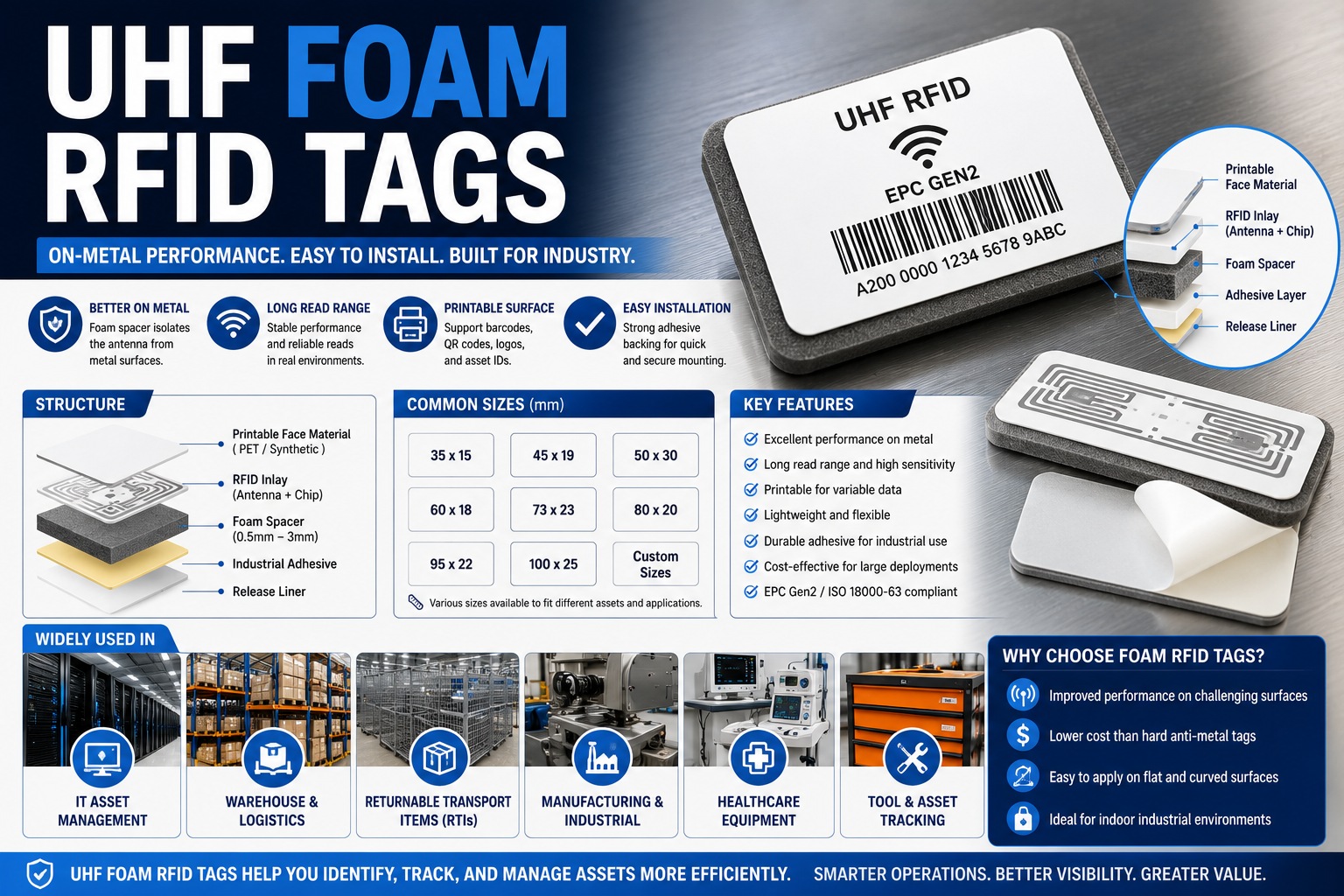
Internal Structure of a UHF Foam RFID Tag
A typical UHF foam RFID label consists of several layers.
From top to bottom:
Printable Face Material
Usually manufactured from PET or synthetic film.
This layer can carry:
- Company logos
- Asset numbers
- Barcodes
- QR codes
- Human-readable text
- Variable serial numbers
Many products support thermal transfer printing.
RFID Inlay
The RFID inlay contains:
- Aluminum or copper antenna
- UHF RFID chip
Common chip families include products from Impinj, NXP, EM Microelectronic, and other major chip manufacturers.
Chip selection depends on:
- Required read sensitivity
- EPC memory
- User memory
- Security features
- Regional deployment
Foam Spacer
The foam layer acts as an RF isolation layer.
Typical thickness ranges from approximately:
- 0.5 mm
- 1 mm
- 1.5 mm
- 2 mm
- 3 mm
Some industrial products use thicker foam when greater separation from metal is required.
Pressure-Sensitive Adhesive
Industrial acrylic adhesives are most commonly used.
Depending on the application, adhesives may be optimized for:
- Metal
- Painted surfaces
- Powder coating
- Plastic
- Glass
- Industrial equipment
Release Liner
The liner protects the adhesive until installation.
How Does a Foam RFID Tag Work?
Like other passive RFID tags, a foam RFID tag contains no internal battery.
The RFID reader transmits radio waves that energize the chip through the antenna.
The chip then responds by backscattering data to the reader.
The foam layer itself does not generate RF signals.
Instead, it improves antenna performance by maintaining appropriate spacing from the mounting surface.
Common Sizes
UHF foam RFID tags are available in many dimensions depending on the required read distance and available mounting space.
Common commercial sizes include:
| Label Size | Typical Applications |
|---|---|
| 35 × 15 mm | Small electronic devices |
| 45 × 19 mm | IT asset management |
| 50 × 30 mm | Office equipment |
| 60 × 18 mm | Metal pallets and logistics assets |
| 70 × 25 mm | Warehouse containers |
| 73 × 23 mm | Industrial asset tracking |
| 80 × 20 mm | Manufacturing equipment |
| 95 × 22 mm | Long-range inventory |
| 100 × 25 mm | Logistics and reusable transport items |
| Custom sizes | OEM applications |
Larger antennas generally provide longer read ranges, while smaller labels fit compact assets but may have reduced performance.
Typical Thickness
Unlike ordinary RFID labels that are only a few hundred microns thick, foam RFID labels are thicker because of the spacer layer.
Typical overall thickness:
- Approximately 1–3 mm
Some heavy-duty industrial models exceed this depending on the foam construction.
Product Features
High-quality UHF foam RFID labels typically offer the following characteristics.
Excellent Performance on Metal
Foam labels are specifically designed to reduce antenna detuning caused by metal surfaces.
Long Read Range
Depending on:
- Reader power
- Antenna type
- Chip sensitivity
- Tag size
- Installation position
Read distances may range from several meters in real-world industrial environments.
Printable Surface
Most labels support:
- Thermal transfer printing
- Variable data printing
- Barcode printing
- QR code printing
- Asset numbering
This allows one label to combine RFID with visual identification.
Lightweight Construction
Compared with rugged ABS or ceramic RFID tags, foam labels add very little weight to the asset.
Easy Installation
Most products use self-adhesive backing.
Installation typically requires:
- Clean the surface.
- Remove the release liner.
- Apply firm pressure.
- Allow the adhesive to achieve full bond strength.
No screws or brackets are normally required.
Cost-Effective
Foam RFID labels are generally less expensive than rugged hard tags, making them attractive for high-volume deployments.
Typical Read Range
Read performance depends on many variables, including:
- Label size
- RFID chip
- Reader power
- Antenna polarization
- Mounting surface
- Reader orientation
- Environmental conditions
Rather than focusing on maximum laboratory values, organizations should validate read performance on actual production assets.
Typical Applications
IT Asset Management
Foam RFID labels are widely used for:
- Laptops
- Desktop computers
- Servers
- Network switches
- Storage devices
Many of these assets have metal housings that reduce the performance of standard RFID labels.
Warehouse and Logistics
Applications include:
- Metal pallets
- Roll cages
- Steel containers
- Reusable transport items
- Warehouse racks
The tags improve inventory visibility while supporting automated identification.
Manufacturing
Industrial manufacturers use foam RFID labels for:
- Production equipment
- Metal fixtures
- Tool management
- Work-in-process tracking
- Returnable containers
Healthcare
Hospitals deploy foam RFID labels on:
- Medical equipment
- Metal instrument trays
- Hospital beds
- Wheelchairs
- Diagnostic devices
Electronics Manufacturing
Foam RFID labels help identify:
- Test equipment
- Production assets
- Electronic cabinets
- Metal enclosures
Library and Archive Equipment
Although HF RFID remains common in libraries, UHF foam labels are increasingly used for metal shelving, cabinets, and specialized storage equipment.
Foam RFID Tags vs Standard RFID Labels
| Feature | Standard UHF Label | UHF Foam RFID Tag |
|---|---|---|
| Metal compatibility | Poor | Excellent |
| Thickness | Very thin | Approximately 1–3 mm |
| Read stability | Lower on metal | Higher on metal |
| Installation | Adhesive | Adhesive |
| Cost | Lower | Moderate |
| Typical application | Cartons, plastic, paper | Metal assets |
Foam RFID Tags vs Hard Anti-Metal RFID Tags
Both products support metal applications but serve different purposes.
Foam RFID labels are ideal when:
- A low-profile design is required.
- Printing is needed.
- Large quantities are deployed.
- Indoor environments dominate.
Hard anti-metal RFID tags are more suitable when:
- Mechanical impact is severe.
- Long outdoor exposure is expected.
- Chemical resistance is critical.
- The tag will be bolted or riveted to the asset.
The selection depends on the operating environment rather than simply choosing the most rugged option.
Best Practices for Installation
To maximize performance:
- Clean the mounting surface thoroughly.
- Avoid oil, grease, or loose paint.
- Apply labels within the recommended temperature range.
- Maintain consistent tag orientation where possible.
- Test the final installation using the intended RFID reader.
- Allow adhesive curing before heavy use.
Proper installation often has as much influence on read reliability as the tag itself.
Frequently Asked Questions
Can foam RFID tags be used on metal?
Yes. Foam RFID tags are specifically designed to improve UHF RFID performance on metal surfaces by creating separation between the antenna and the metal.
Are foam RFID tags waterproof?
Many industrial products are manufactured with PET face materials and durable adhesives that provide good resistance to moisture. However, waterproof performance depends on the complete label construction and environmental rating.
Can foam RFID tags be printed?
Yes. Many models support thermal transfer printing for barcodes, QR codes, serial numbers, and asset identification.
Are foam RFID tags reusable?
If removed from the original asset, the adhesive usually cannot provide the same bonding performance. Most adhesive-backed foam RFID labels are intended for permanent installation.
Are all foam RFID tags anti-metal tags?
Not necessarily. While many foam RFID labels are optimized for metal applications, performance varies depending on antenna design, foam thickness, chip selection, and intended use. Product specifications should always be verified.
Conclusion
UHF foam RFID tags provide an effective balance between performance, cost, and ease of installation. By incorporating a foam spacer between the RFID inlay and the mounting surface, they deliver significantly better performance on metal assets than standard RFID labels while remaining thinner and more economical than rugged hard tags.
Their printable surface, adhesive installation, and compatibility with global RAIN RFID standards make them well suited for IT asset management, warehouse logistics, manufacturing, healthcare, and industrial automation.
When selecting a foam RFID label, organizations should evaluate not only tag dimensions but also foam thickness, chip type, adhesive, environmental conditions, and the required read performance. Real-world testing on the final asset remains the most reliable way to ensure long-term RFID system success.