


In the RFID industry, EM cards and MIFARE cards are two of the most widely used contactless cards for identification, access control, and payment systems. Although they may look identical on the outside, the technology inside them is fundamentally different.
Understanding the differences between EM RFID cards and MIFARE RFID cards is critical when designing an RFID system or selecting cards for a project. This article explains how these two technologies work, their main differences, and which one is better for your application.
What Is an EM Card?
An EM card refers to a low-frequency RFID card typically built on the EM4100 RFID Chip or compatible chips such as EM4200 RFID Chip or TK4100 RFID Chip.
These cards operate at 125 kHz and are mainly used for simple identification applications.
Key Characteristics of EM Cards
- Frequency: 125 kHz (Low Frequency RFID)
- Read-only UID
- Very low cost
- Short read distance
- Minimal security
The chip inside an EM card only stores a unique serial number (UID). When the card approaches a reader, the reader scans the UID and checks whether the ID exists in the system database.
Typical Applications
EM cards are commonly used in:
- Basic door access control
- Time attendance systems
- Parking access cards
- Apartment entry systems
- Low-cost identification badges
Because they contain only a fixed UID, EM cards are easy to deploy but also easy to clone, which limits their use in security-sensitive environments.
What Is a MIFARE Card?
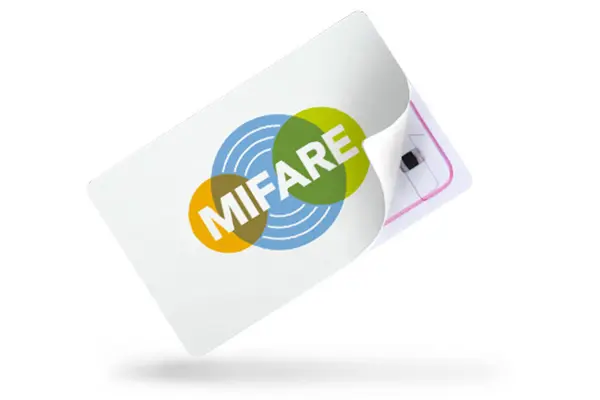
A MIFARE card is a high-frequency RFID card developed by NXP Semiconductors under the MIFARE Contactless Technology platform.
These cards operate at 13.56 MHz and are based on the ISO/IEC 14443 contactless smart card standard.
Unlike EM cards, MIFARE cards contain secure memory sectors that can store data and support encryption.
Common MIFARE Chips
Several versions of MIFARE cards exist:
- MIFARE Classic 1K
- MIFARE Classic 4K
- MIFARE Ultralight
- MIFARE DESFire EV1
Each chip offers different storage capacities and security levels.
Key Characteristics of MIFARE Cards
- Frequency: 13.56 MHz (High Frequency RFID)
- Read/write memory
- Multiple sectors for data storage
- Encryption and authentication
- Higher security
Because of these capabilities, MIFARE cards can store user credentials, balances, tickets, or encrypted identifiers.
Typical Applications
MIFARE cards are widely used in:
- Public transportation ticketing
- Cashless payment systems
- Hotel key cards
- Campus ID cards
- Event and festival wristbands
- Smart building access systems
Need High-Quality RFID Cards at Factory Prices?
XIUCHENG RFID is a professional RFID manufacturer in China specializing in large-scale production of EM Cards and MIFARE Cards. We provide reliable RFID solutions for access control, hotel systems, transportation cards, and smart ID projects worldwide.
- Factory-direct pricing for bulk orders
- High-quality RFID chips and strict QC process
- Custom printing, UID encoding, and packaging
- Fast global delivery
EM Card vs. MIFARE Card: Key Differences
| Feature | EM Card | MIFARE Card |
|---|---|---|
| Frequency | 125 kHz | 13.56 MHz |
| RFID Type | Low Frequency | High Frequency |
| Data Storage | UID only | Read/write memory |
| Security | Very low | Medium to high |
| Encryption | No | Yes |
| Cost | Very cheap | Higher |
| Typical Use | Basic access control | Smart card applications |
The most significant difference is functionality. EM cards only provide identification, while MIFARE cards function as smart cards capable of storing and processing data.
Security Comparison
Security is one of the biggest factors when choosing between these two card types.
EM Card Security
EM cards have no encryption and no authentication mechanism. Any compatible reader can read the UID, and the card can be cloned easily using inexpensive RFID tools.
Because of this limitation, EM cards are generally used only in low-security environments.
MIFARE Card Security
MIFARE cards offer sector-based authentication and encryption. For example:
- MIFARE Classic 1K uses proprietary Crypto-1 encryption.
- MIFARE DESFire EV1 supports advanced encryption such as AES and 3DES.
These security features make MIFARE cards suitable for financial transactions, transport systems, and enterprise security systems.
Cost Comparison
Cost is another important factor for large-scale deployments.
EM Card Cost
EM cards are one of the cheapest RFID cards available, often used in projects where:
- Thousands of cards are required
- Security is not a primary concern
- The card only needs to provide identification
MIFARE Card Cost
MIFARE cards cost more due to their microcontroller and memory architecture. However, they provide additional functionality such as:
- Data storage
- Encryption
- Multi-application support
For many systems, the additional cost is justified by greater flexibility and security.
Compatibility With RFID Readers
Another important difference is reader compatibility.
- EM cards work with 125 kHz low-frequency readers.
- MIFARE cards require 13.56 MHz high-frequency readers.
These two technologies are not cross-compatible, meaning a reader designed for EM cards cannot read MIFARE cards.
Some modern readers support dual-frequency operation to accommodate both card types.
When Should You Choose an EM Card?
An EM card is the right choice when:
- The system only needs basic identification
- Low cost is the top priority
- Security requirements are minimal
- The infrastructure already uses 125 kHz readers
Examples include:
- Office attendance systems
- Residential access cards
- Gym membership cards
When Should You Choose a MIFARE Card?
A MIFARE card is more suitable when:
- The system needs data storage
- Encryption and authentication are required
- Multiple applications are integrated into one card
- The project involves payments or ticketing
Examples include:
- Metro cards
- Cashless payment systems
- Hotel key cards
- Corporate smart IDs
The Future of RFID Cards
As security requirements increase, many organizations are gradually migrating from low-frequency EM cards to high-frequency smart cards such as MIFARE DESFire EV1 and newer NFC-compatible technologies.
These advanced cards support:
- Mobile wallet integration
- Secure authentication
- Multi-application ecosystems
For new deployments, high-frequency smart cards are becoming the industry standard.
Conclusion
Although EM cards and MIFARE cards look similar, their underlying technologies and capabilities are very different.
- EM cards are simple, inexpensive, and suitable for basic identification.
- MIFARE cards provide memory, encryption, and smart card functionality.
For modern RFID systems that require security, flexibility, and scalability, MIFARE technology is generally the better choice. However, for low-cost access control systems, EM cards remain a practical and widely used solution.

About XIUCHENG RFID
XIUCHENG RFID specializes in manufacturing a wide range of RFID products, including RFID Silicone Wristbands, Tyvek Wristbands, Fabric Wristbands, Elastic Wristbands, Vinyl Wristbands, RFID Laundry Tags, Animal Tags, and RFID Cards. All products are produced under strict quality control and advanced production technology.
With 12 years of experience in wristband design, tag design, quality management, and customer relationship management, we have built a solid foundation for delivering reliable and high-performance RFID solutions.


