


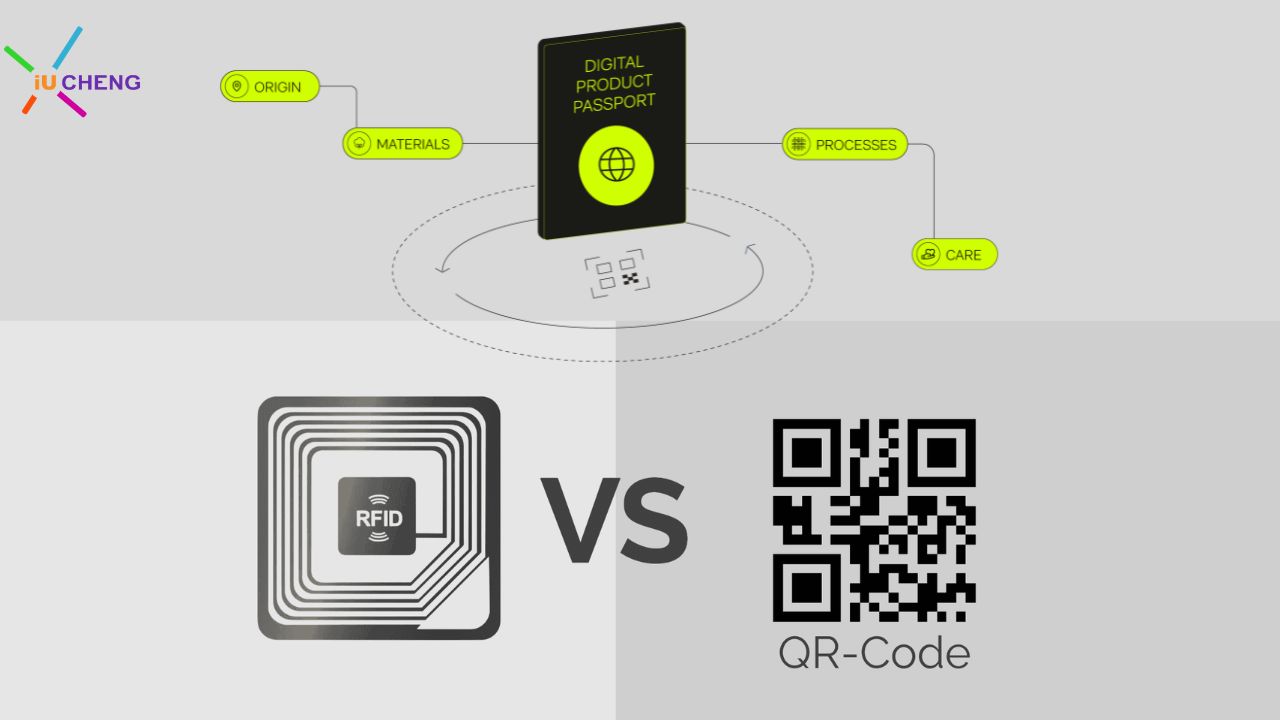
With the rollout of Digital Product Passport (DPP) frameworks—particularly under policy initiatives from the European Union—product identification is moving from a labeling exercise to a data infrastructure problem.
Every physical item now needs a persistent, machine-readable link to a structured dataset that evolves over time: materials, origin, repair events, ownership changes, and end-of-life handling. The choice of data carrier directly impacts whether that system is scalable, reliable, and compliant.
Two technologies dominate current deployments: RFID (including UHF and NFC) and QR codes. They are often treated as interchangeable. In practice, they solve different layers of the DPP stack.
DPP System Requirements (What the Carrier Must Support)
Before comparing technologies, it’s critical to define what DPP actually requires at the system level:
- Persistent identity: survives the full product lifecycle
- Automated data capture: minimal human intervention across logistics and operations
- High read reliability: across environments (warehouse, retail, post-sale)
- Interoperability: integration with ERP, PLM, and compliance systems
- Consumer access layer: optional but increasingly expected
Any carrier technology that fails in one of these dimensions creates downstream inefficiencies or compliance risks.
Technology Characteristics: RFID vs QR Code
RFID (UHF / NFC)
RFID uses radio frequency communication to identify tagged objects. It operates without line-of-sight and supports batch processing.
- UHF RFID: long-range, bulk reading, supply chain automation
- NFC (HF RFID): short-range, secure interaction, consumer engagement
Key properties:
- Non-line-of-sight reading
- Simultaneous multi-tag scanning
- Chip-level unique identifiers (UID/EPC)
- Optional secure memory and encryption (NFC)
QR Code
QR codes are optical 2D barcodes encoding a static or dynamic identifier.
Key properties:
- Line-of-sight required
- Single-item scanning
- Extremely low cost
- Universally readable via smartphones
Operational Comparison in DPP Context
1. Data Capture Model
RFID enables passive, event-driven data collection. Items are read automatically when passing through checkpoints (dock doors, conveyors, retail gates). This creates a continuous data stream aligned with DPP lifecycle requirements.
QR codes rely on intentional human action. Each scan is discrete and dependent on operator compliance. In practice, this leads to data gaps.
Conclusion: RFID supports systematic lifecycle visibility, while QR codes provide episodic interaction.
2. Scalability in Supply Chain Environments
In high-throughput environments, scanning efficiency is a hard constraint.
- RFID can read hundreds of items per second in motion
- QR codes scale linearly with labor input
For DPP, where every unit must be tracked across multiple stages, manual scanning introduces bottlenecks and cost escalation.
Conclusion: RFID is the only viable option for industrial-scale DPP deployment.
3. Durability and Data Continuity
DPP assumes that the product identity remains accessible over years.
- RFID inlays can be embedded within labels, packaging, or product structures
- QR codes are exposed and vulnerable to abrasion, contamination, or removal
A damaged QR code effectively breaks the link to the passport unless redundancy is implemented.
Conclusion: RFID provides higher identity persistence, especially in harsh or long lifecycle scenarios.
4. Security and Anti-Counterfeiting
DPP is increasingly tied to authenticity and compliance verification, particularly in regulated sectors and high-value goods.
- RFID chips carry immutable unique identifiers
- NFC supports cryptographic authentication (e.g., secure elements)
- QR codes can be duplicated with minimal effort
This difference is decisive in sectors like luxury, pharmaceuticals, and electronics.
Conclusion: RFID (especially NFC) offers hardware-level trust, which QR cannot replicate.
5. Consumer Interaction Layer
This is where QR codes retain a clear advantage.
- No specialized hardware required
- Immediate usability via smartphone cameras
- Familiar user behavior
NFC narrows the gap with “tap-to-interact,” but still depends on device compatibility and user awareness.
Conclusion: QR codes remain the most frictionless consumer interface, particularly for mass-market products.
6. Cost Structure
Cost must be evaluated beyond unit price:
| Component | RFID | QR Code |
|---|---|---|
| Tag cost | Higher (chip + antenna) | Near zero |
| Infrastructure | Readers + middleware required | None |
| Labor | Low (automated) | High (manual scanning) |
| Error rate cost | Low | Potentially high |
In DPP scenarios, labor and error costs often outweigh the initial tag cost difference.
Conclusion: QR codes are cheaper at entry level; RFID is more cost-efficient at scale.
Where Each Technology Fits in DPP Architecture
Rather than a binary choice, most mature DPP systems adopt a layered approach:
RFID as the Data Backbone
- Supply chain visibility
- Inventory automation
- Lifecycle event capture
- Compliance reporting
QR Code as the Access Layer
- Consumer-facing information
- Marketing and storytelling
- Backup access mechanism
NFC as the Bridge
- Secure authentication
- Brand protection
- Post-sale engagement
Industry-Specific Observations
Fashion & Textiles
RFID is already embedded at scale for inventory and anti-theft. DPP extends its role into resale authentication and sustainability tracking. QR codes are typically added for consumer transparency.
Electronics
Component-level traceability and repair history favor RFID. QR codes are used for documentation access and regulatory disclosures.
Luxury Goods
NFC (RFID) is becoming standard for authentication and ownership verification. QR codes alone are insufficient due to cloning risks.
Strategic Conclusion
From a purely technical perspective, RFID outperforms QR codes in every dimension that matters for Digital Product Passports:
- Automation
- Scalability
- Data integrity
- Security
- Lifecycle continuity
However, QR codes remain relevant as a low-cost, universal interface layer.
The practical conclusion is not substitution, but role separation:
RFID functions as the infrastructure layer of DPP, while QR codes operate as the access layer.
Final Perspective: Why This Matters Now
DPP is not a short-term trend. It represents a structural shift toward:
- Regulated product transparency
- Circular economy enablement
- Data-driven supply chains
In this context, the choice of identification technology is not tactical—it defines whether your system can scale, comply, and deliver long-term value.
Organizations treating QR codes as a complete DPP solution will likely encounter limitations as regulatory and operational complexity increases. RFID, by contrast, aligns with the direction the market is already moving toward: automated, verifiable, and persistent product intelligence.

About XIUCHENG RFID
XIUCHENG RFID specializes in manufacturing a wide range of RFID products, including RFID Silicone Wristbands, Tyvek Wristbands, Fabric Wristbands, Elastic Wristbands, Vinyl Wristbands, RFID Laundry Tags, Animal Tags, and RFID Cards. All products are produced under strict quality control and advanced production technology.
With 12 years of experience in wristband design, tag design, quality management, and customer relationship management, we have built a solid foundation for delivering reliable and high-performance RFID solutions.


