


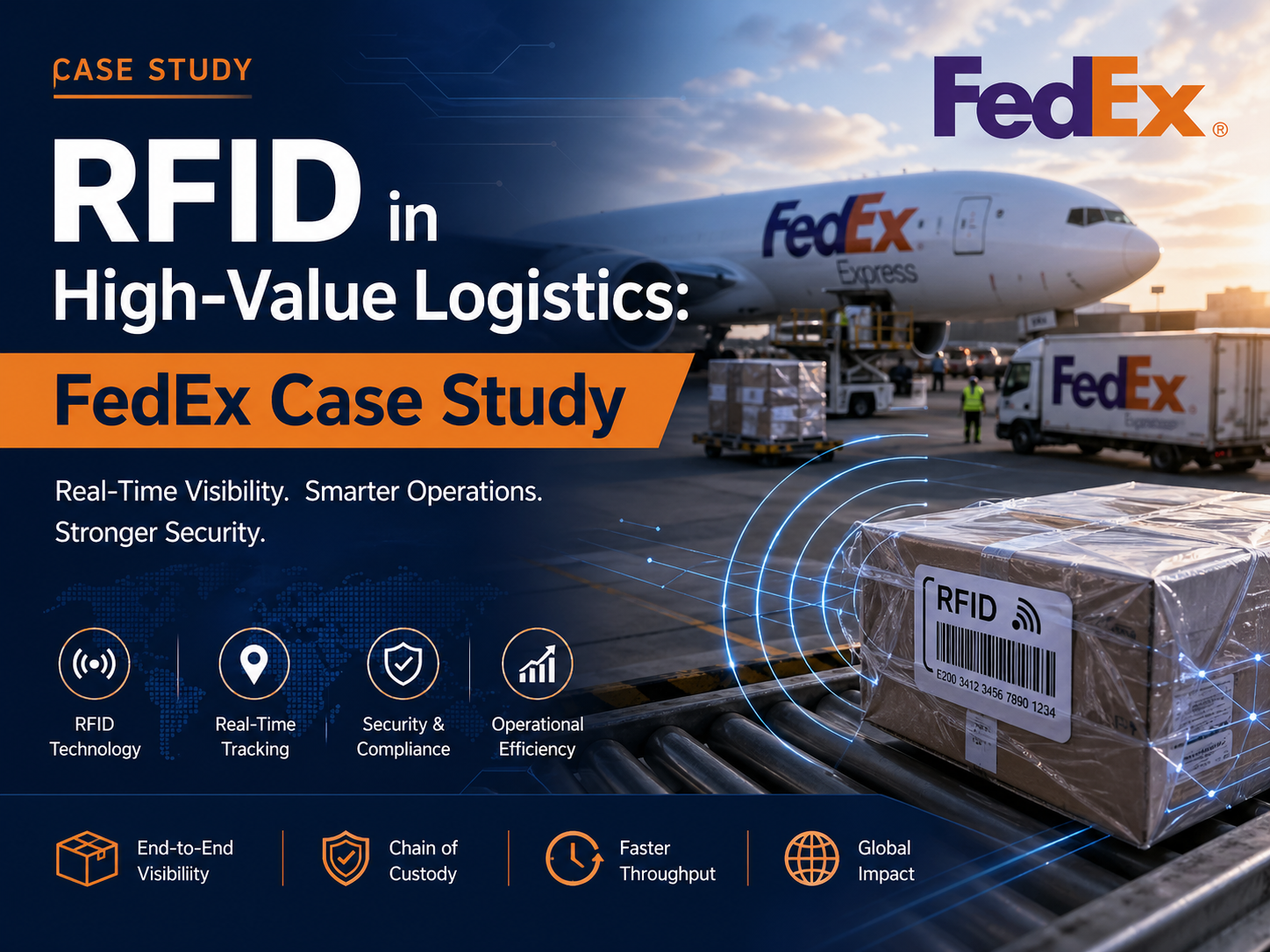
High-value logistics is one of the most demanding sectors in modern supply chain management. Shipments such as pharmaceuticals, luxury goods, aerospace components, sensitive electronics, and confidential documents require more than basic tracking. They demand real-time visibility, chain-of-custody verification, tamper resistance, and operational accuracy across global transportation networks.
For global logistics providers like FedEx, UPS, RFID technology has become an important tool for improving visibility and reducing operational risk in complex logistics environments.
This case study examines how RFID supports high-value logistics operations, why large logistics companies adopt RFID systems, and what lessons manufacturers, warehouse operators, and enterprise supply chain managers can learn from the FedEx approach.

Why High-Value Logistics Needs RFID
Traditional barcode systems work well for basic parcel identification, but they have limitations in high-speed, high-security logistics environments.
Barcodes require:
- Direct line-of-sight scanning
- Manual handling
- Individual item scanning
- Human intervention at checkpoints
In high-value logistics, these limitations create operational bottlenecks and increase the risk of:
- Lost shipments
- Misrouted assets
- Unauthorized handling
- Inventory discrepancies
- Delayed audits
- Chain-of-custody disputes
RFID addresses these problems by enabling automatic, non-line-of-sight identification of packages, containers, pallets, and transport assets.
For logistics operators handling thousands of sensitive shipments daily, this creates measurable improvements in:
- Operational visibility
- Security compliance
- Scan accuracy
- Throughput speed
- Asset utilization
- Exception management

The Role of RFID in FedEx Operations
FedEx has publicly discussed and tested RFID technologies across multiple logistics applications over the years, particularly in shipment tracking, asset monitoring, and operational automation.
While not every FedEx logistics process relies on RFID, the company has explored RFID in several strategic areas where barcode-only workflows become inefficient.
These applications include:
- High-value package tracking
- Airport cargo handling
- Container identification
- Sortation automation
- Returnable transport item management
- Temperature-sensitive shipment monitoring
- Warehouse asset tracking
Large logistics providers typically combine RFID with:
- Barcode systems
- GPS tracking
- IoT sensors
- Warehouse management systems (WMS)
- Transportation management systems (TMS)
- Security and compliance software
RFID becomes part of a broader visibility infrastructure rather than a standalone technology.
The High-Value Logistics Challenge
Global logistics companies face several recurring problems when transporting expensive or sensitive goods.
1. Limited Real-Time Visibility
A shipment may pass through:
- Pickup vehicles
- Cross-docking hubs
- Air cargo terminals
- Customs checkpoints
- Distribution centers
- Final-mile delivery routes
Without automated tracking, operational blind spots emerge between checkpoints.
RFID reduces these visibility gaps by automatically registering movement events whenever tagged assets pass RFID readers.
2. Manual Scan Dependency
Barcode systems depend heavily on operators performing scans correctly.
In high-volume logistics facilities, this creates issues such as:
- Missed scans
- Duplicate scans
- Delayed updates
- Human error
- Congestion during peak operations
RFID portals can scan multiple tagged items simultaneously without requiring precise orientation.
This is particularly useful in:
- Conveyor systems
- Pallet movement
- Cage tracking
- Trailer loading
- Airport ULD handling
3. Chain-of-Custody Requirements
Industries such as pharmaceuticals, defense, and luxury retail require proof of custody throughout transportation.
RFID enables:
- Timestamped movement records
- Automated handoff logging
- Asset authentication
- Tamper monitoring integration
This improves auditability and compliance reporting.
4. Asset Loss and Misrouting
High-value shipments often travel through multiple facilities and carriers.
RFID helps reduce:
- Wrong-destination routing
- Container loss
- Missing transport assets
- Unlocated inventory
The ability to identify assets automatically at dock doors and transfer points improves operational control.
How RFID Works in High-Value Logistics
A typical RFID-enabled logistics workflow involves four components:
RFID Tags
Tags are attached to:
- Parcels
- Cases
- Pallets
- Roll cages
- Cargo containers
- Returnable transport assets
Common tag types include:
Passive UHF RFID Tags
Used for:
- Package tracking
- Warehouse automation
- Dock door scanning
- Conveyor identification
Advantages:
- Low cost
- Long read range
- High-volume deployment
Active RFID Tags
Used for:
- High-value cargo
- Long-distance asset tracking
- Real-time location systems (RTLS)
Advantages:
- Battery-powered
- Longer read distances
- Continuous beacon transmission
Sensor RFID Tags
Used for:
- Cold chain logistics
- Pharmaceutical transport
- Environmental monitoring
These tags may record:
- Temperature
- Humidity
- Shock exposure
- Light exposure
RFID Readers
Readers are deployed at:
- Dock doors
- Warehouse aisles
- Conveyor tunnels
- Cargo transfer zones
- Vehicle gates
- Airport handling stations
These readers automatically capture asset movement data without manual intervention.
Middleware and Integration
RFID systems generate large volumes of data.
Middleware filters and processes events before integrating with:
- ERP systems
- WMS platforms
- Logistics dashboards
- Security systems
- Analytics platforms
This transforms raw RFID reads into operational intelligence.
Workflow: High-Value Shipment Handling
Step 1: Shipment Preparation
A high-value shipment receives:
- RFID label
- Barcode backup label
- Security seal
- Digital shipment ID
The RFID tag is associated with shipment data inside the logistics platform.
Step 2: Pickup and Initial Verification
At pickup:
- RFID readers verify package identity
- Shipment status updates automatically
- Driver custody is recorded
No manual barcode scan may be necessary.
Step 3: Hub Processing
As packages move through sorting facilities:
- RFID portals identify shipments automatically
- Conveyor routing systems redirect packages
- Exceptions are flagged in real time
This reduces handling delays during high-volume operations.
Step 4: Airport Cargo Handling
RFID can support tracking of:
- Unit load devices (ULDs)
- Cargo containers
- Sensitive air freight
In airport logistics environments, RFID improves loading accuracy and asset visibility.
Step 5: Final Delivery Confirmation
At delivery:
- Shipment arrival is verified
- Custody records are completed
- Delivery events sync with customer systems
For regulated industries, this creates a reliable audit trail.
Benefits Observed in RFID Logistics Deployments
Although implementation results vary by logistics network, RFID deployments in high-value logistics environments typically produce several measurable benefits.
Faster Processing Speeds
RFID enables bulk scanning without stopping package flow.
This significantly improves throughput in:
- Distribution centers
- Cross-docking facilities
- Air cargo operations
Improved Shipment Accuracy
Automated identification reduces manual handling errors.
Benefits include:
- Fewer routing mistakes
- Better shipment reconciliation
- Reduced package loss
Better Security Visibility
RFID creates automatic tracking records across multiple checkpoints.
This improves:
- Chain-of-custody documentation
- Security investigations
- Theft detection
- Compliance reporting
Reduced Labor Dependency
RFID decreases reliance on repetitive manual scanning tasks.
This helps logistics companies:
- Reduce operational friction
- Improve labor efficiency
- Scale during peak seasons
Enhanced Customer Visibility
Enterprise customers increasingly expect real-time shipment intelligence.
RFID supports:
- Automated status updates
- Predictive tracking
- Faster exception detection
- Improved service transparency
Challenges of RFID in Logistics
RFID implementation is not without challenges.
Infrastructure Cost
Large-scale logistics RFID deployments require:
- Reader infrastructure
- Network integration
- Software development
- Process redesign
Initial investment can be substantial.
Metal and Liquid Interference
Certain shipment types reduce RFID read performance.
Examples include:
- Metal containers
- Liquid products
- Dense packaging environments
Specialized RFID tags are often necessary.
Data Management Complexity
RFID systems generate huge event volumes.
Without proper filtering and analytics, companies can experience:
- Data overload
- Duplicate reads
- System noise
Middleware architecture becomes critical.
Multi-System Integration
RFID rarely works alone.
Successful deployment requires integration with:
- ERP systems
- Transportation systems
- Warehouse software
- Security platforms
This integration complexity can slow deployment timelines.
Why RFID Matters More in 2026
The logistics industry is changing rapidly.
Several trends are accelerating RFID adoption:
Growth of High-Value E-Commerce
Luxury products, electronics, and medical products increasingly move through global parcel networks.
These goods require stronger visibility and authentication.
Supply Chain Security Pressure
Governments and enterprise customers now demand:
- Better traceability
- Anti-counterfeiting measures
- Audit-ready shipment histories
RFID supports these requirements.
Labor Shortages
Automation is becoming essential in logistics operations.
RFID reduces dependency on repetitive manual scanning workflows.
Real-Time Supply Chain Intelligence
Modern logistics is shifting from reactive tracking to predictive visibility.
RFID data feeds AI-driven logistics systems capable of:
- Predictive delay detection
- Automated exception management
- Dynamic routing optimization
Lessons for Logistics Companies
The FedEx RFID approach demonstrates several important principles for logistics operators.
RFID Works Best in Targeted Deployments
Not every shipment requires RFID.
The strongest ROI usually appears in:
- High-value shipments
- Returnable assets
- Sensitive cargo
- High-throughput facilities
Integration Matters More Than Hardware
RFID tags and readers alone do not create visibility.
Operational value comes from integrating RFID data into logistics workflows.
Hybrid Systems Are Common
Most enterprise logistics networks still use both:
- RFID
- Barcode systems
Hybrid approaches provide flexibility and redundancy.
Scalability Must Be Planned Early
Large logistics networks require:
- Reader density planning
- Data governance
- Tag standardization
- Cross-facility interoperability
RFID architecture decisions affect long-term scalability.
Final Thoughts
RFID has evolved from a niche tracking technology into a core component of modern high-value logistics infrastructure.
For companies like FedEx, RFID helps improve shipment visibility, automate operational workflows, strengthen security controls, and reduce handling inefficiencies across global logistics networks.
As logistics operations become more automated and customer expectations continue rising, RFID adoption will likely expand further across:
- Air cargo
- Pharmaceutical logistics
- Luxury retail distribution
- Electronics supply chains
- Cold chain transportation
- Secure document logistics
For logistics providers, RFID is no longer just about tracking packages. It is becoming part of a larger intelligent supply chain ecosystem built around automation, visibility, and real-time operational control.

About XIUCHENG RFID
XIUCHENG RFID specializes in manufacturing a wide range of RFID products, including RFID Silicone Wristbands, Tyvek Wristbands, Fabric Wristbands, Elastic Wristbands, Vinyl Wristbands, RFID Laundry Tags, Animal Tags, and RFID Cards. All products are produced under strict quality control and advanced production technology.
With 12 years of experience in wristband design, tag design, quality management, and customer relationship management, we have built a solid foundation for delivering reliable and high-performance RFID solutions.


