


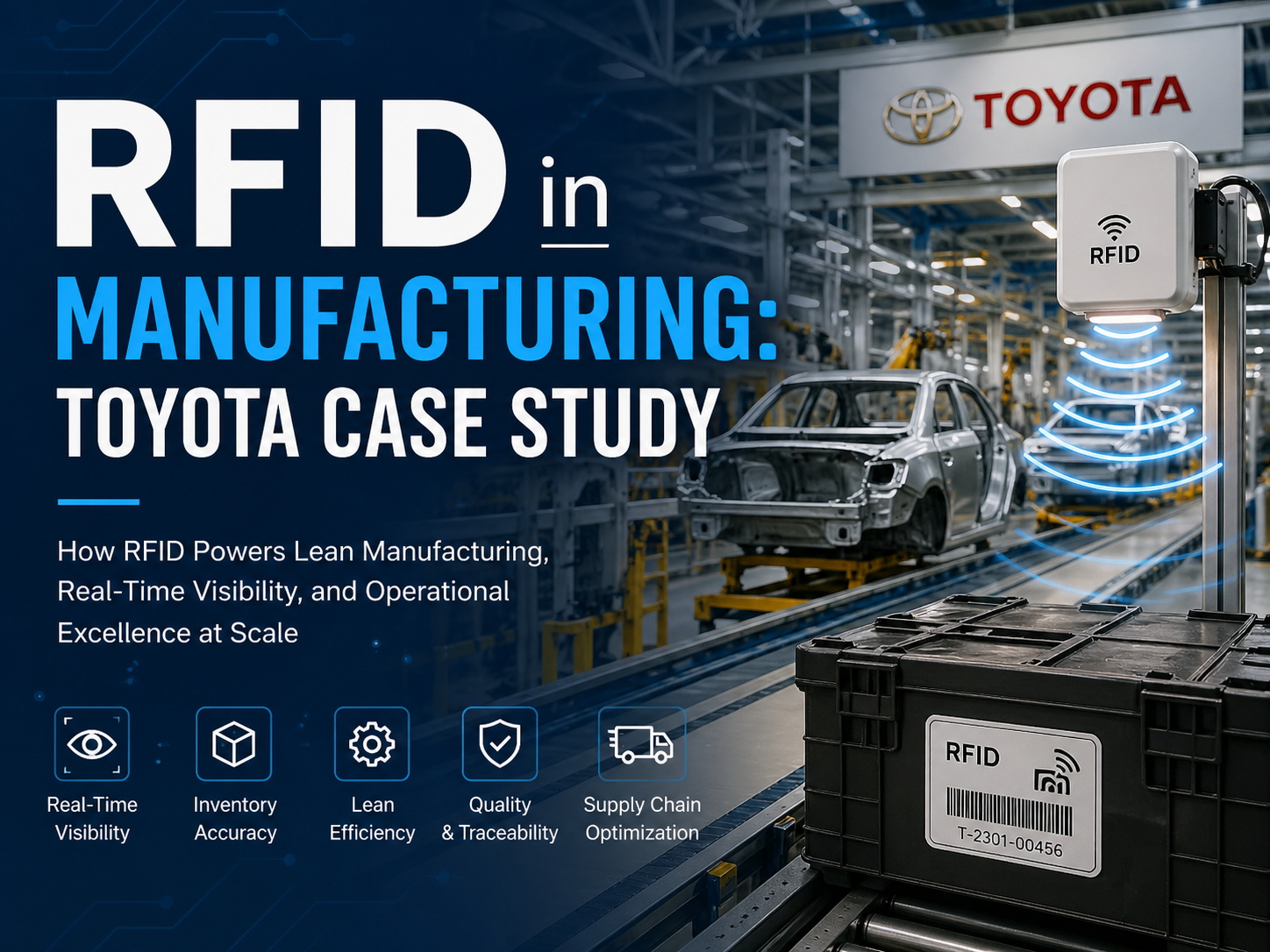
Manufacturing companies have spent decades trying to solve the same operational problems: inventory inaccuracies, production bottlenecks, missing parts, delayed shipments, and limited real-time visibility across the factory floor. Traditional barcode systems improved traceability, but they still required manual scanning and human intervention.
RFID changed that equation.
Among global manufacturers, Toyota is frequently cited as one of the companies that helped push lean manufacturing and industrial automation into mainstream operations. While Toyota is best known for the Toyota Production System (TPS) and Just-In-Time (JIT) manufacturing, RFID technology became an important supporting layer for achieving real-time visibility and reducing operational waste at scale.
This article examines how RFID fits into Toyota’s manufacturing environment, what operational problems it addresses, and what other manufacturers can learn from Toyota’s RFID deployment strategies.
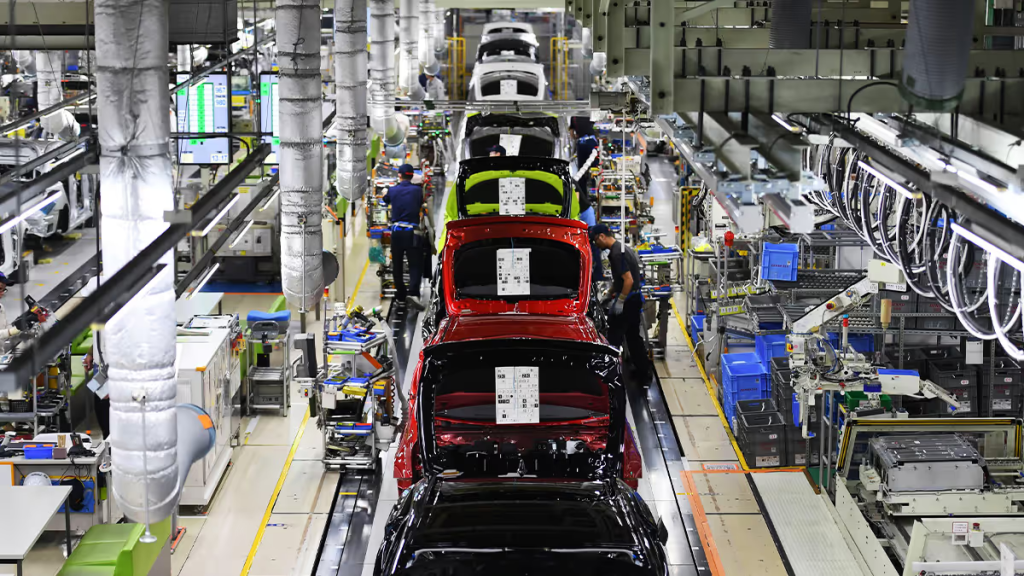
Why RFID Became Important in Modern Manufacturing
Modern factories operate under enormous pressure:
- Thousands of moving components
- Multi-stage assembly processes
- Strict quality control requirements
- Global supplier coordination
- Minimal inventory buffering
- Increasing labor costs
In automotive manufacturing especially, even a small tracking failure can stop an assembly line worth millions of dollars per day.
Traditional tracking systems often fail because:
- Barcodes require line-of-sight scanning
- Manual scanning introduces labor dependency
- Human errors create inventory mismatches
- Paper-based workflows slow production
- Real-time asset visibility is limited
RFID solves many of these issues by enabling:
- Automatic identification
- Bulk reading without line-of-sight
- Real-time inventory monitoring
- Continuous production tracking
- Automated workflow triggering
For manufacturers practicing lean manufacturing, these capabilities are extremely valuable.
Toyota’s Manufacturing Philosophy and RFID
Toyota’s manufacturing philosophy is built around eliminating waste (“Muda”), improving efficiency, and maintaining synchronized production flow.
The company’s famous Just-In-Time model depends on delivering the right part:
- At the right time
- In the right quantity
- To the right workstation
That level of synchronization becomes difficult when factories handle:
- Tens of thousands of components
- Hundreds of suppliers
- Multiple assembly lines
- Global production networks
RFID became a practical tool for improving visibility and supporting Toyota’s lean manufacturing objectives.
Instead of replacing TPS, RFID enhanced it.
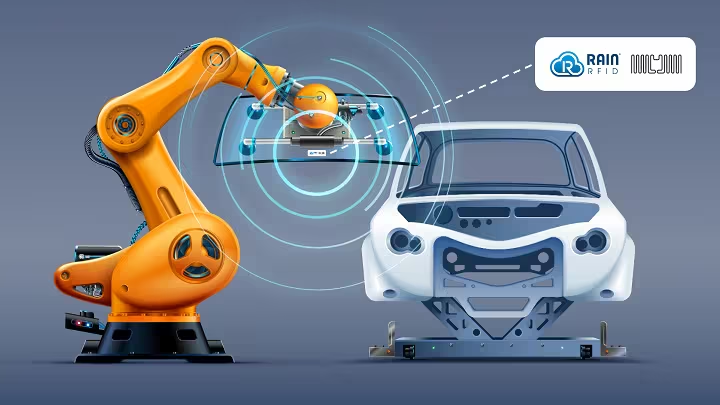
Where Toyota Uses RFID in Manufacturing
Toyota and its suppliers have used RFID across multiple manufacturing processes, including:
1. Parts and Component Tracking
Automotive production involves massive quantities of components:
- Engines
- Wiring harnesses
- Seats
- Tires
- Electronic modules
- Dashboard assemblies
RFID tags attached to reusable containers, pallets, or parts allow factories to automatically track movement throughout the production process.
Benefits include:
- Reduced misplaced inventory
- Faster material replenishment
- Improved production synchronization
- Better supplier coordination
When a tagged container enters a workstation area, RFID readers can instantly identify the contents without manual scanning.
This reduces delays and prevents assembly interruptions.
2. Work-in-Process (WIP) Tracking
One of the biggest challenges in manufacturing is knowing exactly where semi-finished products are located.
Toyota uses production tracking systems to monitor vehicles and components as they move through different assembly stages.
RFID enables:
- Automatic checkpoint recording
- Real-time assembly progress monitoring
- Production bottleneck identification
- Error reduction during sequencing
For example, when a vehicle chassis moves into a paint or inspection area, RFID readers automatically update the production management system.
This creates continuous visibility across the factory floor.
3. Kanban Automation
Toyota popularized the Kanban system as part of lean manufacturing.
Traditional Kanban systems relied heavily on physical cards and manual processes.
RFID-enabled Kanban systems automate replenishment workflows.
When inventory levels drop below predefined thresholds:
- RFID readers detect container movement
- Systems automatically trigger replenishment signals
- Suppliers receive updated production demand information
This reduces:
- Manual inventory counting
- Production delays
- Overstocking
- Human error
RFID essentially modernizes traditional lean manufacturing principles.
4. Returnable Transport Item (RTI) Management
Automotive manufacturers use large quantities of reusable containers, pallets, and transport racks.
These assets are expensive and frequently lost within supply chains.
Toyota suppliers often use RFID to track:
- Returnable containers
- Steel racks
- Shipping totes
- Specialized transport equipment
Benefits include:
- Reduced container loss
- Improved asset utilization
- Faster turnaround cycles
- Better supplier accountability
For high-volume manufacturing operations, RTI tracking alone can generate substantial cost savings.
5. Quality Control and Traceability
Automotive manufacturing requires strict traceability for safety and compliance reasons.
RFID helps manufacturers maintain production histories for:
- Components
- Production batches
- Assembly stages
- Inspection records
If a defect is discovered later, manufacturers can identify:
- Which batch was affected
- Which supplier provided the component
- Which production line assembled the vehicle
- Which vehicles may require recalls
This significantly improves recall management and quality assurance.
How RFID Supports Toyota’s Lean Manufacturing Model
Toyota’s production system focuses heavily on operational efficiency.
RFID contributes in several important ways.
Reduced Human Dependency
Manual scanning introduces variability.
RFID automates data collection, reducing dependence on operator actions.
Faster Material Flow
Real-time tracking helps materials move efficiently between:
- Warehouses
- Production lines
- Assembly cells
- Shipping areas
This supports continuous production flow.
Lower Inventory Waste
Toyota’s JIT model aims to minimize excess inventory.
RFID improves inventory accuracy, allowing manufacturers to operate with leaner stock levels while maintaining confidence in availability.
Improved Production Visibility
Factory managers gain real-time operational insights, including:
- Line status
- Inventory movement
- Production delays
- Asset locations
This improves decision-making speed.
RFID Technologies Commonly Used in Automotive Manufacturing
Toyota-related manufacturing environments typically use several RFID technologies depending on the application.
UHF RFID
Most manufacturing environments use UHF RFID because it supports:
- Longer read ranges
- Fast bulk reading
- Conveyor tracking
- Warehouse visibility
Typical applications:
- Pallets
- Containers
- Vehicle tracking
- Logistics
HF RFID / NFC
HF RFID is often used for shorter-range identification and secure data storage.
Applications may include:
- Tool identification
- Access control
- Maintenance records
Rugged Industrial RFID Tags
Automotive factories involve harsh environments:
- Heat
- Chemicals
- Metal surfaces
- Vibration
Industrial RFID tags used in manufacturing often include:
- High-temperature resistance
- Metal-mount compatibility
- Waterproof encapsulation
- Long service life
Challenges Toyota and Manufacturers Face with RFID
Despite the benefits, RFID implementation is not always simple.
Metal Interference
Automotive manufacturing contains large amounts of metal, which can affect RFID signal performance.
Specialized anti-metal RFID tags are often required.
System Integration
RFID systems must integrate with:
- ERP systems
- MES platforms
- Warehouse systems
- Supplier databases
Integration complexity can become a major project challenge.
Infrastructure Costs
Large-scale RFID deployments require:
- Readers
- Antennas
- Middleware
- Network upgrades
- Software platforms
ROI calculations are critical before deployment.
Data Management
RFID generates massive amounts of operational data.
Factories need systems capable of:
- Real-time processing
- Filtering duplicate reads
- Event management
- Production analytics
Lessons Manufacturers Can Learn from Toyota
Toyota’s approach to RFID offers several practical lessons.
Start with Operational Problems
Successful RFID projects are not driven by technology hype.
They solve measurable operational issues such as:
- Missing inventory
- Production delays
- Container loss
- Traceability gaps
RFID Works Best with Process Discipline
RFID alone does not fix broken manufacturing processes.
Toyota’s success comes from combining RFID with strong operational systems and lean manufacturing principles.
Reusable Asset Tracking Often Delivers Fast ROI
Many manufacturers see rapid returns from RFID container tracking because:
- Asset losses decrease
- Inventory accuracy improves
- Manual labor is reduced
This is often a good starting point for RFID adoption.
Real-Time Visibility Is the Biggest Long-Term Advantage
The true value of RFID is not simply automation.
It is continuous operational visibility.
Factories can make faster, more accurate decisions when production data updates automatically in real time.
Future of RFID in Smart Manufacturing
RFID is becoming increasingly important in Industry 4.0 environments.
Modern smart factories combine RFID with:
- IoT sensors
- AI analytics
- Machine vision
- Autonomous robots
- Digital twins
Future automotive manufacturing systems may use RFID for:
- Predictive maintenance
- Automated quality inspection
- Real-time supply chain synchronization
- Fully autonomous inventory management
As manufacturing becomes more data-driven, RFID will continue evolving from a tracking technology into a core infrastructure layer for industrial intelligence.
Final Thoughts
Toyota’s use of RFID demonstrates how identification technology can support lean manufacturing at scale.
The company did not adopt RFID as a standalone innovation. Instead, it integrated RFID into a broader operational philosophy focused on efficiency, waste reduction, and real-time visibility.
For manufacturers considering RFID adoption today, the key takeaway is clear:
RFID delivers the greatest value when it improves operational flow, increases inventory accuracy, and provides actionable production visibility.
In highly competitive manufacturing industries, those advantages can directly affect profitability, production stability, and customer satisfaction.
For RFID manufacturers and system integrators, automotive manufacturing remains one of the most mature and demanding RFID application environments — and one of the clearest demonstrations of RFID’s long-term industrial value.
Learn more about RFID case studies

About XIUCHENG RFID
XIUCHENG RFID specializes in manufacturing a wide range of RFID products, including RFID Silicone Wristbands, Tyvek Wristbands, Fabric Wristbands, Elastic Wristbands, Vinyl Wristbands, RFID Laundry Tags, Animal Tags, and RFID Cards. All products are produced under strict quality control and advanced production technology.
With 12 years of experience in wristband design, tag design, quality management, and customer relationship management, we have built a solid foundation for delivering reliable and high-performance RFID solutions.


