


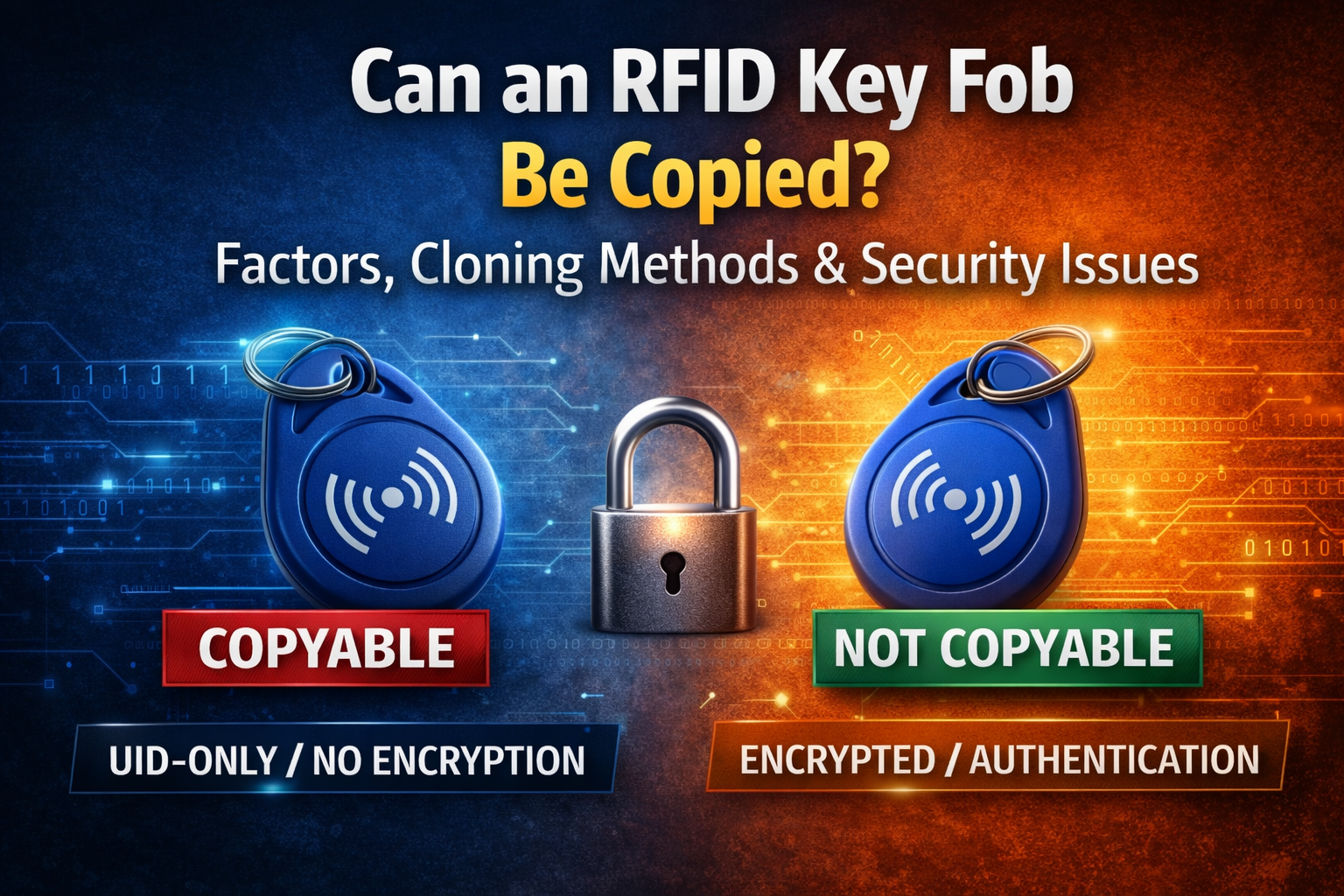
Whether an RFID key fob can be copied depends entirely on the RFID technology and security architecture used by the access control system. Some key fobs can be duplicated easily, while others are designed to prevent cloning at the hardware and cryptographic level.
There is no universal answer. The determining factors are frequency, chip type, and authentication method.
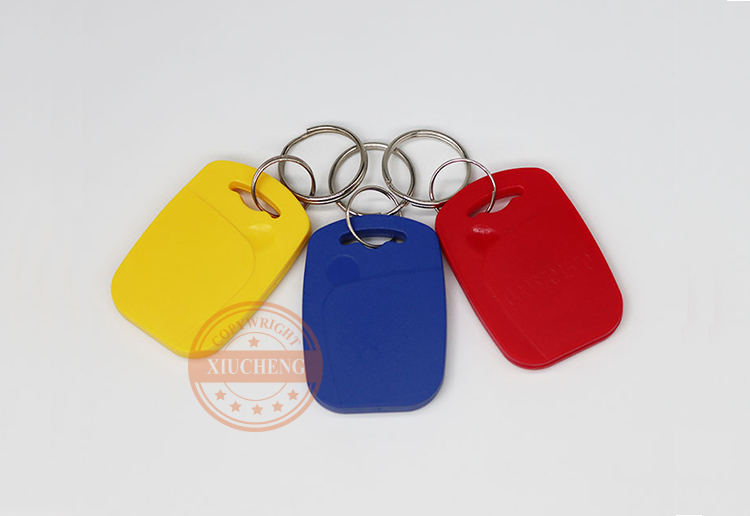
What an RFID Key Fob Actually Transmits
An RFID key fob is a passive transponder consisting of an integrated circuit and an antenna. When energized by a reader, it responds in one of two ways:
- By transmitting a fixed identifier (UID)
- By performing a cryptographic challenge–response
Only the first category is inherently copyable.
If the system relies solely on a static UID for access decisions, cloning the credential is technically trivial. If the system requires cryptographic authentication, copying the fob is not feasible without access to secret keys.
RFID Key Fobs That Can Be Copied
Low-Frequency (125 kHz) RFID Key Fobs
Most legacy access systems use 125 kHz LF RFID technology. Common chips include EM4100, EM4102, and TK4100.
These chips:
- Broadcast a fixed UID
- Do not support encryption
- Cannot authenticate the reader
Because the UID is neither encrypted nor diversified, it can be read and written onto a compatible rewritable chip such as T5577.
In practice, copying this type of key fob takes seconds and requires no access to the original system.
High-Frequency RFID Without Encryption
Some 13.56 MHz HF key fobs, such as MIFARE Ultralight, also lack cryptographic protection.
Although they operate at a higher frequency, they still rely on:
- Plain UID transmission
- No mutual authentication
As a result, these fobs can also be copied when used in UID-only access control systems.
RFID Key Fobs That Are Difficult or Impossible to Copy
MIFARE Classic (Conditional)
MIFARE Classic uses a proprietary encryption scheme (Crypto-1). While weaknesses in Crypto-1 are publicly known, cloning still requires:
- Knowledge of sector keys
- Weak system configuration
- Improper key management
As a result, MIFARE Classic fobs are not universally copyable, but they should no longer be considered secure by modern standards.
MIFARE DESFire (EV1, EV2, EV3)
MIFARE DESFire is designed specifically to prevent cloning.
It uses:
- AES or 3DES encryption
- Mutual authentication
- Session-based secure messaging
- Secure key storage inside the chip
The UID alone is insufficient for access. Cryptographic keys never leave the chip, making duplication of a valid credential impractical.
DESFire fobs cannot be copied in real-world conditions.
HID iCLASS SE, SEOS, and Similar Secure Credentials
Enterprise access control platforms such as HID iCLASS SE and SEOS use:
- Secure elements
- Diversified keys
- Backend-controlled credential issuance
Only the system issuer can provision a valid credential. Copying is not possible outside the authorized ecosystem.
Why “UID-Only” Access Control Is Insecure
Many older access control systems make access decisions based only on the card or fob UID. This approach assumes that the UID is secret, which it is not.
UID-based systems fail because:
- UIDs are broadcast in clear text
- Readers do not authenticate credentials
- Cloned credentials are indistinguishable from originals
Modern standards explicitly recommend cryptographic authentication, not UID comparison.
How to Determine If Your RFID Key Fob Can Be Copied
A key fob is likely copyable if:
- The system operates at 125 kHz
- Replacement fobs can be issued without authorization
- The system predates modern encryption standards
A key fob is likely secure if:
- It uses DESFire or equivalent technology
- Enrollment requires system administrator approval
- The system logs credential usage centrally
Legal and Security Considerations
Copying an RFID key fob without authorization may violate:
- Property access regulations
- Contractual agreements
- Local criminal law
From a system owner’s perspective, cloning represents a credential compromise, not a convenience feature.
Conclusion
An RFID key fob is copyable only if the access control system allows it by design.
- Legacy LF and UID-only HF systems are vulnerable.
- Modern encrypted RFID systems are not.
Security is determined by system architecture, not by the physical appearance of the key fob.
If access security matters, the correct solution is encrypted RFID with proper key management, not attempts to control copying at the user level.


