


A Smart, Wearable Solution for Access, Payments, and Brand Engagement
Silicone rings have become a popular alternative to cards, wristbands, and key fobs. When combined with NFC technology, they transform into powerful, wearable tools for identification, access control, and digital interaction.
If you are looking to create a custom NFC silicone ring for your brand, event, or system, this guide explains how NFC-enabled rings work, how they can be customized, and why they are increasingly used across industries.

What Is an NFC Silicone Ring?
An NFC silicone ring is a wearable device that embeds a passive NFC transponder inside a flexible, waterproof silicone body.
When tapped against an NFC reader or smartphone, the ring transmits data such as an ID, URL, or encrypted credential—no battery required.
The result is a hands-free, always-on wearable that works seamlessly in daily use.


Why Choose a Silicone Ring for NFC?
Silicone is an ideal material for NFC wearables due to its unique properties:
- Soft and comfortable for long-term wear
- Waterproof and sweat-resistant
- Resistant to heat, chemicals, and UV exposure
- Suitable for sports, hospitality, and industrial environments
Combined with NFC, silicone rings are durable, hygienic, and easy to use.
How NFC Silicone Ring Customization Works
Customization goes far beyond color and size. A professional NFC silicone ring can be tailored at both hardware and software levels.
1. NFC Chip Selection
Choose the right NFC chip based on your application:
- NTAG213 / NTAG215 / NTAG216 – URL sharing, digital business cards, marketing
- MIFARE Ultralight – Basic access control
- MIFARE DESFire EV1 / EV2 – High-security access and payment systems
Chip choice determines memory size, security level, and system compatibility.
2. Ring Size and Color Options
Custom NFC silicone rings can be produced in multiple sizes to fit different users.
Color options include:
- Solid colors
- Two-tone designs
- Pantone-matched brand colors
This makes them ideal for branding and identity programs.
3. Logo and Branding Customization
Brand visibility is critical for conversion-driven projects.
Options include:
- Debossed or embossed logos
- Laser engraving
- Color-filled branding
- Serial numbers or QR codes
Custom branding turns a simple ring into a brand touchpoint.
4. NFC Data Programming
NFC rings can be pre-programmed before delivery:
- URLs (websites, landing pages, menus)
- Encrypted IDs for access systems
- vCards or contact info
- App launch commands
This allows you to deploy rings immediately without additional setup.
5. Environmental and Usage Customization
Depending on the use case, NFC silicone rings can be designed for:
- Water parks and resorts
- Gyms and fitness clubs
- Music festivals and events
- Industrial access environments
Material hardness, sealing method, and encapsulation depth can all be adjusted.
Use Cases That Drive ROI
Access Control
NFC silicone rings replace cards and key fobs for doors, lockers, and gates.
Cashless Payments
In closed-loop systems, rings enable fast, tap-and-go transactions.
Events and Festivals
Rings streamline entry, payments, and attendee engagement.
Membership & Loyalty
One wearable connects users to digital services and rewards.
Brand Marketing
Tap-to-open URLs turn rings into long-term marketing assets.
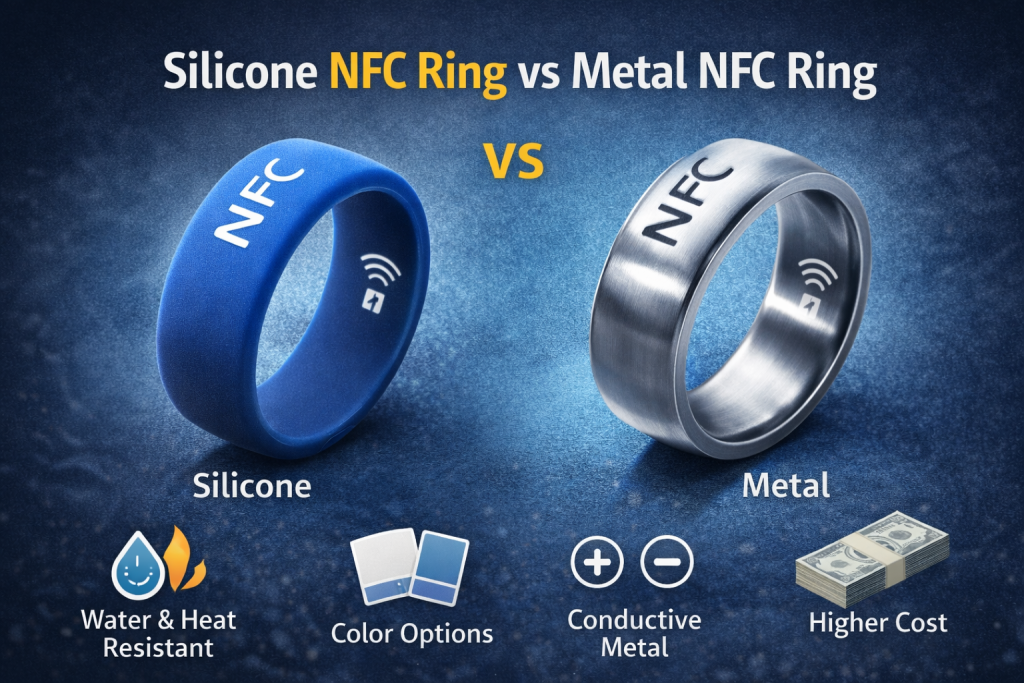
Silicone NFC Rings vs Metal NFC Rings: Which Converts Better?
Both silicone and metal NFC rings are used in access control, payments, and brand engagement. However, when it comes to real-world adoption, comfort, and conversion, silicone NFC rings consistently outperform metal alternatives in most commercial scenarios.
1. Wearability and User Comfort
Silicone NFC Rings
- Soft, flexible, and lightweight
- Comfortable for all-day wear
- Safe for sports, fitness, and active environments
- Suitable for a wide range of finger sizes
Metal NFC Rings
- Rigid and heavier
- Can feel uncomfortable during extended wear
- Not ideal for physical activity or industrial use
Comfort directly impacts adoption. If users stop wearing the ring, conversion stops.
2. Durability in Real-World Environments
Silicone NFC Rings
- Waterproof and sweat-resistant
- Resistant to chemicals, chlorine, and UV exposure
- Perform reliably in pools, gyms, and outdoor environments
Metal NFC Rings
- Susceptible to scratches and surface wear
- Performance can be affected by moisture and impact
- Less suitable for harsh or wet environments
For high-frequency daily use, silicone rings offer greater long-term reliability.
3. NFC Performance and Signal Stability
Silicone NFC Rings
- Non-metallic housing allows stable RF coupling
- Consistent read performance across different readers
- Less signal interference
Metal NFC Rings
- Metal housing can attenuate NFC signals
- Requires complex antenna isolation
- Inconsistent performance depending on reader design
From a technical standpoint, silicone provides a more forgiving RF environment.
4. Customization and Branding Flexibility
Silicone NFC Rings
- Wide color options, including Pantone matching
- Easy logo embossing, debossing, and laser marking
- Cost-effective customization at scale
Metal NFC Rings
- Limited color and branding options
- Higher customization costs
- Longer production lead times
For brands and events, visual identity plays a major role in user engagement.
5. Safety and Application Scope
Silicone NFC Rings
- Non-conductive and safe for industrial and medical environments
- No risk of short circuits or conductive contact
- Suitable for healthcare, manufacturing, and sports venues
Metal NFC Rings
- Conductive material limits use in certain environments
- Not recommended for industrial or medical settings
Safety restrictions can significantly reduce deployment options.
6. Cost Efficiency and Scalability
Silicone NFC Rings
- Lower unit cost
- Ideal for large-scale deployments
- Easier replacement and reordering
Metal NFC Rings
- Higher production cost
- Less practical for mass distribution
- Replacement cost is significantly higher
For projects focused on ROI and scale, silicone NFC rings offer a clear advantage.
What to Consider Before Ordering
Before customizing NFC silicone rings, evaluate:
- System compatibility (reader, app, backend)
- Required security level
- Quantity and lead time
- Compliance with NFC and ISO standards
Working with an experienced NFC manufacturer ensures smooth deployment.
Final Thoughts
Customizing your silicone ring with NFC is not just about adding technology—it’s about creating a wearable experience that users adopt naturally.
Whether you are building an access system, launching a branded product, or upgrading customer interaction, NFC silicone rings offer a flexible, durable, and high-conversion solution.
Ready to Customize Your NFC Silicone Rings?
If you’re planning a project, a professional supplier can help you:
- Select the right NFC chip
- Design the ring structure
- Apply branding and pre-programming
- Deliver production-ready NFC rings
Contact us to discuss your customization requirements.


