


Decathlon, one of the world’s largest sporting goods retailers, has implemented RFID technology to improve inventory management, operational efficiency, and customer service. This case study examines how Decathlon applied RFID, the results achieved, and lessons for other retailers.
Retail Challenges
Large-scale retailers like Decathlon face challenges that traditional barcode systems struggle to handle:
- Thousands of SKUs across multiple categories.
- Inventory inaccuracies and misplaced stock.
- Pressure to provide seamless online and in-store experiences.
- Risk of theft or loss in high-volume environments.
RFID offers a solution that addresses these challenges by enabling real-time inventory visibility, bulk scanning, and enhanced supply chain management.
Decathlon’s Scale and Pre-RFID Challenges
Decathlon operates over 1,800 stores across more than 60 countries, selling a wide range of sports apparel, footwear, equipment, and accessories.
Before RFID:
- Inventory counts were time-consuming and error-prone.
- Online and in-store stock information did not always align.
- Labor-intensive manual processes consumed significant staff hours.
- Shrinkage and misplacement were difficult to track.
These factors highlighted the need for a technology-driven solution to maintain operational efficiency and customer satisfaction.
RFID Technology Overview
RFID (Radio Frequency Identification) allows automatic identification of items via electromagnetic fields. Key points for Decathlon’s implementation:
- Passive UHF RFID tags are used across most products.
- Tags do not require batteries and can be read at several meters.
- Each tag stores a unique product ID and SKU.
- RFID readers include handheld units for inventory checks and fixed readers in warehouses for tracking.
This combination ensures accurate inventory counts, faster stock movement, and integration with Decathlon’s ERP and point-of-sale systems.
Implementation Process
Decathlon’s RFID rollout followed a structured approach:
Pilot Phase
- Initial tests in stores in France and Spain.
- Focused on high-volume categories like apparel, footwear, and accessories.
- Evaluated tag placement, durability, and read accuracy.
Tag Placement Strategy
- Apparel: tags sewn into inner labels or hems.
- Footwear: embedded in insoles or tongues.
- Accessories: discreet placement on packaging or leather products.
Integration and Hardware
- ERP and POS systems were connected to capture real-time RFID data.
- Handheld and fixed readers deployed across stores and warehouses.
- Custom APIs ensured smooth communication between RFID systems and backend platforms.
Staff Training
- Employees received hands-on training on scanning, troubleshooting, and interpreting RFID data.
- Adoption was smoothened through workshops and real-use demonstrations.
Phased Rollout
- Pilot in 10–15 high-volume stores.
- Category expansion across 50 European stores.
- Global rollout covering Asia, North America, and South America.
Operational Benefits
Inventory Accuracy
- Increased from ~70% to over 95%.
- Bulk scanning drastically reduced errors in stock counts.
Labor Efficiency
- Manual inventory efforts reduced by up to 70%.
- Staff redirected toward customer service and in-store operations.
Stock Availability
- Out-of-stock incidents reduced by 30–40%.
- Automatic replenishment supported by real-time RFID data.
Omnichannel Fulfillment
- Click-and-collect order accuracy reached 99%.
- Inventory visibility ensured online stock matched in-store reality.
Loss Prevention
- Misplaced or stolen items detected more quickly.
- RFID enabled faster stock verification in both stores and warehouses.
Customer Experience
RFID deployment also benefits customers indirectly:
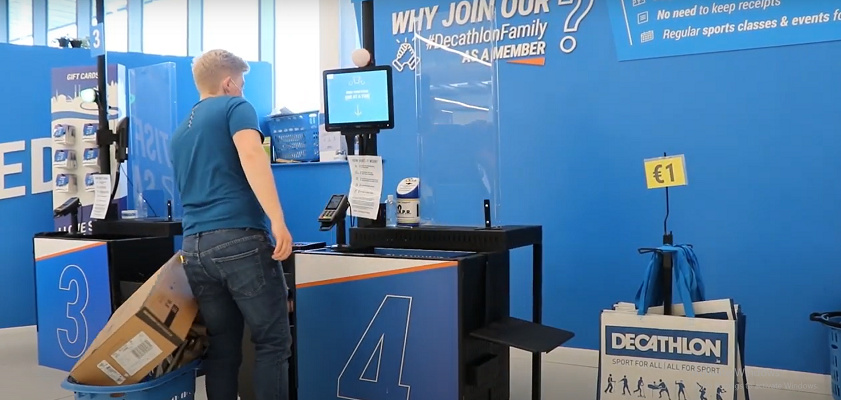
- Faster checkout with multiple items scanned simultaneously.
- Accurate stock availability online and in-store.
- Efficient click-and-collect and same-day pickups.
- Staff can locate items quickly, improving service quality.
Challenges and Lessons Learned
Technical Considerations
- Metallic products and dense textiles initially interfered with reads.
- Specialized anti-metal tags and strategic placement solved most issues.
Operational Insights
- Staff needed training on RFID-specific procedures.
- ERP integration required adjustments to handle real-time data.
Cost and ROI
- Initial investment included tags, readers, and software integration.
- ROI achieved through reduced labor, improved inventory accuracy, and fewer stockouts.
Comparison with Other Retailers
| Retailer | RFID Type | Scale | Outcome |
|---|---|---|---|
| Decathlon | Passive UHF | 1,800+ stores | >95% inventory accuracy, labor efficiency, fewer stockouts |
| Zara | Passive UHF | 2,000+ stores | Near real-time stock tracking, supply chain optimization |
| Walmart | Mixed UHF/LF | 4,700+ stores | Bulk inventory management, improved logistics |
| Target | UHF | 1,900+ stores | Omnichannel efficiency, warehouse tracking |
Decathlon stands out for efficient deployment across sporting goods categories, balancing cost, reliability, and scalability.
Future Trends
- IoT-enabled smart shelves: automatically detect stock levels.
- RFID + blockchain: enhanced product authenticity and traceability.
- Predictive analytics: AI uses RFID data to forecast demand and optimize inventory.
- Sustainability: reduced overproduction and better logistics, lowering carbon footprint.
Conclusion
Decathlon’s RFID implementation demonstrates:
- Improved operational efficiency through accurate inventory tracking.
- Enhanced omnichannel operations, supporting online orders and in-store pickup.
- Labor savings and reduced human error.
- Better customer experience through reliable stock availability and faster service.
- Strategic advantage for managing large-scale retail operations.
Decathlon serves as a model for retailers seeking to modernize operations and leverage technology for both operational excellence and customer satisfaction.


