


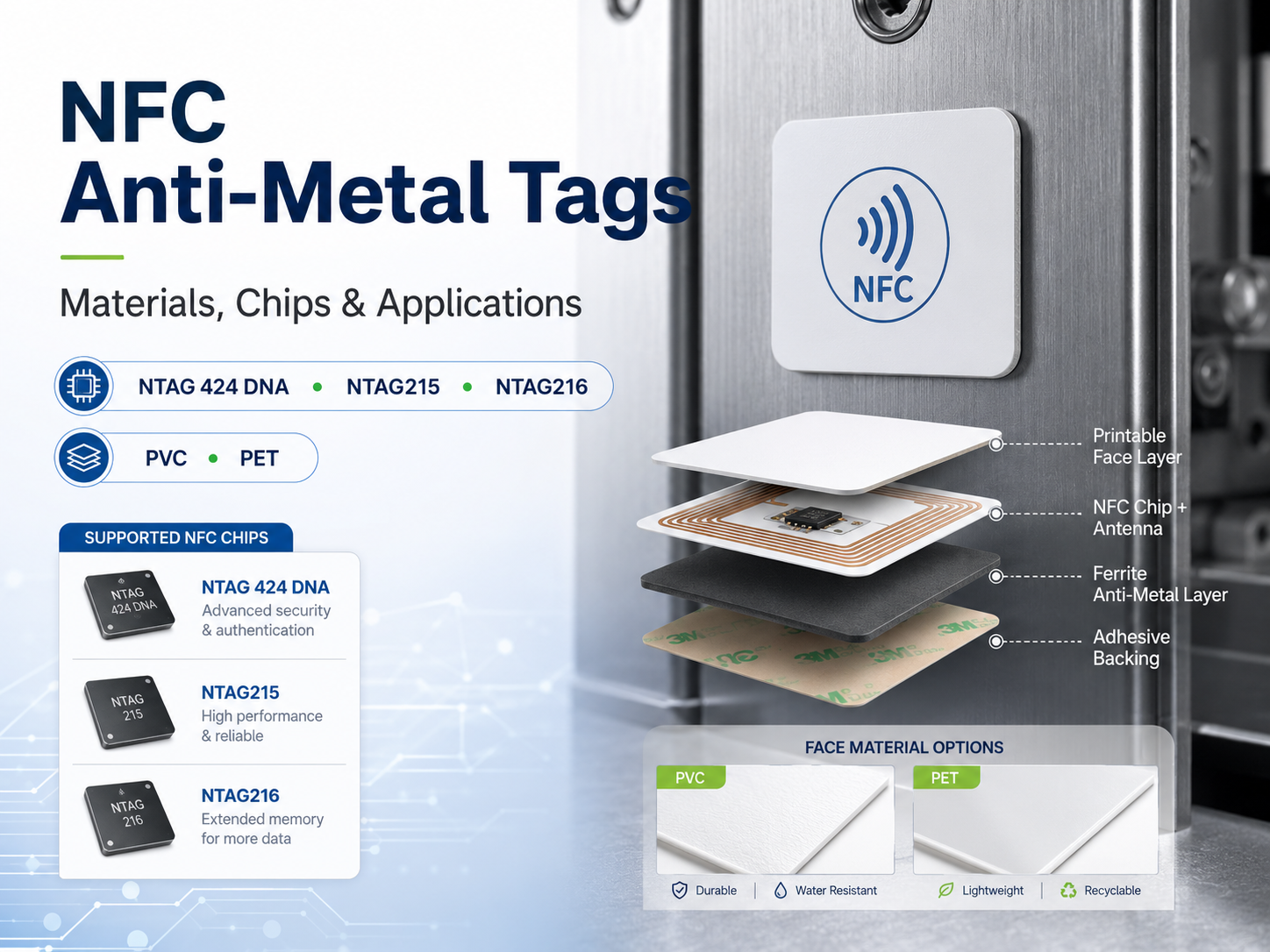
NFC tags are widely used for product identification, equipment management, digital product information, authentication and customer engagement. However, a standard NFC label usually performs poorly when it is attached directly to metal.
Metal changes the electromagnetic field around the tag antenna. This can detune the antenna, reduce energy transfer and, in some cases, make the tag completely unreadable. An NFC anti-metal tag solves this problem by adding a magnetic isolation layer between the antenna and the metal surface.
The finished tag may look like a normal PVC or PET NFC sticker, but its internal structure is different. Material selection, ferrite thickness, antenna design, adhesive and chip type all affect the final reading performance.
This guide explains:
- How NFC anti-metal tags work
- The typical structure of an on-metal NFC label
- The differences between PVC and PET materials
- When to choose NTAG215, NTAG216 or the NTAG 424 DNA chip
- Common industrial and consumer applications
- The specifications buyers should confirm before ordering
What Is an NFC Anti-Metal Tag?
An NFC anti-metal tag, also called an on-metal NFC tag, is an NFC transponder designed to operate when mounted on a metal or conductive surface.
Like a standard NFC tag, it normally contains:
- An NFC chip
- A loop antenna
- A printable or protective surface material
- An adhesive layer
The key difference is the addition of a ferrite or magnetic shielding layer behind the antenna.
This layer separates the NFC antenna from the metal substrate and redirects the magnetic field through the antenna. Without this barrier, the nearby metal can alter the antenna’s inductance and operating frequency, preventing reliable communication between the tag and an NFC-enabled smartphone or reader.
Most NFC anti-metal tags operate at 13.56 MHz. Depending on the selected chip, they may comply with NFC Forum Type 2 or Type 4 specifications and ISO/IEC 14443 Type A.
Why Standard NFC Tags Do Not Work Well on Metal
NFC communication relies on near-field magnetic coupling between the reader antenna and the tag antenna.
When a conventional NFC inlay is placed directly on metal, electrical currents are induced in the metal surface. These currents oppose the reader’s magnetic field and disrupt the antenna’s tuning.
The result may include:
- Significantly reduced reading distance
- Unstable smartphone detection
- Different performance on different metal surfaces
- Failed data reading or writing
- Complete loss of NFC functionality
Adding a thicker adhesive or a normal plastic spacer may create a small physical gap, but it does not provide the same magnetic isolation as a properly selected ferrite layer.
For reliable production use, an NFC tag intended for metal should be designed and tuned as a complete on-metal construction.
The Typical Structure of an NFC Anti-Metal Tag
A flexible anti-metal NFC label usually contains several laminated layers.
1. Printable face material
The top layer provides the visible surface of the tag. It may be printed with:
- A company logo
- Product instructions
- A QR code
- A serial number
- Asset information
- Safety symbols
- Branding graphics
PVC and PET are two common face materials.
2. Protective coating or overlaminate
A transparent coating or film may be added to improve resistance to:
- Scratching
- Moisture
- Cleaning chemicals
- UV exposure
- Printed-image wear
The protection level depends on the exact film, coating, ink and lamination process.
3. NFC inlay
The inlay contains the NFC chip and antenna. The antenna is commonly produced from etched aluminum or copper.
The inlay dimensions and antenna geometry influence:
- Reading performance
- Final tag size
- Compatibility with small metal objects
- Sensitivity to mounting conditions
- Smartphone user experience
4. Ferrite anti-metal layer
The ferrite layer is the functional component that allows the tag to operate on metal.
It acts as a magnetic barrier between the antenna and the conductive mounting surface. Ferrite thickness and magnetic properties must be matched to the antenna design.
A thinner ferrite layer can produce a lower-profile label, but it may provide less isolation. A thicker or higher-performance ferrite layer may improve performance but increase tag thickness and cost.
5. Pressure-sensitive adhesive
The adhesive fixes the tag to the metal surface.
Adhesive selection should consider:
- Smooth or textured metal
- Painted or powder-coated surfaces
- Stainless steel or aluminum
- Surface contamination
- Oil and grease exposure
- Indoor or outdoor use
- Application temperature
- Long-term operating temperature
- Permanent or removable installation
A strong chip and antenna will not compensate for an adhesive that lifts from the equipment after several weeks.
6. Release liner
The release liner protects the adhesive before installation and is removed when the label is applied.
For automatic labeling, the liner, tag pitch and roll direction must also be compatible with the application equipment.
PVC NFC Anti-Metal Tags
PVC, or polyvinyl chloride, is commonly used as the visible surface or protective body of flexible NFC tags.
PVC anti-metal tags can be produced as:
- Thin adhesive stickers
- Printed round discs
- Flexible labels
- Laminated cards
- Epoxy-covered tags
- Custom-shaped promotional tags
Advantages of PVC Material
Flexibility
Flexible PVC can conform to mildly curved surfaces more easily than a rigid label construction.
This makes it suitable for:
- Metal bottles
- Cylindrical equipment
- Appliances
- Curved machine housings
- Promotional products
The permitted bending radius still depends on the antenna and ferrite layer. Excessive bending can crack the antenna or change its tuning.
Good printability
PVC offers a smooth surface for logos, graphics, numbers and QR codes. It can support several printing and finishing processes depending on the tag construction.
Cost-effective customization
PVC is often selected for customized anti-metal tags that require a branded appearance without an industrial hard-tag enclosure.
Available in different finishes
Possible surface finishes include:
- Glossy white
- Matte white
- Transparent
- Colored PVC
- Printed PVC
- Epoxy-coated PVC
Limitations of PVC Anti-Metal Tags
PVC is not automatically suitable for every industrial environment.
The exact formulation can affect:
- Temperature resistance
- UV stability
- Chemical resistance
- Flexibility
- Dimensional stability
- Long-term outdoor durability
Plasticizers used in some flexible PVC formulations may also influence aging and adhesive interaction. Buyers should therefore evaluate the complete finished tag rather than approving the product based only on the word “PVC.”
Typical Applications for PVC Anti-Metal NFC Tags
PVC constructions are commonly used for:
- Smart promotional products
- Metal business cards and displays
- Consumer electronics
- Home appliances
- Interactive metal signage
- Digital menus mounted on metal
- NFC social media tags
- Smart product information
- Indoor equipment identification
- Branded customer-engagement tags
PVC is often appropriate when appearance, flexibility and economical custom printing are more important than extreme industrial durability.
PET NFC Anti-Metal Tags
PET stands for polyethylene terephthalate. In the label industry, PET is often referred to as polyester.
PET is widely used for durable identification labels because it can provide a thin, strong and dimensionally stable surface. Specific PET label constructions can also offer strong resistance to moisture, abrasion, weathering and chemicals.
Advantages of PET Material
Thin profile
PET film can provide a durable printed surface without making the finished tag unnecessarily thick.
The ferrite layer will still make an anti-metal tag thicker than a standard NFC label, but a PET face can help maintain a relatively low-profile construction.
Dimensional stability
PET generally retains its shape better than highly flexible vinyl materials. This can be useful when the tag must remain flat and properly aligned over time.
Resistance to tearing and abrasion
A suitable PET face or PET overlaminate can improve resistance to:
- Edge damage
- Scuffing
- Surface wear
- Handling
- Cleaning
- Printed-information loss
Moisture and chemical resistance
Industrial polyester label materials are available for environments involving water, humidity, cleaning agents and limited chemical contact.
However, chemical resistance should never be assumed from the material name alone. The ink, top coating, adhesive and ferrite layer must also survive the same environment.
Industrial appearance
White, silver and transparent PET materials are commonly used for:
- Equipment labels
- Electronics labels
- Rating plates
- Asset identification
- Maintenance labels
- Durable product markings
Limitations of PET Anti-Metal Tags
PET is generally less conformable than soft PVC. A PET label may not be the best choice for a very tight curve or irregular mounting surface.
It may also cost more than a basic PVC construction, particularly when combined with:
- High-performance adhesive
- Chemical-resistant printing
- UV-resistant overlaminate
- Thick ferrite
- Serialized data
- Security chips
Typical Applications for PET Anti-Metal NFC Tags
PET anti-metal tags are commonly suitable for:
- IT asset tracking
- Servers and network equipment
- Industrial machinery
- Electrical cabinets
- Laboratory equipment
- Metal tools
- Maintenance records
- Appliance identification
- Automotive components
- Reusable metal containers
- Industrial product authentication
PET is usually the stronger choice when buyers need a thin, professional and durable label for equipment or product identification.
PVC vs PET for NFC Anti-Metal Tags
The material should be selected according to the mounting surface and operating environment rather than price alone.
| Requirement | PVC | PET |
|---|---|---|
| Flexibility | Generally better | Moderate |
| Tight curved surfaces | Often more suitable | Requires testing |
| Dimensional stability | Moderate | Generally better |
| Thin industrial labels | Suitable | Often preferred |
| Abrasion resistance | Depends on coating | Typically strong with suitable construction |
| Moisture resistance | Available | Typically strong |
| Chemical resistance | Product-specific | Industrial-grade options widely available |
| Custom color printing | Good | Good |
| Promotional use | Common | Suitable |
| Industrial asset labels | Suitable for light-duty use | Often preferred |
| Outdoor use | Requires qualified construction | Requires qualified construction |
| Cost | Often lower | Often higher |
This table represents common material tendencies, not guaranteed performance values. A finished NFC label is a multi-layer product, and the weakest layer may determine its service life.
Choosing the NFC Chip
The face material determines the physical characteristics of the tag. The chip determines memory, communication features and security capabilities.
PVC and PET anti-metal tags can be manufactured with different NFC chips. There is no rule that a particular chip must be paired with a particular face material.
For example:
- A PVC anti-metal tag can use NTAG215, NTAG216 or NTAG 424 DNA.
- A PET anti-metal label can also use any of these chips.
- Chip selection should be based on data and security requirements.
- Material selection should be based on physical and environmental requirements.
NTAG215 for General-Purpose NFC Anti-Metal Tags
NTAG215 is part of NXP’s NTAG21x family. It operates at 13.56 MHz and is compliant with NFC Forum Type 2 Tag and ISO/IEC 14443 Type A specifications.
NTAG215 provides 504 bytes of user memory.
It also supports features such as:
- A manufacturer-programmed unique identifier
- NDEF data storage
- Configurable password protection
- Read-only locking
- NFC counter functions
- UID mirroring
- ECC-based originality signature
- Fast-read commands
NTAG215 provides more memory than NTAG213 while remaining appropriate for mainstream NFC applications.
Some buyers incorrectly write the model as “NATG215.” The correct NXP product name is NTAG215.
When to Choose NTAG215
NTAG215 is suitable when the tag needs to store:
- A standard or moderately long URL
- A product identification record
- Contact details
- A small text record
- Application-launch information
- Device-pairing data
- A serialized NDEF message
Common NTAG215 anti-metal applications include:
- Metal equipment identification
- Interactive product displays
- Consumer electronics
- Gaming accessories
- Smart toys
- Maintenance information
- Digital manuals
- Promotional products
- Product registration
NTAG215 offers password-based access control, but it should not be treated as a cryptographic anti-counterfeiting chip. Password protection and static identifiers do not provide the same security model as NTAG 424 DNA.
NTAG216 for Larger NDEF Records
NTAG216 is also an NFC Forum Type 2 Tag IC from the NTAG21x family.
Its main advantage is its larger memory. NTAG216 provides 888 bytes of user memory, compared with 504 bytes for NTAG215.
NTAG216 supports the same general family features, including:
- Unique identifier
- NDEF compatibility
- Password protection
- Locking functions
- NFC counter
- UID and counter mirroring
- ECC-based originality signature
- Fast reading
When to Choose NTAG216
NTAG216 is useful when the application requires a larger NDEF message, such as:
- A longer URL with tracking parameters
- A more detailed digital business card
- Multiple small NDEF records
- Extended product information
- Device configuration data
- A multilingual text record
- Larger offline data storage
Typical NTAG216 anti-metal applications include:
- Machinery information labels
- Smart equipment manuals
- Metal display stands
- Electronic product registration
- Building maintenance points
- Industrial asset records
- Larger contact or configuration records
In many modern deployments, the tag only needs to store a short URL. The web server then provides the detailed content. In those cases, the extra memory of NTAG216 may not be necessary.
Choosing the largest memory by default can increase cost without improving user experience.
NTAG 424 DNA for Secure Authentication
NTAG 424 DNA is designed for applications requiring stronger security, privacy and product authentication.
Unlike NTAG215 and NTAG216, which are NFC Forum Type 2 tags, NTAG 424 DNA is an NFC Forum Type 4 Tag.
NXP specifies 416 bytes of memory organized as:
- 32-byte capability container
- 256-byte NDEF file
- 128-byte protected data file
The main value of NTAG 424 DNA is not large storage capacity. Its value comes from its cryptographic security architecture.
Key features include:
- AES-128 cryptography
- Secure Dynamic Messaging
- Secure Unique NFC authentication
- Three-pass mutual authentication
- Protected data access
- Encrypted communication options
- Random ID and encrypted UID functions
- NXP originality checks
- Dynamic URL construction
- Common Criteria EAL4 certification
How Secure Dynamic Messaging Works
With a basic NTAG215 or NTAG216 implementation, the phone normally reads static NDEF content. If the tag contains a URL, the same URL is generally returned at every tap unless the tag is rewritten.
NTAG 424 DNA can generate changing authentication data during an ordinary NFC read.
Depending on the configuration, the URL can include mirrored data such as:
- Tag identification information
- A tap counter
- A unique message authentication code
- Encrypted dynamic data
A backend server receives the dynamic URL parameters and verifies whether the cryptographic response is valid.
This makes copied static tag data much less useful. A counterfeit label may reproduce the printed design and static URL, but it cannot correctly generate the required cryptographic response without the original secure chip and keys.
Applications for NTAG 424 DNA Anti-Metal Tags
Combining NTAG 424 DNA with an anti-metal construction is useful when a secure NFC tag must be attached to a metal product, component or package.
Typical applications include:
- Luxury goods authentication
- Premium cosmetics in metal packaging
- High-value electronics
- Industrial spare parts
- Medical devices
- Pharmaceutical packaging components
- Automotive parts
- Secure maintenance records
- Brand protection
- Warranty activation
- Controlled digital content
- Loyalty programs
- Supply-chain traceability
- Reusable metal containers
- Secure equipment identification
NTAG 424 DNA is especially relevant when the business needs to distinguish an authentic product from a copied label.
However, the chip is only one part of a secure system. A complete implementation also requires:
- Secure key management
- Proper chip personalization
- A verification backend
- Access-control design
- Event monitoring
- Rules for suspicious tap behavior
- Secure manufacturing and data handling
Using an NTAG 424 DNA chip without correctly configuring its security functions may not provide the expected protection.
NTAG215 vs NTAG216 vs NTAG 424 DNA
| Feature | NTAG215 | NTAG216 | NTAG 424 DNA |
| NFC Forum type | Type 2 | Type 2 | Type 4 |
| User or application memory | 504 bytes | 888 bytes | 416 bytes structured memory |
| Main advantage | Balanced memory and cost | Larger NDEF capacity | Cryptographic authentication |
| Password protection | Yes | Yes | Advanced AES-based access control |
| Dynamic secure authentication | No | No | Yes |
| Suitable for static URLs | Yes | Yes | Yes |
| Suitable for secure anti-counterfeiting | Limited | Limited | Yes, with a complete backend |
| Typical cost level | Standard | Standard to moderate | Higher |
| Best use | General NFC interaction | Larger data records | Authentication and secure experiences |
The correct chip depends on the business requirement:
- Choose NTAG215 for general NFC interaction with moderate memory.
- Choose NTAG216 when the NDEF message genuinely needs more storage.
- Choose NTAG 424 DNA when secure authentication is more important than memory size.
Common NFC Anti-Metal Tag Applications
Industrial Equipment Management
A PET anti-metal NFC label can be placed on a machine, motor, control cabinet or production tool.
A technician can tap the tag to access:
- Equipment identification
- Operating instructions
- Maintenance history
- Inspection forms
- Spare-parts lists
- Safety documents
- Service videos
The NFC chip usually stores a URL or equipment identifier rather than the entire maintenance record.
IT Asset Identification
Anti-metal NFC tags can be attached to:
- Servers
- Desktop computers
- Network switches
- Storage devices
- Metal laptop housings
- Data-center racks
The tag can connect the physical asset to an asset-management system, service record or support page.
PET is commonly selected for this application because a thin and durable equipment label is often preferred.
Tool Tracking and Inspection
NFC anti-metal tags can identify tools and inspection points where operators interact with each item individually.
The user can tap the tag to:
- Confirm an inspection
- Open a checklist
- Record maintenance
- Report damage
- View calibration status
- Identify the assigned department
NFC is useful for intentional close-range interaction. For automatic bulk inventory counting, UHF RFID may be more suitable.
Consumer Electronics
Manufacturers can integrate NFC anti-metal tags into or onto electronic products for:
- Product registration
- Warranty activation
- User manuals
- App downloads
- Wi-Fi or Bluetooth pairing support
- Customer service
- Authenticity verification
The tag must be tested in its final position because batteries, shielding, housings and internal metal components can influence NFC performance.
Metal Packaging
Metal tins, cosmetic containers, beverage-related promotional packages and premium gift boxes can interfere with normal NFC labels.
An anti-metal tag allows a brand to add:
- Product stories
- Authentication
- Loyalty programs
- Reorder links
- Usage instructions
- Campaign content
- Supply-chain information
NTAG215 or NTAG216 may be adequate for general engagement. NTAG 424 DNA is more appropriate when authentication or controlled content is required.
Automotive Components
NFC anti-metal tags can be used on suitable automotive parts for:
- Part identification
- Installation instructions
- Service history
- Warranty registration
- Component authentication
- Digital product documentation
Automotive environments require careful validation for heat, fluids, abrasion, vibration and long-term adhesion.
Facility and Maintenance Points
An NFC anti-metal tag can be installed on:
- Fire equipment cabinets
- Electrical panels
- HVAC systems
- Elevators
- Pumps
- Valves
- Metal doors
- Safety stations
Employees can tap the tag to open a site-specific checklist or record an inspection.
Factors That Affect Reading Performance
Tag Size
A larger antenna usually offers more design flexibility and potentially better coupling with a smartphone.
Very small anti-metal tags may have a shorter or less consistent read range. They should be tested with the intended phone models and mounting object.
Ferrite Thickness
The ferrite layer must provide enough isolation from the metal.
A thin ferrite layer can reduce total thickness, but performance may become more sensitive to:
- Metal type
- Antenna dimensions
- Smartphone position
- Surface curvature
- Adhesive thickness
Metal Type and Object Geometry
A tag may perform differently on:
- Stainless steel
- Aluminum
- Painted steel
- Curved pipe
- Flat cabinet
- Small metal tool
- Large metal panel
Testing on a generic metal sheet does not fully reproduce every final application.
Tag Orientation
The user must place the phone’s NFC antenna close to the tag. The location of the phone antenna varies by model.
A clear NFC symbol or “Tap Here” instruction can improve user experience.
Adhesive and Mounting Gap
Adhesive thickness changes the physical spacing between the antenna, ferrite and metal surface. Changing the adhesive can therefore affect both bonding and RF performance.
Printing and Lamination
Metallic inks, foil layers and conductive decorative materials placed near the antenna can interfere with performance.
Printed graphics should be evaluated as part of the complete tag construction.
How to Specify an NFC Anti-Metal Tag
A clear request for quotation should include the following information.
Mounting surface
Specify:
- Metal type
- Painted or unpainted surface
- Flat or curved shape
- Surface texture
- Available mounting area
Tag dimensions
Provide the maximum:
- Length
- Width
- Diameter
- Thickness
Face material
State whether the application requires:
- PVC
- PET
- White surface
- Transparent surface
- Silver finish
- Matte finish
- Gloss finish
Chip
Select according to the application:
- NTAG215
- NTAG216
- NTAG 424 DNA
- Another NFC chip where technically appropriate
Data requirements
Explain whether the tag will store:
- A URL
- Product ID
- Contact details
- Device settings
- Authentication data
- Multiple NDEF records
Security requirements
Clarify whether the application needs:
- Read-only locking
- Password protection
- Unique serialization
- Tap counting
- Dynamic URL authentication
- Anti-counterfeiting
- Tamper evidence
- Backend verification
Environmental conditions
Provide expected exposure to:
- Water
- Cleaning chemicals
- Oil
- UV light
- Heat
- Cold
- Abrasion
- Outdoor weather
- Repeated handling
Printing and encoding
Confirm whether the supplier must provide:
- Logo printing
- QR codes
- Variable serial numbers
- UID printing
- NDEF encoding
- URL encoding
- Database association
- NTAG 424 DNA personalization
Testing Before Mass Production
An NFC anti-metal tag should be tested on the actual product before mass production.
The test should include:
- Apply the tag to the final metal surface.
- Allow the adhesive to reach its specified bond strength.
- Test multiple NFC-enabled Android phones and iPhones.
- Test different tapping positions and orientations.
- Verify data reading and website redirection.
- Test tags before and after environmental exposure.
- Check printing, edge lifting and surface wear.
- Confirm serialized data and database matching.
- Validate NTAG 424 DNA authentication with the production backend.
- Repeat testing on several production samples.
The approved sample should define the complete construction, including chip, antenna, ferrite, face material, adhesive, printing and encoding.
Changing only one component may affect the final result.
Common Purchasing Mistakes
Selecting the chip only by memory size
More memory does not automatically mean a better tag.
A short URL may fit easily in NTAG215. NTAG216 is useful only when the application requires the additional capacity. NTAG 424 DNA should be selected for security rather than storage size.
Assuming every “waterproof” tag has the same durability
Water resistance depends on the finished construction, sealing, adhesive and test method.
A waterproof PVC face does not guarantee that the antenna edges or adhesive will survive long-term outdoor exposure.
Using a standard NFC sticker with extra adhesive foam
A simple spacer may produce acceptable results in a prototype, but it is less predictable than a tuned ferrite anti-metal construction.
Ignoring the final metal object
Performance on a flat steel test plate may not match performance on a small curved component or electronic enclosure.
Treating password protection as anti-counterfeiting
The password functions in NTAG215 and NTAG216 can restrict certain memory operations, but they are not equivalent to the AES-based dynamic authentication of NTAG 424 DNA.
Failing to build the verification backend
A secure chip does not independently decide whether a product is authentic. The server must validate the cryptographic response and apply appropriate business rules.
Final Recommendations
For a flexible, printable and economical on-metal NFC tag, a PVC construction may be appropriate, particularly for indoor promotional and consumer-facing applications.
For a thin, dimensionally stable and durable industrial label, PET is often the better starting point.
For chip selection:
- Use NTAG215 for standard URLs, identification and general interactive applications.
- Use NTAG216 when additional NDEF storage is genuinely required.
- Use NTAG 424 DNA for secure authentication, anti-counterfeiting and protected digital experiences.
The final product should not be selected by face material or chip name alone.
Reliable NFC anti-metal performance depends on the complete system:
- Correctly tuned antenna
- Suitable ferrite layer
- Appropriate PVC or PET face material
- Compatible adhesive
- Protected printing
- Proper data encoding
- Realistic testing on the final metal object
Frequently Asked Questions
What material is used in an NFC anti-metal tag?
A typical anti-metal NFC label contains a PVC or PET face, an NFC chip and antenna, a ferrite isolation layer, pressure-sensitive adhesive and a release liner. Additional coatings or overlaminates may be added for protection.
Is PVC or PET better for an NFC tag?
PVC is generally preferred for flexibility, conformability and economical custom printing. PET is often preferred for thin industrial labels requiring better dimensional stability, abrasion resistance and environmental durability.
Neither material is universally better. The correct choice depends on the application.
What is the difference between NTAG215 and NTAG216?
NTAG215 provides 504 bytes of user memory, while NTAG216 provides 888 bytes. Their general communication and security features are similar. NTAG216 is mainly selected when a larger NDEF record is required.
Is NATG215 a real NFC chip?
“NATG215” is normally a spelling error. The correct NXP chip name is NTAG215.
Is NTAG 424 DNA better than NTAG216?
They serve different purposes.
NTAG216 provides a larger general-purpose user memory area. NTAG 424 DNA provides advanced AES-based security and dynamic authentication.
For a normal URL or digital business card, NTAG216 may be sufficient. For secure product authentication, NTAG 424 DNA is the more appropriate choice.
Can NTAG215 be used for anti-counterfeiting?
NTAG215 includes a unique identifier, originality signature and password-related features, but it does not provide the same dynamic cryptographic authentication as NTAG 424 DNA.
It may support basic identification, but it should not be treated as a high-security anti-counterfeiting solution.
Can NFC anti-metal tags work on stainless steel?
Yes, provided the tag has a suitable ferrite layer and antenna design. The finished tag should still be tested on the actual stainless-steel component.
Can an anti-metal NFC tag also work on plastic?
Many on-metal NFC tags can also be read when applied to plastic, glass or other non-metal surfaces. However, performance may differ because the antenna was tuned for an anti-metal construction.
What is the reading distance of an NFC anti-metal tag?
The practical reading distance depends on antenna size, ferrite, metal surface, phone model and tag orientation. NFC is a short-range technology, and smartphone interaction normally requires the device to be placed close to the tag.
Does NTAG 424 DNA work with smartphones?
NTAG 424 DNA is designed for NFC-enabled devices and supports standard NDEF reading. The user experience and authentication workflow still depend on correct tag configuration, phone compatibility and backend implementation.
Can an NFC anti-metal tag be printed with a QR code?
Yes. A QR code, serial number, logo and NFC tap symbol can be printed on the PVC or PET face. The QR code can provide an alternative access method for users who do not activate NFC.


