In the global pharmaceutical industry, few risks are as critical as counterfeit drugs and supply chain opacity. For multinational manufacturers such as Pfizer, RFID technology has evolved from a pilot compliance tool into a strategic infrastructure component that supports serialization, anti-counterfeiting, regulatory compliance, and patient safety.
Why Pharmaceutical Giants Need RFID
Pharmaceutical supply chains are inherently complex:
- Multi-site API and finished drug manufacturing
- International cold chain logistics
- Contract manufacturing organizations (CMOs)
- Wholesalers, hospital networks, retail pharmacies
Each node introduces potential risk: diversion, temperature excursions, misrouting, and counterfeit infiltration.
For companies operating at Pfizer’s scale, traditional barcode-based tracking lacks real-time automation, non-line-of-sight reading capability, and high-throughput bulk scanning. RFID closes that gap.
Core Applications of RFID in Pfizer’s Pharmaceutical Ecosystem
1. Anti-Counterfeiting and Product Authentication
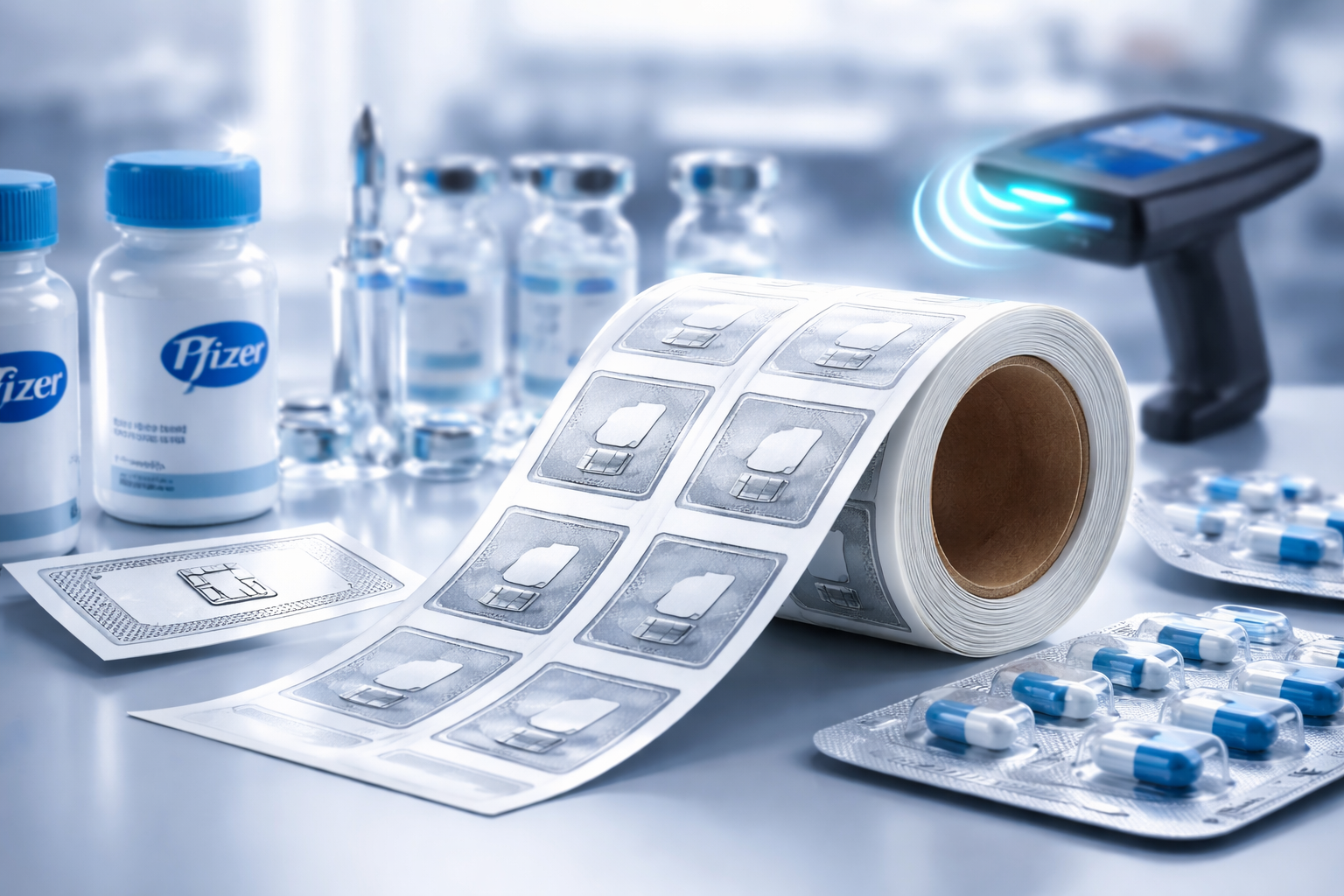
Counterfeit drugs represent a multi-billion-dollar global threat. RFID-enabled smart labels embed a unique identifier (EPC – Electronic Product Code) into each saleable unit, case, or pallet.
How it works:
- Each RFID tag is encoded during packaging with serialized data.
- RFID readers validate authenticity at distribution centers and authorized partners.
- Suspicious products that lack valid digital identity are flagged automatically.
Unlike static barcodes, RFID tags can support cryptographic authentication (when integrated with secure chips), significantly increasing resistance to cloning and tampering.
For high-value biologics and specialty medicines, this layer of verification directly protects brand integrity and patient health.
2. Serialization and Regulatory Compliance
Global pharmaceutical regulations increasingly mandate serialization and traceability:
- U.S. Drug Supply Chain Security Act (DSCSA)
- EU Falsified Medicines Directive (FMD)
- China Drug Administration traceability policies
RFID enhances serialization systems by enabling:
- Automated aggregation (unit → case → pallet)
- Bulk verification without line-of-sight
- Rapid recall execution
For Pfizer, RFID infrastructure reduces manual scanning bottlenecks in high-volume packaging lines and distribution centers, especially when integrated with ERP and warehouse management systems (WMS).
3. Cold Chain Monitoring and Condition Tracking
Many Pfizer products—particularly vaccines and biologics—require strict temperature control.
RFID-based sensor tags (active or semi-passive) can:
- Record temperature excursions
- Log humidity or shock events
- Provide chain-of-custody documentation
When deployed across refrigerated transport and storage environments, RFID ensures that any deviation from validated storage conditions is immediately traceable.
This is especially critical in global immunization programs where product integrity must be validated across borders.
4. Warehouse and Distribution Automation
In large pharmaceutical distribution centers, RFID improves operational efficiency through:
- Real-time inventory visibility
- Automated pallet tracking at dock doors
- Faster order picking validation
- Reduced shrinkage and misplacement
Unlike manual barcode scanning, UHF RFID portals can read hundreds of tagged items simultaneously, reducing labor dependency and error rates.
For a global enterprise like Pfizer, even marginal improvements in warehouse accuracy translate into substantial operational savings.
5. Recall Management and Risk Mitigation
Drug recalls require speed and precision.
With RFID-enabled traceability:
- Affected batch numbers are located instantly.
- Distribution paths are reconstructed digitally.
- Retail and hospital inventories are verified remotely.
This significantly reduces recall time and limits financial and reputational damage.
RFID Technology Stack Used in Pharmaceutical Settings
In pharmaceutical environments similar to Pfizer’s operations, the RFID architecture typically includes:
- HF (13.56 MHz) RFID for item-level tagging in controlled environments
- UHF (860–960 MHz) RFID for case and pallet tracking in logistics
- Secure IC chips supporting ISO/IEC 14443 or ISO/IEC 18000-6C standards
- Middleware integrating RFID events into SAP or enterprise systems
Selection depends on read range requirements, regulatory constraints, and environmental conditions.
Strategic Benefits for a Pharmaceutical Leader Like Pfizer
From a strategic standpoint, RFID delivers measurable enterprise value:
- Enhanced brand protection through anti-counterfeit safeguards
- Regulatory alignment across global markets
- Operational efficiency in logistics and distribution
- Improved patient safety and product integrity
- Data-driven supply chain transparency
For a publicly traded pharmaceutical leader such as Pfizer, supply chain transparency is not merely operational—it is reputational.
Challenges and Considerations
Despite its advantages, RFID deployment in pharma must address:
- High initial infrastructure investment
- Integration with legacy IT systems
- Data governance and cybersecurity
- Global frequency standard differences
However, as chip costs decline and global traceability mandates expand, RFID adoption continues to accelerate in the life sciences sector.
The Future: Toward Intelligent Pharmaceutical Supply Networks
RFID is increasingly converging with:
- Blockchain-based verification platforms
- IoT sensor ecosystems
- AI-driven demand forecasting
- Digital twins of pharmaceutical logistics networks
For global pharmaceutical manufacturers, RFID is no longer optional. It is foundational infrastructure for intelligent, compliant, and patient-centric supply chains.
Conclusion
The application of RFID tags in Pfizer’s pharmaceutical operations illustrates a broader industry transformation. RFID is not just an identification tool—it is a digital trust layer embedded into the pharmaceutical value chain.
By strengthening anti-counterfeiting defenses, enabling full serialization, and delivering real-time supply chain visibility, RFID technology supports what matters most in healthcare: patient safety and therapeutic reliability.
For procurement managers and pharmaceutical supply chain strategists, the question is no longer whether RFID should be implemented—but how comprehensively it can be deployed to future-proof operations.

About XIUCHENG RFID
XIUCHENG RFID specializes in manufacturing a wide range of RFID products, including RFID Silicone Wristbands, Tyvek Wristbands, Fabric Wristbands, Elastic Wristbands, Vinyl Wristbands, RFID Laundry Tags, Animal Tags, and RFID Cards. All products are produced under strict quality control and advanced production technology.
With 12 years of experience in wristband design, tag design, quality management, and customer relationship management, we have built a solid foundation for delivering reliable and high-performance RFID solutions.