


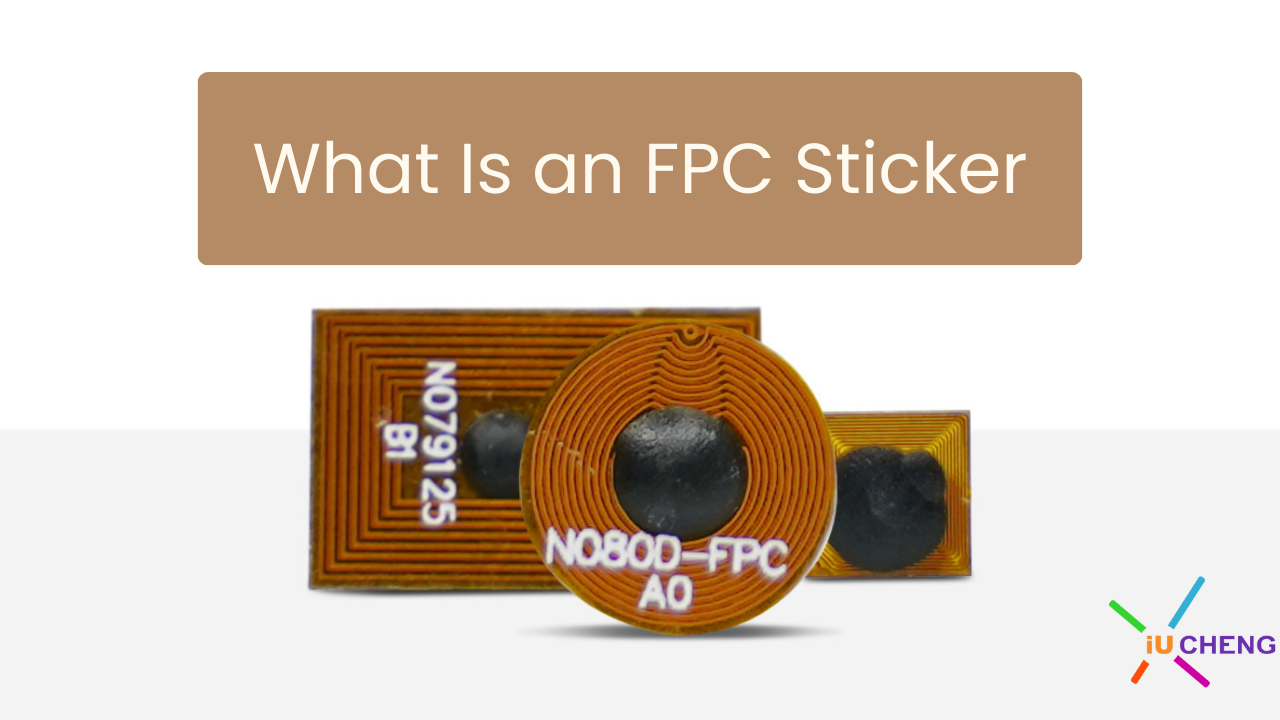
An FPC sticker is a flexible electronic label based on Flexible Printed Circuit (FPC) technology. In the RFID and NFC industry, FPC stickers are widely used as high-performance antennas or complete transponder inlays where traditional etched aluminum or copper antennas cannot meet size, durability, or precision requirements.
Because of their thin profile, high dimensional accuracy, and excellent RF performance, FPC stickers are increasingly used in smart devices, industrial identification, and embedded RFID/NFC applications.
What Is an FPC Sticker?
An FPC (Flexible Printed Circuit) sticker is a thin, flexible circuit formed by etching copper traces on a polyimide (PI) or PET substrate.
In RFID/NFC applications, an FPC sticker typically consists of:
- A flexible copper antenna
- An RFID or NFC chip bonded to the circuit
- A pressure-sensitive adhesive layer for mounting
Unlike traditional RFID labels, FPC stickers are not printed antennas—they are precision-engineered circuits, offering more stable electrical characteristics.
Key Components of an FPC Sticker
1. Flexible Substrate
Usually made of polyimide (PI) or PET, providing:
- Mechanical flexibility
- Heat resistance
- Long-term dimensional stability
2. Copper Antenna Circuit
- Chemically etched copper traces
- Tight tolerance and repeatable impedance
- Optimized for specific frequencies (HF or UHF)
3. RFID / NFC Chip
Common chip options include:
- NTAG213 / 215 / 216 (NFC)
- ISO 15693 HF chips
- UHF EPC Gen2 chips
4. Adhesive Layer
- Permanent or removable adhesive
- Allows bonding to plastic, glass, or curved surfaces
How Does an FPC Sticker Work?
The working principle of an FPC sticker follows standard passive RFID/NFC operation:
- A reader or NFC-enabled device emits an RF field
- The FPC antenna captures energy from the field
- The captured energy powers the RFID/NFC chip
- The chip processes the request and modulates a response
- Data is transmitted back to the reader via the antenna
Because the antenna geometry is precisely controlled, FPC stickers provide more stable coupling and read performance, especially in compact or embedded designs.
Why Use an FPC Sticker Instead of a Traditional RFID Label?
1. Superior Electrical Stability
Copper-etched antennas maintain consistent impedance and resonance, which is critical in small or high-frequency designs.
2. Ultra-Thin and Flexible
FPC stickers can be:
- Extremely thin
- Foldable or conformal to curved surfaces
- Embedded inside products without affecting aesthetics
3. High Design Freedom
FPC allows:
- Custom antenna shapes
- Tight integration with product housings
- Optimized layouts for space-constrained devices
4. Better Performance Near Electronics
Compared with printed antennas, FPC designs perform more reliably near:
- Batteries
- Displays
- Electronic components
Common Applications of FPC Stickers
FPC stickers are widely used in applications where standard RFID labels are not sufficient:
- Smartphones and consumer electronics
- Wearable devices
- Smart locks and access modules
- Medical devices
- Industrial equipment identification
- Embedded NFC in plastic housings
In many NFC-enabled devices, the internal antenna is essentially a custom FPC sticker.
FPC Sticker vs Standard RFID Sticker
| Feature | FPC Sticker | Standard RFID Sticker |
|---|---|---|
| Antenna material | Etched copper | Printed aluminum/copper |
| Thickness | Ultra-thin | Thin |
| Flexibility | High | Medium |
| RF stability | Very high | Medium |
| Customization | Extensive | Limited |
| Cost | Higher | Lower |
Limitations of FPC Stickers
While powerful, FPC stickers are not always the best choice:
- Higher manufacturing cost
- Not ideal for ultra-low-cost mass labeling
- Requires careful antenna design for each application
They are best suited for performance-critical or embedded use cases.
Final Thoughts
An FPC sticker is a precision RFID/NFC solution built on flexible circuit technology. By combining etched copper antennas, flexible substrates, and compact chip integration, FPC stickers deliver stable RF performance in applications where space, reliability, and integration matter.
For system designers and solution providers, FPC stickers offer a high-performance alternative to traditional RFID labels—especially in compact electronic and industrial products.


