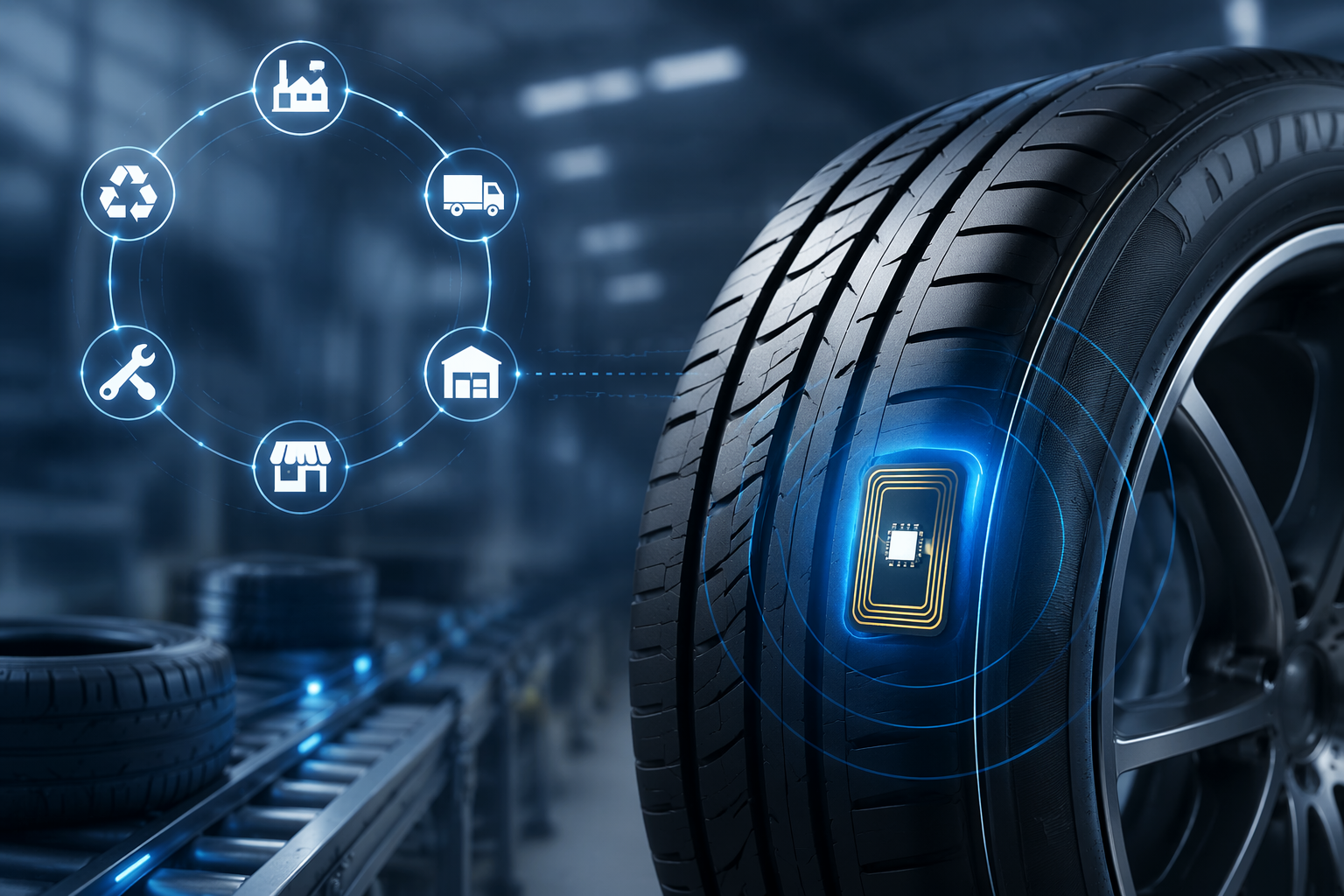
In the global tire industry, physical products are increasingly being connected to digital systems. One of the most visible examples of this transformation is the adoption of RFID (Radio Frequency Identification) tags in tires, including initiatives associated with major manufacturers like Michelin.
This is not a branding experiment. It is a structural shift in how tires are identified, tracked, and managed across their entire lifecycle.
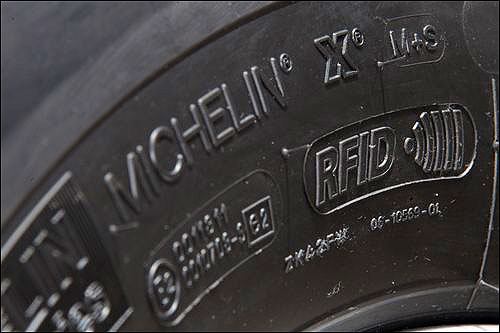
1. Michelin’s RFID Adoption: Industry Context
The tire industry operates at an unusual scale and complexity. A single tire may pass through multiple systems before reaching its final usage point:
- Manufacturing plants
- Global distribution centers
- Regional warehouses
- Retail installers
- Vehicle fleets
- Retreading facilities (for commercial tires)
- Recycling and end-of-life processing
Traditionally, this system relied on printed codes, barcodes, and batch-level tracking. These methods are increasingly insufficient in a supply chain where:
- Inventory moves in high volume
- Product variation is extremely high (size, model, specification)
- Traceability requirements are tightening globally
RFID emerged as a solution to this fragmentation.
Instead of tracking “batches of tires,” the industry is moving toward tracking “individual tire identity.”
2. Why Tires Need a Digital Identity
A tire is one of the few automotive components that has a long, complex, and physically demanding lifecycle. Unlike many parts that are replaced as units, tires:
- Wear continuously during operation
- Are rotated between positions
- May be retreaded or reused (especially in commercial fleets)
- Often remain in service tracking systems long after physical installation
This creates a fundamental problem:
The physical identity of a tire must remain stable, even as its operational context changes.
A digital identity solves this problem by assigning each tire a unique, persistent identifier that remains linked to it across its entire lifecycle.
This concept is often referred to as digital traceability or digital product identity.
3. What RFID Actually Changes in Tire Tracking
RFID does not change what a tire is physically. It changes how the tire is recognized by systems.
Instead of relying on manual scanning or visual inspection, RFID allows:
- Non-line-of-sight identification
- Bulk reading of multiple tires simultaneously
- Faster data capture in logistics environments
- Reduced dependency on manual input
Technically, each RFID tag carries a unique ID that connects the physical tire to a digital record in a backend system.
That digital record may include:
- Manufacturing data (batch, plant, date)
- Specification details (size, type, model)
- Distribution history
- Installation records
- Maintenance or inspection events (in fleet systems)
The key shift is simple but important:
The tire becomes a node in a data network, not just a physical product.
4. RFID Across the Tire Lifecycle
To understand why RFID matters, it helps to look at where it is used.
4.1 Manufacturing and Quality Control
At the production stage, RFID helps ensure:
- Each tire has a unique identity from the moment it is created
- Quality data can be linked to individual units
- Defect tracking becomes more precise (not batch-level, but unit-level)
This improves traceability in case of recalls or quality investigations.
4.2 Supply Chain and Logistics
In warehousing and distribution, RFID significantly improves operational efficiency:
- Multiple tires can be scanned instantly without line-of-sight
- Inventory counts become faster and more accurate
- Misrouting or shipping errors are reduced
For large tire manufacturers and distributors, even small efficiency gains scale into major cost reductions.
4.3 Retail and Installation
At the retail level, RFID supports:
- Correct tire identification during installation
- Reduced risk of mounting wrong specifications
- Faster checkout and inventory reconciliation
In environments where technicians handle large product variety, automation reduces human error.
4.4 Fleet Management and Long-Term Use
The most advanced use case is in commercial fleet operations.
For fleets, tires are not consumables in a simple sense—they are managed assets.
RFID enables:
- Tracking tire usage history
- Monitoring rotation and replacement cycles
- Linking tire identity to vehicle history
- Supporting predictive maintenance models
This is especially relevant in logistics, trucking, and public transport sectors where tire performance directly impacts operational cost and safety.
5. Supply Chain vs Retail vs Fleet: Why RFID Matters Differently
RFID value is not uniform across the industry. Its importance depends on the stage of the ecosystem.
Supply Chain Perspective
Focus: efficiency and accuracy
Key benefit: automated inventory visibility
Retail Perspective
Focus: speed and correctness
Key benefit: reduced manual handling errors
Fleet Perspective
Focus: lifecycle intelligence
Key benefit: asset-level tracking and optimization
What connects all three is a single idea:
The tire is no longer managed as a physical SKU, but as a continuously updated data asset.
6. The Broader Trend: Digital Product Identity
The use of RFID in tires is part of a larger industrial transformation often described as:
- Industrial IoT (IIoT)
- Smart manufacturing
- Digital Product Passport systems
Regulatory and sustainability pressures are also accelerating this shift, especially in regions where lifecycle transparency and circular economy reporting are becoming mandatory.
In this context, RFID is not the final innovation—it is the foundational layer that makes everything else possible.
Final Perspective
The adoption of RFID in tires, including initiatives associated with companies like Michelin, is not about adding a chip to a product.
It represents a structural change in how industrial products are defined:
From static physical goods
→ to traceable, data-connected assets
This transition is still in progress, but its direction is clear. The tire industry is moving toward full lifecycle digital identity, and RFID is one of the key technologies enabling that shift.