


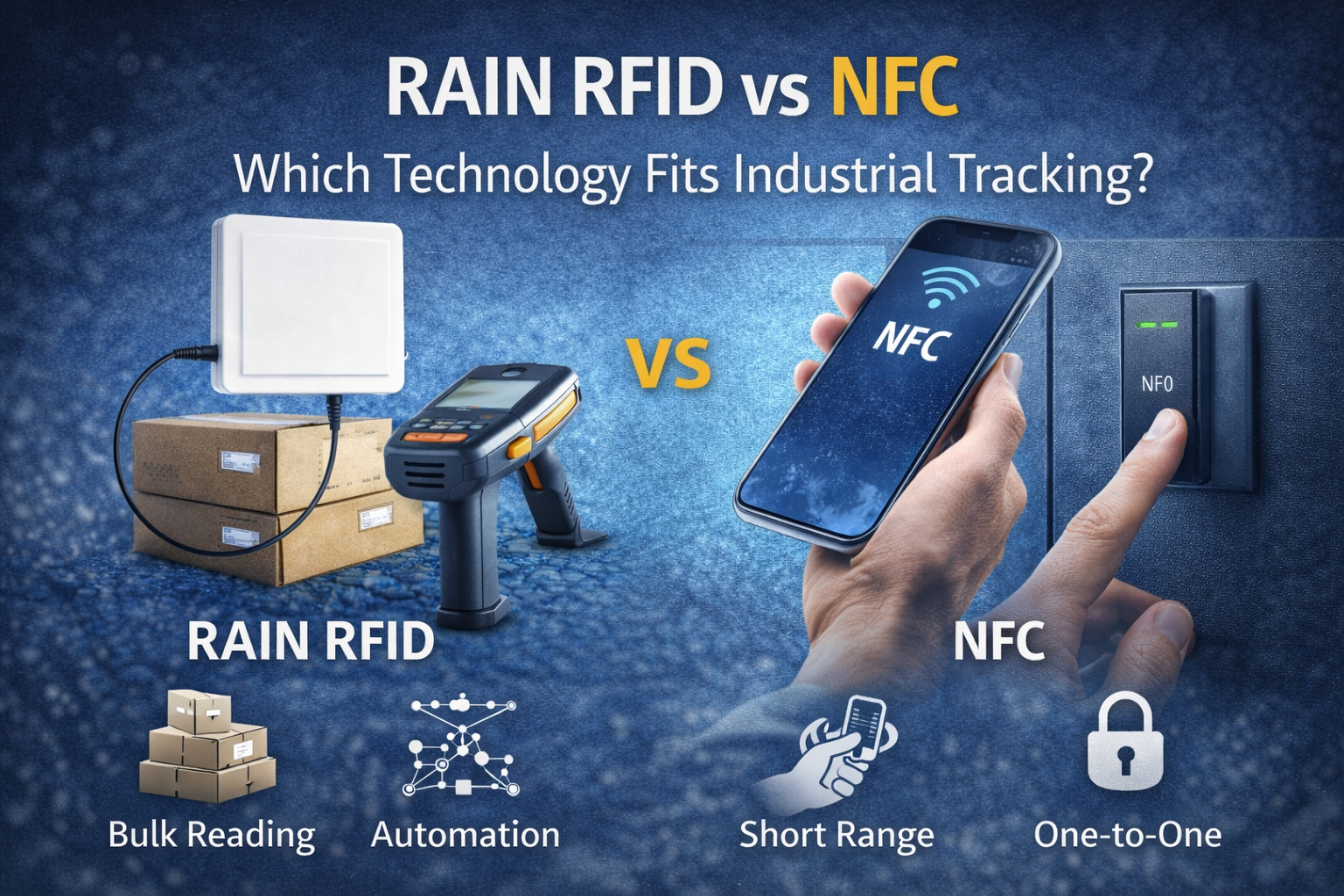
When selecting RFID technology for industrial tracking, the comparison between RAIN RFID and NFC is unavoidable. Both are based on RFID standards, yet they serve fundamentally different operational models.
For system integrators and industrial solution providers, choosing the wrong technology can lead to poor scalability, inaccurate data, or failed automation projects. This article explains the real differences, practical boundaries, and correct use cases for RAIN RFID and NFC in industrial environments.
Understanding the Core Difference
The key distinction is not frequency alone, but how the system is designed to operate at scale.
- RAIN RFID is built for bulk identification, automation, and long-range reading
- NFC is built for intentional, close-range, one-to-one interaction
If your project involves industrial inventory, logistics, manufacturing, or asset tracking, this difference is decisive.
Technology Overview
What Is RAIN RFID?
RAIN RFID is the commercial ecosystem based on UHF RFID (EPC Gen2 / ISO 18000-63). It enables:
- Simultaneous reading of hundreds or thousands of items
- Read ranges up to 10 meters or more
- Fixed and handheld reader infrastructure
- Fully automated data capture without human intervention
RAIN RFID is widely deployed in manufacturing, warehousing, retail, logistics, and industrial laundry.
What Is NFC?
NFC (Near Field Communication) operates at 13.56 MHz and is designed for:
- Very short read distance (typically <4 cm)
- One-to-one interaction
- Consumer devices such as smartphones
- Secure authentication, pairing, or data exchange
NFC is common in access control, mobile payments, smart posters, and device pairing, not large-scale industrial tracking.
RAIN RFID vs NFC: Industrial Comparison
| Criteria | RAIN RFID | NFC |
|---|---|---|
| Operating range | 3–10+ meters | < 4 cm |
| Read mode | Bulk / simultaneous | Single tag |
| Line of sight required | No | No |
| Automation level | Very high | Very limited |
| Reader type | Fixed + handheld | Phones / proximity readers |
| Throughput | Hundreds–thousands/sec | One at a time |
| Industrial scalability | Excellent | Poor |
| Typical role | Tracking & inventory | Identification & interaction |
Why RAIN RFID Fits Industrial Tracking
1. Bulk Reading Is Mandatory in Industrial Systems
Industrial environments rarely deal with single items in isolation.
Examples:
- Pallets of goods moving through dock doors
- Work-in-process items on production lines
- Hundreds of garments in industrial laundry
- High-density inventory in warehouses
RAIN RFID can capture all tags in a read zone automatically, without slowing operations.
NFC cannot do this—by design.
2. Automation Without Human Interaction
RAIN RFID systems are built around:
- Fixed readers
- Portal or zone antennas
- Event-driven software logic
This allows:
- Automatic inventory updates
- Real-time visibility
- Reduced labor cost
- High data accuracy (>99% in mature systems)
NFC requires a deliberate tap action, which introduces manual steps and limits scalability.
3. Infrastructure Integration
RAIN RFID integrates cleanly with:
- WMS
- ERP
- MES
- Manufacturing execution systems
- Industrial middleware platforms
NFC, in contrast, is usually device-centric, not infrastructure-centric.
Where NFC Still Makes Sense
NFC is not “inferior”—it is simply designed for different problems.
NFC is suitable when:
- User intent matters (tap to confirm)
- Short-range security is required
- Smartphones must act as readers
- One item = one interaction
Examples:
- Access control
- Equipment authentication
- Consumer engagement
- Smart packaging (tap for info)
These are not industrial tracking scenarios.
Common System Integrator Mistake
A frequent error is attempting to use NFC for:
- Warehouse inventory
- Production tracking
- Asset management
This usually fails due to:
- Manual scanning bottlenecks
- Human error
- Poor throughput
- Unacceptable labor cost
If the system must scale, RAIN RFID is the correct foundation.
Cost Considerations
While NFC tags may appear cheaper at first glance, total system cost tells a different story.
RAIN RFID systems reduce:
- Labor hours
- Manual scanning time
- Inventory errors
- Process delays
In industrial deployments, ROI is driven by automation, not tag unit price.
Final Recommendation for Industrial Tracking
Choose RAIN RFID if your project requires:
- Automated identification
- Bulk reading
- High throughput
- Infrastructure-level integration
- Long-term scalability
Choose NFC if your project requires:
- Short-range interaction
- User-initiated actions
- Smartphone compatibility
- Secure one-to-one identification
For industrial tracking, RAIN RFID is not an alternative—it is the industry standard.


