RFID pet microchips have been used worldwide for decades, yet many pet owners still ask the same critical question: Are RFID microchips safe for pets?
This concern is understandable. Implanting any device—no matter how small—raises questions about health, radiation, long-term effects, and animal welfare.
This article examines RFID pet microchip safety from a technical, medical, and regulatory perspective, separating evidence-based facts from common myths.
What Is an RFID Pet Microchip Made Of?
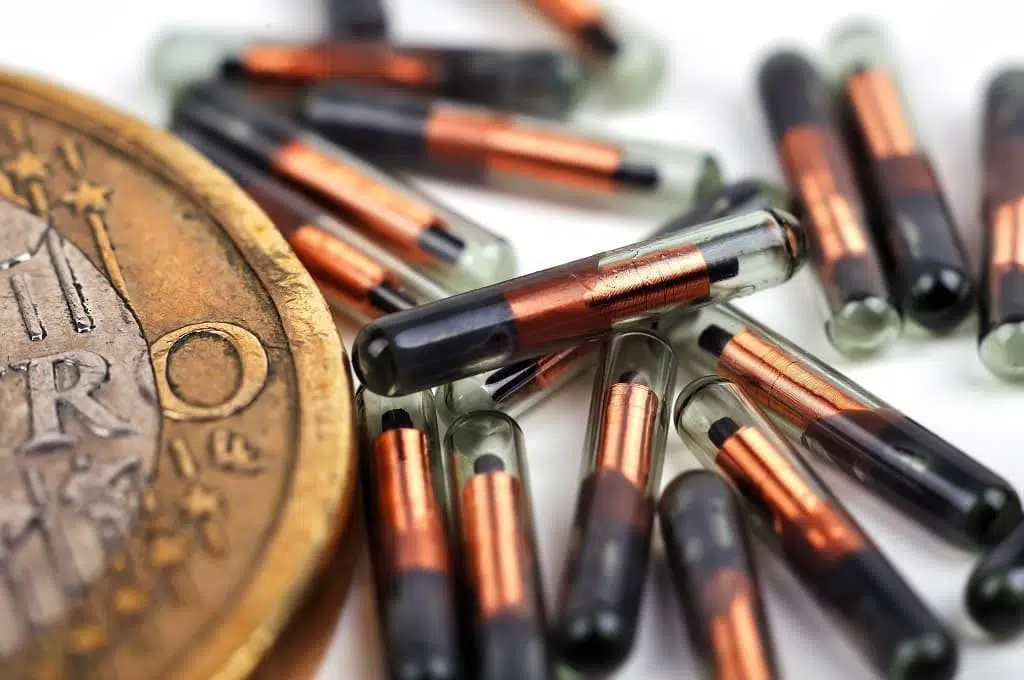
An RFID pet microchip is a passive, implantable, low-frequency (LF) RFID transponder, typically operating at 134.2 kHz and compliant with ISO 11784/11785.
A standard microchip consists of:
- An RFID integrated circuit (IC)
- A copper antenna coil
- A biocompatible glass capsule
- Anti-migration coating (e.g., parylene)
There is no battery, no moving parts, and no active transmitter.
Does an RFID Microchip Emit Radiation?
Short answer: No—only when scanned, and even then at extremely low levels.
RFID pet microchips are passive devices:
- They remain completely inactive most of the time
- They do not emit signals on their own
- They activate only when exposed to a scanner’s electromagnetic field
The scanner’s field:
- Is low-frequency (LF)
- Is non-ionizing
- Is far below levels associated with tissue damage
From a physics standpoint, this is comparable to induction used in:
- Electric toothbrush charging
- Contactless access cards
Is the Implantation Procedure Safe?
Yes—microchipping is considered a routine veterinary procedure.
Key points:
- Implantation uses a sterile, single-use injector
- Comparable to a standard vaccination injection
- Usually does not require anesthesia
- Takes only a few seconds
Adverse reactions are rare and typically limited to:
- Temporary swelling
- Mild discomfort at the injection site
Serious complications are statistically extremely uncommon.
Long-Term Health Effects: What Does the Evidence Say?
RFID pet microchips have been used at scale since the 1990s, with hundreds of millions of animals microchipped globally.
Based on veterinary and regulatory consensus:
- No causal link has been established between ISO-compliant RFID microchips and systemic illness
- The glass capsule is inert and biocompatible
- The chip does not degrade or release chemicals
Microchip migration can occur in rare cases, but:
- It does not affect chip function
- It does not pose a health risk
- Modern anti-migration coatings greatly reduce this possibility
Do RFID Microchips Cause Cancer?
This is one of the most frequently cited fears.
What the science shows:
- Isolated laboratory studies (often misquoted online) involved rodents under artificial conditions
- These findings have not been replicated in real-world veterinary populations
- Large-scale, long-term field data shows no increased cancer risk
Major veterinary organizations worldwide continue to endorse microchipping.
Regulatory and Veterinary Approval
RFID pet microchips are regulated and approved by:
- Veterinary authorities
- Animal welfare organizations
- National pet identification programs
Most countries:
- Require ISO 11784/11785 compliance
- Mandate biocompatible materials
- Enforce manufacturing quality standards
In many regions, pet microchipping is legally required, which would not be the case if safety risks were substantiated.
RFID Microchips vs Other Pet Technologies (Safety Perspective)
| Technology | Implantable | Battery | Long-Term Safety Risk |
|---|---|---|---|
| RFID Microchip | ✅ Yes | ❌ No | Extremely low |
| GPS Tracker | ❌ No | ✅ Yes | Battery, choking risk |
| Bluetooth Tag | ❌ No | ✅ Yes | Limited range, loss risk |
From a risk analysis standpoint, passive RFID microchips are among the safest identification technologies available.
Why RFID Microchips Are Still the Gold Standard
From a system-level perspective, RFID microchips are:
- Passive and maintenance-free
- Non-invasive after implantation
- Universally readable by shelters and vets
- Independent of power, apps, or networks
This reliability is exactly why they are trusted in:
- Veterinary medicine
- Animal shelters
- Government-mandated ID programs
What Actually Matters More Than the Chip Itself
Safety also depends on:
- Using ISO-compliant microchips
- Proper implantation by trained professionals
- Registering and maintaining accurate database information
An unregistered chip is safe—but ineffective.
Final Verdict: Are RFID Pet Microchips Safe?
Based on decades of global use, regulatory oversight, and veterinary evidence:
Yes—RFID pet microchips are safe.
They pose:
- No ongoing radiation risk
- No chemical exposure risk
- No meaningful long-term health risk
They remain one of the most reliable and safest tools for permanent pet identification ever developed.