Pet microchip scanners are a critical part of global animal identification systems. While most people understand that a scanner can “read a microchip,” very few understand how it actually works—especially when it comes to ISO 11784 and ISO 11785 compliant RFID tags.
This article explains, from an engineering and standards perspective, how pet microchip scanners read ISO 11784/11785 animal RFID transponders, and why compatibility matters.
What Are ISO 11784 and ISO 11785?
ISO 11784 and ISO 11785 are international standards for animal identification using RFID.
They define how data is structured and transmitted, not how databases work.
ISO 11784 – Data Structure
ISO 11784 specifies:
- A 15-digit unique identification number
- Country code or manufacturer code
- Bit allocation and encoding format
This ensures global uniqueness of every animal microchip ID.
ISO 11785 – Air Interface Protocol
ISO 11785 defines:
- How the RFID tag communicates with the reader
- Modulation method
- Timing and signal structure
- Operating frequency: 134.2 kHz (Low Frequency)
Together, these standards guarantee interoperability between chips and scanners worldwide.
Types of ISO 11785 Animal RFID Protocols
Pet microchip scanners must support one or both of the following protocols:
FDX-B (Full Duplex B)
- Global standard for pets
- Continuous field transmission
- Faster read response
- Best compatibility with modern scanners
HDX (Half Duplex)
- Older protocol
- Pulsed field operation
- Higher peak power
- Still used in some regions
Learn more: FDX-B vs. HDX: Which Animal RFID Tags Should You Choose?
Most modern scanners are FDX-B dominant but remain backward compatible with HDX.
What Is Inside a Pet Microchip Scanner?
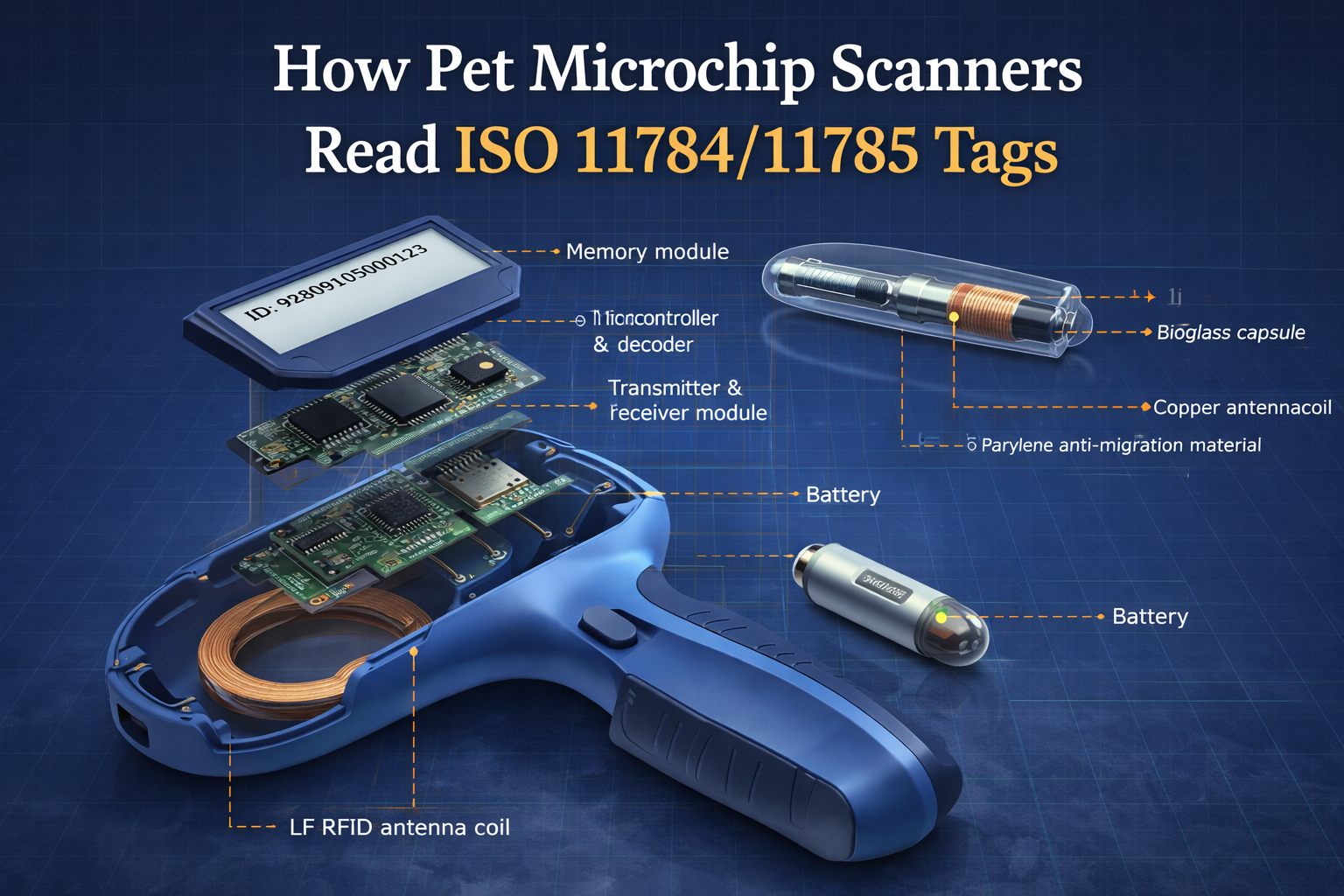
A professional animal RFID scanner typically includes:
- LF RFID transmitter (134.2 kHz)
- Receiver and demodulation circuit
- Microcontroller / decoder
- Antenna coil
- Display and memory module
- Battery power system
The scanner functions as both:
- Energy source (for passive tags)
- Signal receiver
Step-by-Step: How a Scanner Reads an ISO 11784/11785 Tag
Step 1: Electromagnetic Field Generation
The scanner emits a low-frequency electromagnetic field at 134.2 kHz via its antenna coil.
This field defines the read zone, typically:
- 5–15 cm for pet microchips
- Orientation-tolerant due to LF inductive coupling
Step 2: Inductive Coupling (Power Transfer)
When a microchip enters the field:
- The chip’s antenna coil inductively couples with the reader
- Energy is harvested from the field
- The chip powers on momentarily
This is why pet microchips do not need batteries.
Step 3: Protocol Handshake
Depending on the protocol:
- FDX-B:
The chip transmits data while the field remains active - HDX:
The scanner alternates between powering and listening phases
The scanner automatically detects the protocol.
Step 4: Data Modulation and Transmission
The microchip sends its ID using load modulation, subtly changing the electromagnetic field.
The transmitted data includes:
- ISO 11784 formatted 15-digit ID
- Manufacturer or country code
- Error-check bits
Step 5: Signal Decoding
The scanner:
- Demodulates the signal
- Verifies data integrity
- Decodes the ID according to ISO rules
Only one number is extracted—no owner data, no medical data.
Step 6: Display and Storage
The scanner displays the ID and may:
- Store it in internal memory
- Transmit it via USB, Bluetooth, or serial interface
- Export it to animal management software
Why ISO Compliance Is Critical
From a system design perspective:
- Shelters use scanners from multiple manufacturers
- Animals move across regions and countries
- Databases depend on consistent ID formats
Without ISO 11784/11785:
- Chips may be unreadable
- Recovery fails
- Identification systems break down
This is why non-ISO microchips are strongly discouraged.
Common Scanner Compatibility Issues
Single-Protocol Scanners
Some low-cost scanners:
- Support FDX-B only
- Fail to read HDX chips
Poor Antenna Design
Low-quality scanners may:
- Have reduced read range
- Be sensitive to chip orientation
Outdat
Older scanners may not fully comply with updated ISO interpretations.
LF RFID vs NFC and UHF (Why Only LF Works)
| Technology | Suitable for Pets? | Reason |
|---|---|---|
| LF RFID (134.2 kHz) | ✅ Yes | Stable in tissue, orientation-independent |
| NFC (13.56 MHz) | ❌ No | Short range, human-centric |
| UHF RFID | ❌ No | Poor performance in biological tissue |
LF RFID remains the only globally accepted technology for implanted animal ID.
Final Thoughts: Scanner and Chip Work as One System
A pet microchip scanner does not “magically read” data—it performs a precisely defined electromagnetic and protocol process governed by ISO 11784 and ISO 11785.
For veterinarians, shelters, and procurement teams:
- Always verify ISO compliance
- Ensure FDX-B support
- Test cross-brand compatibility
Because in animal identification, a readable chip is the difference between lost and found.